

























































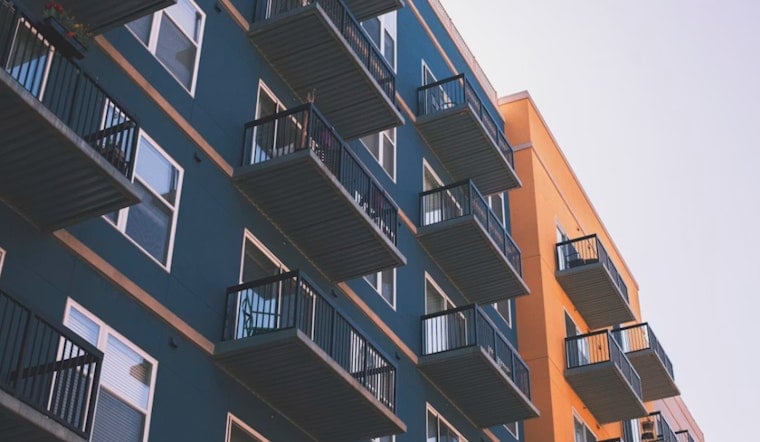
New apartments built in Raleigh have gotten smaller over the past decade, even as renters are paying hundreds of dollars more each month to live in them. Raleigh's average new apartment size fell by 21 square feet since 2016, landing at 930 square feet, while the average apartment rent in the city climbed to $1,683 a month, an increase of $544 over the same 10-year span.
That combination — shrinking space, rising cost — puts Raleigh at odds with most of the country. According to Axios, the typical new apartment across 100 cities studied by RentCafe actually grew by 13 square feet between 2016 and 2025, a little over 1%, continuing an upward trend in national average apartment size that has held since 2022. Raleigh moved in the opposite direction, with RentCafe reporting that the city's average new apartment size shrank even as renters here ended up paying more for less room, not less.
Raleigh's decline is real but modest compared to the extremes recorded elsewhere in RentCafe's national survey. Boston posted the steepest decadal drop among major cities, shrinking 90 square feet to an average of 747 square feet, according to a review by Multifamily Executive. Seattle remained the smallest market overall at 645 square feet, while Tallahassee, Florida boasted the largest new units studied at 1,156 square feet.
Why Developers Are Building Smaller
The shift toward smaller floor plans is not necessarily a sign that renters are getting a worse deal, according to RentCafe senior research analyst Veronica Grecu, whose comments were cited by Boston Agent Magazine. Grecu noted that developers in high-demand markets deliberately prioritize studios and one-bedrooms to maximize the number of units they can deliver and to cater to smaller, single-person households, rather than simply cutting corners on space.
That calculus makes particular sense in a metro area experiencing Raleigh's kind of growth. U.S. Census Bureau estimates released in May 2026 showed the City of Raleigh had officially surpassed 500,000 residents for the first time, reaching 506,306 people after adding more than 56,000 residents since 2020, per a report from WPTF. Wake County, meanwhile, is adding roughly 66 net new residents every day, a pace that has led regional planners to estimate the county will need between 125,000 and 175,000 additional housing units over the next 10 to 15 years, according to Wake County government demographic records.
A Historic Wave of New Construction
Developers have responded to that demand with an unprecedented building push. A Yardi Matrix market report found that developers completed 10,899 new multifamily units across the Raleigh-Durham metro in 2025, with another 11,854 units under construction as of December of that year. That surge in supply has put some downward pressure on advertised rents even as long-term costs keep climbing: RentCafe's broader market analysis, updated in August 2026, put Raleigh's overall average apartment rent at $1,588 a month for a 948-square-foot unit, down 1.61% year-over-year, with studios averaging $1,322 for 517 square feet and three-bedrooms averaging $2,028 for 1,349 square feet.
Other rent trackers tell a similar story of short-term softening layered on top of a much steeper long-term climb. Apartment List data showed Raleigh's median rent at $1,375 a month in September 2026, down 1.7% year-over-year, though the same report noted that year-to-date rent growth in 2026 of 3.6% was outpacing the 2.6% growth recorded over the same period in 2025. Zillow figures cited by Axios put Raleigh's average apartment rent at $1,683 a month, and even after adjusting for inflation — which rose 39% over the decade — Raleigh's apartment rent still increased by 6.5% over 10 years.
Zoning Fights and Affordability Pushback
The tension between supply, cost, and space has spilled into local politics and the courts. Legal challenges to Raleigh's “missing middle” land-use reforms, which opened single-family zones to multi-unit options under text amendments TC-5-20 and TC-20-21, have continued after the North Carolina Court of Appeals allowed a procedural lawsuit from neighborhood residents to proceed in state court, a case Hoodline previously reported came alongside a city amicus brief warning that rapid growth had sparked unprecedented civil litigation against high-density developments.
Affordability advocates have pushed for their own remedies. Local group Livable Raleigh urged the city council in March 2026 to put a $200 million voter-approved affordable housing bond on the fall ballot, aiming to fund transit-adjacent housing construction and preserve older multi-unit properties. Housing costs have also hit public-sector workers hard: a joint survey from Wake County and the Wake County Public School System found 52% of responding school staff said they could not afford to live in Wake County, with 38% saying they had considered leaving the district over housing costs, prompting county leaders in August 2026 to propose building workforce housing on vacant school land.
Taken together, the data paints a picture of a city growing faster than its housing stock can comfortably absorb, where developers are betting on smaller, more efficient units to keep pace with single-person household demand, even as the total cost of living in Raleigh keeps rising. Whether the $200 million bond makes the fall ballot, or whether workforce housing on school land materializes, remains to be seen as the city works through both the zoning litigation and the underlying math of supply, demand, and affordability.




