

























































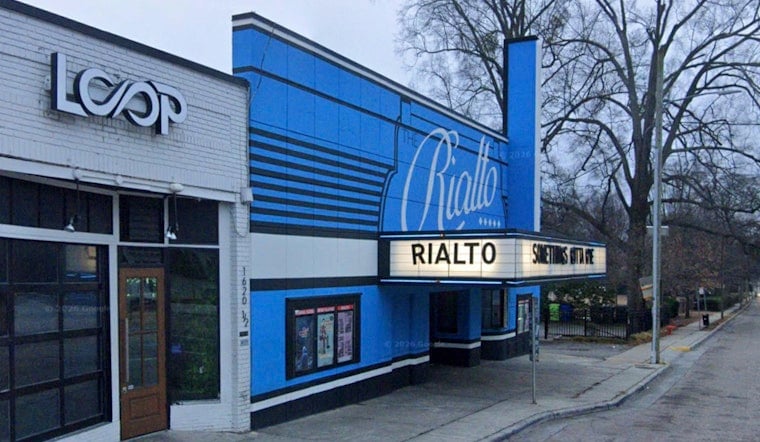
Godfrey Cheshire delivered the Raleigh Times as a boy, grew up reading two newspapers a day, and eventually became the kind of film critic who drank beers with David Lynch and interviewed Charlton Heston. On Wednesday at 7 p.m., Raleigh's Rialto Theatre will host a Q&A and book signing celebrating Cheshire's four-decade career, timed to the release of his new career-spanning collection, Cheshire on Film.
The event, reported by the Raleigh News & Observer, brings Cheshire back to the city where he got his start at The Spectator, Raleigh's first alt-weekly, before bylines in The Village Voice, Variety, and The New York Times carried his name well beyond North Carolina. According to the News & Observer, tickets for the Rialto event cost $16.50 and can be purchased online. The Sticking Place Books collection, published September 1, gathers hundreds of Cheshire's reviews written across 40 years, according to the dossier's publishing details, with a foreword from actor and director Alex Winter, who dedicated the book to Cheshire.
From Delivery Boy to Cannes Regular
Cheshire was born in the 1950s, when Raleigh's population barely exceeded 100,000, and he has described himself simply as old Raleigh. Per the News & Observer's account, he double-majored in English and radio/TV/film at UNC, read the World Book Encyclopedia as a kid, and traced his first real intellectual reaction to a movie back to The Man Who Shot Liberty Valance — a film he has called the one that really hooked him.
He began covering the Triangle arts scene in 1978, working for Bernie Reeves, who published The Spectator and, as the News & Observer notes, hired writers without regard to their political views. Cheshire has said he had no credentials when he started there, but the magazine let him treat Raleigh, Durham, and Chapel Hill as a unified arts scene at a time when the region had few outlets covering film or music seriously. Reeves died in 2018. Cheshire worked at The Spectator for more than a decade, establishing what the News & Observer describes as a sophisticated North Carolina readership, and he has said his writing there helped establish local art houses and encourage post-punk and new wave music in the Triangle.
Reviewing R.E.M. and the Films That Shaped Him
Long before he was reviewing Paris, Texas, Blue Velvet, and Sherman's March for national audiences, Cheshire was covering an early-era R.E.M. show in 1984 and later traveled across Europe with the band. He attended two downtown Raleigh theaters as the city's moviegoing options were narrow — Raleigh had only two single-screen downtown theaters at the time, with the Ambassador the larger draw — before the Varsity Theater started showing art-house movies and expanded what local audiences could see. Blue Velvet, notably, was set in Lumberton, North Carolina, giving Cheshire's regional film criticism an unusually personal throughline.
Cheshire moved to New York in 1991 and, according to RogerEbert.com, spent a decade as chief film critic for New York Press, writing alongside Matt Zoller Seitz and Armond White during what media scholars consider a golden era for alt-weekly arts journalism. He later served as chairman of the New York Film Critics Circle and remains a member of the National Society of Film Critics, and he received three Association of Alternative Newsweeklies awards for best arts criticism in 2001 and 2005, per Wikipedia. He also attended about a dozen Cannes trips over the course of his career, according to the News & Observer.
A Documentary Confronting Family History
Cheshire's work extended into filmmaking as well as criticism. In 2007 he wrote and directed the documentary Moving Midway, which followed his cousin's relocation of their ancestral 155-year-old North Carolina plantation house and uncovered 100 previously unknown African American relatives descended from enslaved people owned by his family, according to the Wikipedia entry on the film. Moving Midway premiered at the Full Frame Documentary Film Festival and was later named one of the ten best films of 2008 by both L.A. Weekly and New York Magazine.
Cheshire also became one of the primary American champions of post-revolutionary Iranian cinema starting in 1992, traveling to Iran seven times and publishing Conversations with Kiarostami in 2019 and In the Time of Kiarostami: Writings on Iranian Cinema in 2022, according to The Criterion Collection. In 1995, he co-founded the North Carolina Film & Video Festival alongside The Spectator and served as its artistic director for its three years of operation, per Raleigh Metro Magazine's account of that era.
A Homecoming at a Rescued Neighborhood Theater
The Rialto itself carries its own history of near-loss and revival. The Five Points theater opened in 1936 as the Colony Theatre, was renamed the Rialto in 1983, and was saved from permanent closure in 2023 when an investment group led by Hayes Permar purchased and renovated the building, as Hoodline previously reported in its coverage of a Rocky Horror tribute at the venue. That same theater has also recently hosted the Native Film Festival's second year, drawing crowds to its screens just weeks before Cheshire's return.
Cheshire's onstage Q&A at the Rialto will be followed by signings of Cheshire on Film, according to the News & Observer, before he carries the book tour to New York City's IFC Center on September 21, where he'll appear in conversation with Winter, the actor and director who wrote the collection's foreword. Winter and Cheshire first crossed paths at Cannes in the late 1990s, according to the dossier's publishing notes tied to the IFC Center event listing. For a critic who began his career treating Raleigh, Durham, and Chapel Hill as one shared arts community, the Wednesday gathering offers a full-circle moment inside a theater that nearly didn't survive to host it.




