

























































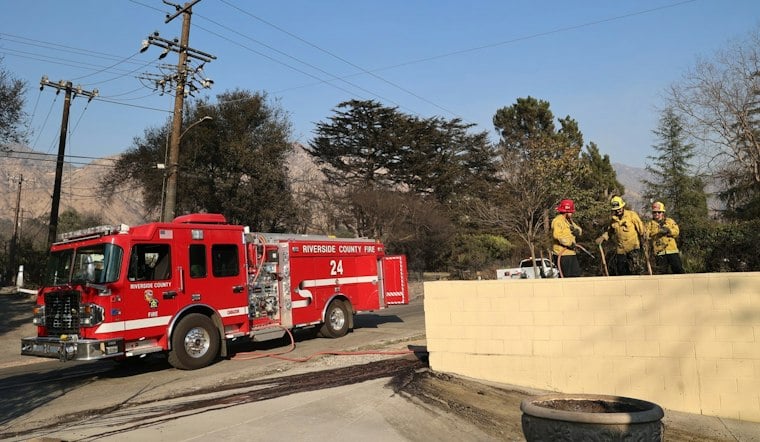
Five people were injured early Thursday after a fire at a two-story apartment complex in downtown Riverside blocked residents’ normal escape route and led them to jump from second-story windows, according to The Press-Enterprise.
Firefighters arrived at about 2:20 a.m. at the complex in the 3400 block of Fifth Street and found one unit fully engulfed. Three people suffered broken legs, including a pregnant woman, while two others also were injured. A firefighter was treated for exhaustion, the newspaper reported.
The injured residents came from an adjacent unit that did not catch fire, but flames elsewhere in the building cut off access to the stairs. Two people jumped from the rear and three from the front before firefighters placed ladders at the windows and helped residents down, according to the report.
A fire can turn an ordinary exit plan into a window escape
The Riverside incident illustrates why apartment safety depends on more than the presence of a designated stairway. Smoke and fire in a neighboring unit can make a shared corridor or stairwell unusable even when a resident’s own apartment has not ignited.
California’s residential egress rules provide a separate escape option for many sleeping rooms. Guidance from Orange County Development Services, summarizing Section 1030 of the California Building Code, says qualifying multifamily sleeping rooms below the fourth story generally must have emergency escape openings with at least 5.7 square feet of clear area and a sill no higher than 44 inches above the floor. Those dimensions are intended to allow occupants to exit and firefighters to enter; they do not make a jump from a second story safe.
The Riverside report said the fire damage remained confined to the apartment where the blaze began, while the unit below sustained water damage from firefighting. Three dogs died and two others were rescued. Four adults were displaced, and the American Red Cross provided assistance.
What is known—and what is not—about the cause
Battalion Chief Matt Stibel said a lithium-ion battery might have started the fire, but the cause remained under investigation. That distinction matters: a battery is a suspected source, not a confirmed finding in the Riverside case.
When lithium-ion batteries fail, they can enter thermal runaway, a self-heating reaction that may produce intense heat, fire or an explosion and toxic gases, according to fire-safety information published by the National Fire Protection Association. That general hazard explains why investigators may examine rechargeable mobility devices or other battery-powered equipment, but it does not establish what ignited this fire.
A recent comparison, not a trend line
The Riverside escape has a recent California comparison, although the circumstances were different. On April 21, 2026, two residents escaped a separate apartment fire through a first-floor window in Canoga Park, KTLA reported. That fire began in a bottom-floor unit, and its cause was also under investigation.
The two incidents show that windows may become emergency escape points when fire affects a building’s ordinary routes, but they differ in height, number of people involved and known injuries. Two examples do not demonstrate that window escapes or battery-related apartment fires are becoming more common.
For Riverside investigators, the central unresolved questions remain what ignited the Fifth Street fire and why smoke and flames made the normal exits unusable so quickly. For residents, the injuries underscore the narrow margin between an emergency escape opening serving its intended purpose and an improvised, dangerous jump.





