

























































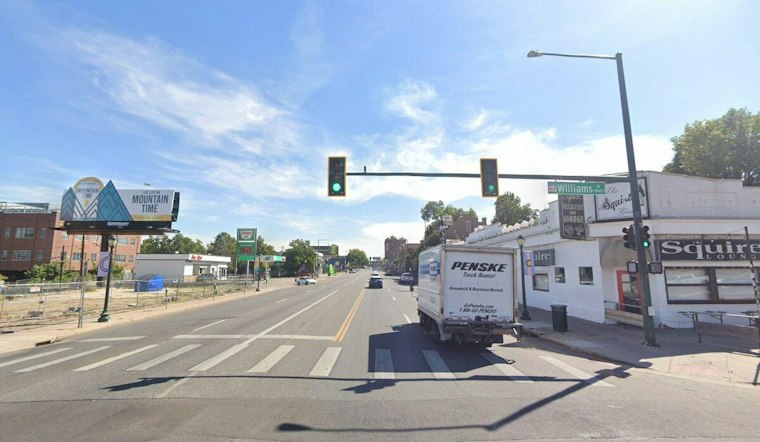
Two RTD passengers were injured Tuesday night when a Route 15L bus collided with a car on eastbound East Colfax Avenue at Williams Street, marking the first crash involving a bus since Denver’s new center bus-only lanes opened along the corridor. The collision happened around 8:15 p.m., just two days after the East Colfax Bus Rapid Transit project opened its first complete section of bus-only lanes on Sunday following roughly two years of construction.
RTD spokesperson Pauline Haberman confirmed the crash to The Denver Post, saying the bus collided with a car at the intersection. She said RTD customers reported injuries, though neither of the two hurt passengers was taken to the hospital. Haberman did not specify what caused the crash, the events leading up to it, or which vehicle struck the other, and the Denver Police Department did not immediately respond to questions Wednesday morning, according to the same report.
The new bus-only lanes run down the center of East Colfax Avenue between Broadway and Colorado Boulevard, with Routes 15 and 15L operating in those center lanes while other drivers are confined to the outer lanes. Those two routes make up the highest-ridership bus corridor in the entire RTD system, carrying between 20,000 and 22,000 daily weekday riders before construction began, according to the Federal Transit Administration, a figure projected to climb past 32,000 once full bus rapid transit service launches.
A Redesigned Street Still Catching Drivers Off Guard
The redesign permanently cuts general vehicle travel down to a single outer lane in each direction between Broadway and Yosemite Street, a structural change reported by Denver7. A continuous concrete curb median now separates eastbound and westbound traffic, restricting left turns to designated intersections with dedicated turn lanes and green arrows, according to CBS Colorado.
City officials have acknowledged the traffic changes have confused drivers, and per the Denver Post’s reporting, navigation apps like Google Maps have directed drivers to turn in spots where turns are no longer permitted. City officials say they are working with route-setting apps to update traffic patterns to reflect the new layout. Whether the outdated navigation guidance contributed to Tuesday’s crash remains unclear, the paper reported.
Drivers caught traveling or turning illegally in the new center lanes face a $135 fine, while scooter riders face a $65 fine, as Denver Police step up enforcement along the corridor this month, according to 9News. Under Colorado state law, motorists are also legally required to yield the right-of-way to transit buses merging back into traffic from a stop, with failure to do so classified as a Class A traffic infraction carrying fines and license points, per guidance from RTD. RTD buses feature illuminated yield signs on their rear bumpers to signal when they intend to merge.
Long-Term Safety Gains Projected, But Transition Brings Friction
City and County of Denver safety modeling had projected the street redesign would cut intersection crashes along the corridor by 24% and overall corridor crashes by 14% by 2040, a forecast noted by Denver Streets Partnership. East Colfax has historically ranked among Denver’s highest-injury traffic corridors, and Tuesday’s crash underscores the friction that can come with drivers adjusting to unfamiliar physical barriers even as long-term safety gains are expected to materialize.
The current bus-only lane setup is considered an interim phase known as Bus-Only Lane Operations, or BOLO, using standard RTD buses rather than the specialized high-capacity vehicles planned for the eventual Lynx-branded bus rapid transit service. Full BRT features, including center-platform stations and ticket vending machines, will not arrive until the entire 9.9-mile corridor connecting Union Station to Interstate 225 in Aurora is complete, which RTD expects in late 2027. Hoodline previously reported on the opening of the center lanes in this earlier coverage, noting that the full BRT experience remains more than a year away.
Construction on the corridor began in October 2024 under a $197 million contract with general contractor Kraemer North America LLC, part of an overall project estimated at $280 million and backed by a $150 million federal Small Starts grant awarded to RTD in 2024. The next phase of construction will shift east, taking over Colfax Avenue between Colorado Boulevard and Niagara Street as work continues toward the project’s expected completion in late 2027.


