

























































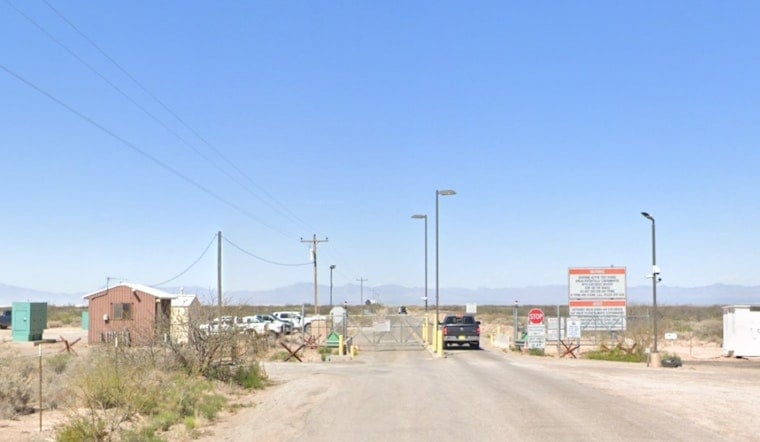
A suspected reconnaissance drone flew in and out over White Sands Missile Range for roughly five days in spring 2025, prompting a sprawling multi-agency response that ended with military officials detaining a group of Chinese nationals who had driven across the country in a rented Mercedes RV before federal authorities took over the case.
The episode, detailed in a report from CNN, is one of several incidents US officials have investigated as they try to determine whether foreign nationals — particularly Chinese nationals — are conducting surveillance flights over American military installations. According to the CNN report, authored by Priscilla Alvarez and Katie Bo Lillis, a task force that included the Army, FBI, Department of Homeland Security, and the Pentagon's UFO-tracking office was assembled to collect intelligence on the drone and study its movement patterns. Officials ultimately checked whether the aircraft carried explosives.
The New Mexico site itself is enormous: White Sands Missile Range spans roughly 3,200 square miles of southern New Mexico, making it the largest overland military test range in the country, according to the White Sands Missile Range official site. It serves as a testing ground for the Army, Navy, Air Force, and NASA, which helps explain why a drone lingering over the property for days drew such an intensive response.
A Cross-Country Trip That Ended in Detention
Per two sources cited in the CNN report, the Chinese nationals traveled from New York across the country to Las Vegas, picking up a third person there, before continuing on to White Sands in the rented RV. Military officials detained the group near the range and turned them over to federal authorities, and the FBI believed, according to two sources, that the people near White Sands had ties to Chinese intelligence. A separate source told CNN that identifying information related to a woman connected to the case was found inside the RV.
That woman had reportedly traveled from Texas to White Sands National Park after arriving on a cruise ship, and remained behind the park's gates after closing, according to the same report. The Department of the Interior ticketed and released her. A former US official called the broader White Sands operation a success story, and US authorities ultimately deemed the operation a success — even as officials cautioned that China's intelligence-gathering apparatus is decentralized, and that Beijing is believed, per US officials, to pressure or incentivize ordinary civilians to conduct nuisance surveillance over military targets rather than relying solely on trained operatives.
The Chinese embassy has pushed back on the broader narrative. A spokesperson denied knowledge of the White Sands episode and said the narrative that China engages in espionage is baseless, per the CNN report. Current and former US officials, meanwhile, told the outlet that true Chinese espionage flights are likely relatively low in number, and a former counterintelligence official said most drone operators the FBI encounters are simply hobbyists.
A Pattern Stretching Back Years
The 2025 New Mexico incursion was not the first time a drone drew scrutiny at White Sands. A similar drone was seen flying a reconnaissance-like pattern over the range in fall 2024, and Customs and Border Protection agents chased that aircraft for roughly 35 miles before tracking it until it crossed into Mexican airspace. In that case, US officials forced the drone to land in a base parking lot using electronic warfare tools.
Other episodes cited in the CNN report illustrate how varied — and sometimes ambiguous — these incursions can be. New Jersey thieves stole 15 pesticide drones that were later recovered by authorities. Off the East Coast in 2023, Coast Guard personnel boarded a Chinese-flagged frigate during a drone episode near Virginia but found nothing definitive linking the ship to the drones. And in a case with a clearer resolution, Chinese national Yinpiao Zhou piloted a drone over Vandenberg Space Force Base during a military satellite launch in 2024, pleaded guilty to flying a small drone into restricted airspace, and was sentenced to four months in federal custody, while a second aircraft-registration charge against him was dismissed as part of a plea deal — a case Hoodline covered in April 2025.
The Bureaucratic Scramble Behind the Response
Drone incursions over US installations run the gamut from hobbyists and drug cartels to tourists and suspected foreign agents, the CNN report notes, and the US government still lacks a single body responsible for countering the problem. That gap became glaring after a mysterious drone swarm breached restricted airspace over Langley Air Force Base in Virginia over 17 consecutive nights in late 2023, forcing the Air Force to temporarily relocate F-22 stealth fighters to protect them, according to CBS News. Federal authorities never conclusively identified who was behind those flights.
That episode prompted Joint Chiefs of Staff officials to create a task force, and then-Defense Secretary Lloyd Austin designated Northern Command as the coordinating authority for small drone incursions at bases in 2023. Northern Command's protocol now convenes a teleconference among affected bases, law enforcement, the FBI, DHS, and the military services whenever an incursion occurs. The Pentagon further overhauled its approach in August 2025, when Defense Secretary Pete Hegseth disestablished the Joint Counter-small Unmanned Aircraft Systems Office and stood up Joint Interagency Task Force 401 to streamline counter-drone procurement across the services, according to Defense One. DHS stood up a similar counter-drone office of its own in January 2026.
Even so, a Department of Defense Inspector General report published in January 2026 found more than 20 overlapping and conflicting Pentagon policies had left numerous installations — including major F-35 pilot training bases — without clear legal authority under 10 U.S.C. § 130i to actively counter drone incursions, according to the Air Force Times. That statute mandated counter-drone defenses for nuclear and testing facilities but excluded training bases entirely. In April 2026, JIATF 401 issued updated guidance granting base commanders expanded authority to evaluate and act against suspicious drone activity beyond installation fence lines, before perimeters are even breached.
Legal Tools and Their Limits
Federal prosecutors have leaned on a World War II-era statute, 18 U.S.C. § 795, which makes it a misdemeanor punishable by up to a year in prison to photograph designated military installations without advance permission from the commanding officer. That law underpinned the Vandenberg case against Zhou, and a similar 2024 prosecution in Virginia, where Chinese graduate student Fengyun Shi was sentenced to six months in prison after pleading guilty to two misdemeanor counts for using a drone to photograph Navy warships under construction at Newport News Shipbuilding, according to US Immigration and Customs Enforcement.
Congress has also moved to widen mitigation powers in 2026, expanding state and local governments' authority to disable threatening drones and granting the CIA new authority to disable threatening drones over the United States, per the CNN report. Separately, federal counter-drone mitigation authorities for DHS and the Justice Department under Section 124n of the Preventing Emerging Threats Act were extended through September 30, 2031, via the FY2026 National Defense Authorization Act, according to EveryCRSReport — though state and local police still lack parallel federal mitigation powers. Legislation Hoodline reported on earlier this year, the drone espionage bill pushed by Sen. Moody, would further criminalize unauthorized surveillance flights over military installations.
Interagency coordination has not always gone smoothly. In February, a military counter-drone laser test near El Paso shot down a Customs and Border Protection unmanned aircraft about 50 miles south of the city, and the FAA closed airspace over El Paso for eight hours after the test was not properly coordinated with the agency — an incident Hoodline detailed at the time. Officials have said there was no indication, per two officials, of an active plot by Iranian proxy groups or ISIS tied to these broader drone incidents.
The scale of the problem has been on stark display at major national events. The FBI established no-drone zones around 2026 World Cup sites and had detected nearly 1,600 illegal drones and confiscated more than 700 of them by the week before the tournament's final, according to the CNN report. Officials have also pointed abroad for a sense of what drone warfare can accomplish: Ukraine used 117 drones in its June 2025 Operation Spiderweb, destroying at least a dozen Russian warplanes at air bases — a reminder, US officials note, of the stakes behind treating even low-altitude surveillance flights as a serious threat.



