

























































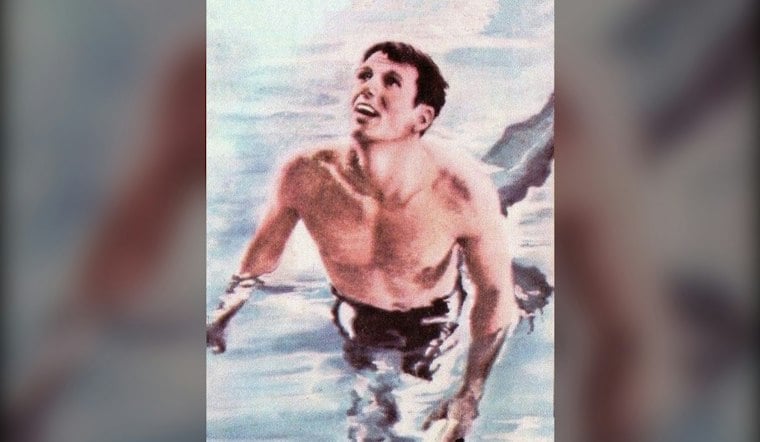
Mike Burton, a three-time Olympic swimming champion who developed his punishing training regimen at a Sacramento-area pool, died on the morning of September 18, 2026, at age 79 following a long struggle with Alzheimer's and dementia. Burton's son, Eric, announced the death on Facebook, describing his father as the toughest man to have ever lived and someone who always inspired him toward greatness.
Burton's death was confirmed by the International Swimming Hall of Fame, which inducted him in 1977. As reported by DC News Now, Burton was the first American to win gold in the 1,500-meter freestyle at consecutive Olympic Games, a feat later duplicated by Bobby Finke at the 2020 and 2024 Olympics. Finke went on to set a world record of 14:30.67 in the event at the 2024 Paris Games, per the same account.
A Childhood Injury Redirected His Path
Burton was born Michael Jay Burton on July 3, 1947, in Des Moines, Iowa, and according to DC News Now's report, he was severely injured at age 12 after being hit by a truck while riding his bicycle. The Sacramento Sports Hall of Fame notes that Burton began competitive swimming at age 14 following that severe bicycle accident, after injuries had already forced him to give up football and baseball. After moving from Des Moines to Northern California as a youth, Burton attended El Camino High School near Sacramento and won 10 Amateur Athletic Union national titles before graduating, according to the Sacramento Sports Hall of Fame.
Burton built his elite distance regimen at the Arden Hills Swim Club in Carmichael, California, under coach Sherm Chavoor, who also trained Olympic gold medalists Mark Spitz and Debbie Meyer, the Hall of Fame's obituary notes. Chavoor's Arden Hills swimmers won 16 Olympic gold medals in 1968 and 1972, according to the American Swimming Coaches Association. Burton followed a high-mileage training regimen designed to maximize cardio endurance and stroke efficiency, an approach DC News Now reports Janet Evans later adopted in similar form.
Mexico City: Illness, Grit and a Record Margin
Burton's international résumé took shape early. At the 1967 Pan American Games in Winnipeg, he won gold in the 1,500-meter freestyle and bronze medals in both the 400-meter freestyle and 200-meter butterfly, according to Olympedia, having begun competing internationally at age 17.
The following year in Mexico City, Burton won both the 1,500-meter and 400-meter freestyle, defeating Ralph Hutton of Canada in the shorter race and John Kinsella by 18 seconds in the longer one, per DC News Now. That margin over Kinsella, Swimming World reports, remains the largest winning margin in Olympic 1,500-meter freestyle history; Burton won the race in 16:38.9. Prior to those victories, Burton was sick, according to EssentiallySports.
A Vitamin Deficiency Nearly Derailed Munich
Defending an Olympic distance title is difficult under any circumstances, and Burton's path to the 1972 Munich Games was anything but smooth. DC News Now reports he was diagnosed with a vitamin deficiency in spring 1972 and subsequently failed to qualify in the 400-meter freestyle and 200-meter butterfly at the U.S. Olympic Trials. At those same trials, Burton barely squeezed into the 1,500-meter freestyle final in eighth and final position before rallying to make the team, according to SwimSwam.
He rewarded that comeback with a world record. Burton won his 1,500-meter freestyle gold medal in Munich in a world-record time of 15 minutes, 52.58 seconds on September 4, 1972, just one day before Palestinian terrorists raided the Munich Olympic Village and killed 11 Israeli team members, DC News Now and Olympedia both note. The attack overshadowed many athletic accomplishments in the Games' final days, including Mark Spitz's record seven gold medals in the pool. Burton, for his part, was chosen to carry the U.S. flag at the closing ceremony.
Records, Barriers and a Lasting Legacy
Over his competitive career, Burton set seven world records, 16 American records, and won 10 AAU national championships, according to the International Swimming Hall of Fame, which also named him Swimmer of the Year in 1968. He was the first swimmer in history to break the 16-minute barrier in the 1,650-yard freestyle, the standard American distance mile event, and the first man to swim the 800-meter freestyle in under 8 minutes, 30 seconds.
Burton later won five NCAA individual titles at UCLA, where he remains a member of the school's Hall of Fame, per DC News Now. After his competitive career ended, he went on to coach swim teams in Iowa, Washington and Montana. Eric Burton's tribute to his father on Facebook capped a career that stretched from a childhood bicycle accident to the top of Olympic distance swimming, and now stands as the final word on a man his son called the toughest to have ever lived.





