

























































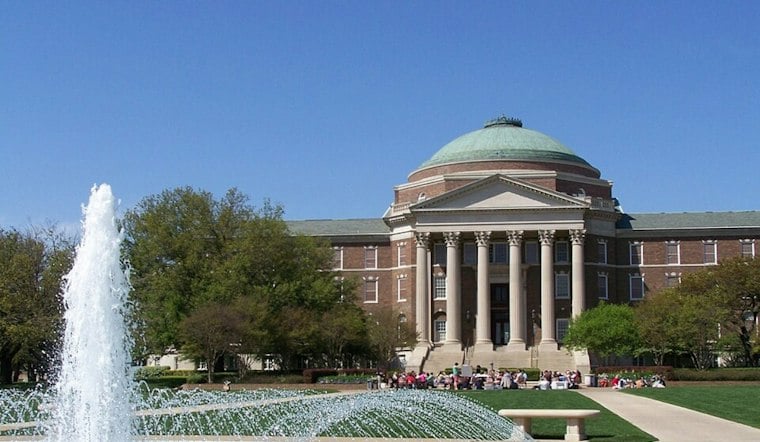
Southern Methodist University has landed a $19.3 million federal grant — the largest in the Dallas school's history — to build what officials are calling the world's first synthetic mine, using a repurposed oil and gas drilling facility nearly 200 miles away in Navasota, Texas. The award comes from the U.S. Department of Energy's new Mine of the Future initiative, aimed at securing America's critical mineral supply chains and modernizing domestic mining capabilities.
The grant was one of four announced Wednesday under a $73 million federal push, according to The Dallas Morning News. SMU was selected alongside Innovative Wireless Technologies, the University of Arizona, and the Curators of the University of Missouri to build real-world testbeds for mining technology, according to the U.S. Department of Energy. The Office of Critical Minerals and Energy Innovation designed the initiative specifically to speed the transfer of laboratory concepts into field-ready mining deployments, per the same agency announcement.
Lynchburg-based Innovative Wireless Technologies, one of SMU's fellow grant recipients, will match its $17.7 million federal award with $7.3 million in private funding to build a $25 million testbed spanning Virginia, West Virginia, and Colorado, according to InvestMETS. That company is partnering with the Colorado School of Mines and Virginia Tech on subterranean and surface wireless communications systems, the outlet reports.
Repurposing an Oil Rig for Mineral Discovery
SMU's synthetic mine will live inside a full-scale oil and gas drilling and automation facility in Navasota — National Oilwell Varco's Springett Technology Center, which houses a 375-ton, 1,500-horsepower Ideal Prime Rig. Engineers there removed the driller's cabin from the rig floor in 2023 to pioneer manless, automated drilling operations, according to Drilling Contractor. NOV originally built the Grimes County facility to test downhole tools, automated pipe handling, and remote rig control, the trade publication notes.
The SMU project will repurpose that research center to test mining tools, workflows, and automation systems built for a new purpose. Dr. Saeed Salehi, the SMU engineering professor leading the effort, said the project should deploy oil and gas drilling technology in mining and wrote that America built the world's best oil and gas industry and should now repurpose it for critical minerals. Salehi holds the Herman Brown Endowed Chair in Engineering at SMU's Lyle School of Engineering and serves as interim executive director of the Hunt Institute for Engineering and Humanity, according to Southern Methodist University. He previously worked as an industry subject matter expert before securing more than $10 million in academic research grants across energy and environmental engineering, per the university.
Chasing a Shale-Style Revolution in Mining
U.S. Energy Secretary Chris Wright visited SMU's campus and met with students, university leaders, and project professors inside Caruth Hall, alongside Assistant Secretary of Energy Audrey Robertson. Wright said mining undergirds the modern world and argued the United States needs the equivalent of a shale revolution in mining, saying the country can become the world's best mining nation. He reported that the average time in the U.S. from discovering materials to developing a mine runs 29 years — a lead time that S&P Global's July 2024 findings placed as the second-worst in the world, trailing only Zambia's 34 years and far behind Canada's 27 years and Australia's 20 years, according to S&P Global.
The SMU project aims to go deep, go fast, go domestic, using what officials describe as the shale playbook and proven oil and gas technology and capabilities. The initiative reflects a broader federal push to reshore mining, processing technology, and manufacturing of critical minerals, which officials say requires both technological advancements and university-level education investment. The U.S. Geological Survey defines critical minerals as materials essential to U.S. economic and national security, vulnerable in the supply chain, and essential to manufacturing — a list that grew from 50 to 60 commodities in November 2025 after the agency added copper, lead, uranium, silver, boron, metallurgical coal, phosphate, potash, rhenium, and silicon due to foreign trade disruption risks, according to the U.S. Geological Survey. That list, mandated under the Energy Act of 2020, now includes lithium, nickel, and copper among the minerals the SMU project is expected to address.
Navasota Becomes a Hub for Federally Funded Research
SMU isn't the only university drawn to the Navasota facility. Texas A&M University researchers secured $3.5 million from the DOE's ARPA-E program in late August to test an AI-powered drilling system for rapid critical mineral discovery at the same NOV technology center, according to the Journal of Petroleum Technology. That project applies real-time sensor analytics and machine learning to evaluate subsurface mineral deposits during active drilling, the trade journal reports — suggesting the Grimes County site is becoming a collaborative, multi-university proving ground for federally backed mining research.
The workforce pressures behind these investments are steep. Federal energy officials reported in August 2026 that more than half of the current U.S. mining workforce is expected to retire by 2029, prompting a federal goal to add 6,000 new mining engineers over the next decade, according to ABC 23 WATM, which reported that Assistant Secretary Robertson highlighted the targets during university visits. Separately, Sandvik Group cited McKinsey & Company data showing 71 percent of mining executives believe talent shortages are already preventing them from hitting production targets, driving companies to recruit heavy equipment operators and engineers out of the oil and gas industry, per Sandvik Group.
A Growing Bet on Energy Research at SMU
The DOE grant lands amid a broader run of investment in SMU's energy research capacity. In December 2025, the Lyle School of Engineering received an in-kind gift of advanced subsurface modeling software from alumnus Vasilii Shelkov, founder of Rock Flow Dynamics, to support energy, geothermal, and mining research under Salehi's direction, according to SMU. The software lets students and researchers simulate fluid flow, reservoir dynamics, and mineral extraction processes, the university notes.
That same month, the O'Donnell Foundation committed $60 million to SMU — the second-largest gift in the university's history — aimed at helping the school become a national leader in energy studies. The SMU synthetic mine project itself is expected to run from 2026 through 2030, positioning the university at the center of a federal effort to rebuild domestic mining muscle at a moment when the sector faces both an aging workforce and mounting geopolitical pressure over critical mineral supply chains.


