

























































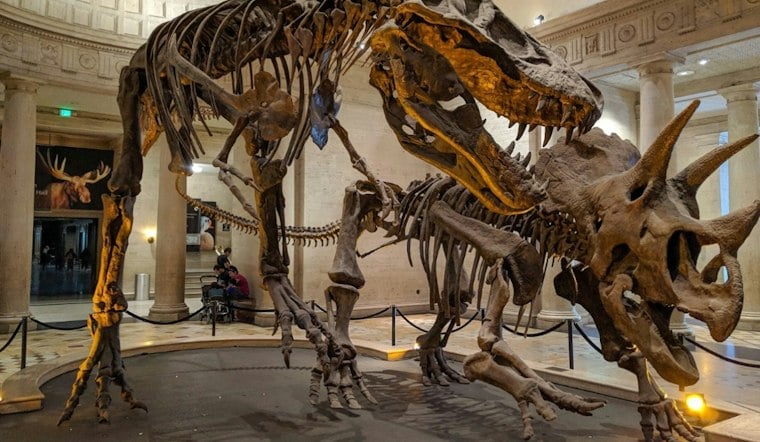
Teeth from a Tyrannosaurus rex nicknamed Thomas, kept at the Natural History Museum of Los Angeles County, plus an isolated partial tooth from another Tyrannosaurus, just settled a decades-old paleontology argument: the king of the dinosaurs really did run hot. New chemical testing published Wednesday in Science Advances puts T. rex's average body temperature at 36.3 degrees Celsius, or 97.3 degrees Fahrenheit, with a margin of error of plus or minus 2.5 degrees Celsius.
That number, reported by BigGo Finance, lands remarkably close to modern African and Asian elephants, which run around 36 degrees Celsius themselves. It sits below ostriches at 39 degrees Celsius and well under small, high-metabolism birds that can top 40 degrees Celsius, according to KSL.com. As reported by WISN, the finding also puts T. rex's internal heat in the same neighborhood as humans, while still running colder than modern birds and hotter than modern cold-blooded reptiles, which typically sit between 82 and 86 degrees Fahrenheit.
How Scientists Read Temperature From a 66-Million-Year-Old Tooth
The method behind the discovery, called clumped isotope paleothermometry, measures how often heavy carbon-13 and oxygen-18 isotopes bond together inside carbonate minerals — a chemical process controlled strictly by temperature at the moment tooth enamel forms, per BigGo Finance's report. Researchers determined the exact temperature at which Thomas's enamel formed by analyzing carbon and oxygen isotopes locked inside it, according to WISN, since enamel's hard structure resists change over millions of years.
Getting there took patience. The Natural History Museum of Los Angeles County initially refused to hand over samples because older mass spectrometry techniques destroyed significant amounts of irreplaceable fossil material, as CNET explains. UCLA spent more than a decade refining the process, according to WISN, eventually cutting the fossil material needed by roughly 90 percent until only a few milligrams were required — a threshold UCLA's Aradhna Tripati confirmed to WISN.
Thomas the T. Rex and a Built-In Control Group
The specimen at the center of the study, nicknamed Thomas, was discovered in Montana in 2003 and is roughly 70 percent complete, standing 34 feet tall, per CNET. Thomas lived sometime between 69 million and 66 million years ago, according to WISN, and now resides at the Natural History Museum of Los Angeles County — the same institution Hoodline covered last month during its T. rex vs. saber-tooth showdown.
To make sure the heat wasn't just a byproduct of a warm Cretaceous climate, researchers also tested five prehistoric crocodilian teeth pulled from the same Hell Creek Formation in Montana. Those teeth averaged 30.9 degrees Celsius, compared to an estimated ambient environmental temperature of 25.9 degrees Celsius for the period, per BigGo Finance. UCLA's Robert Eagle told WISN the study provided a direct constraint on T. rex's actual body temperature, calling it confirmation that the animal was a warm-bodied organism.
A Predator Built to Chase, Not Bask
The gap between T. rex and its cold-blooded crocodilian neighbors matters because it points toward an active hunting lifestyle rather than a lizard-like existence dependent on sunlight. A warm-bodied T. rex supports the idea that tyrannosaurs were active predators with fast metabolisms, per WISN, and a higher, self-regulated body temperature would have let the animal stay active for longer stretches while pursuing prey and eating more than other reptiles of its era.
The research team acknowledged inertial homeothermy as a limitation, meaning multi-ton dinosaurs could maintain elevated temperatures partly through thermal inertia — where sheer physical mass retains environmental heat — rather than through metabolic endothermy alone, according to BigGo Finance. The distinction separates being warm because of size from being warm because of an internally driven engine, and the debate remains open. That tension echoes a 2022 study in Nature, which used organic lipoxidation markers preserved in fossilized bones to argue that high metabolic rates evolved in the common ancestors of theropods and sauropods, according to YaleNews' coverage of that earlier research.
From Mexico to the Arctic, on Internal Heat Alone
Whatever the exact mechanism, the temperature data helps explain one of paleontology's more startling footprints — literally. A fossilized T. rex footprint turned up in Alaska in 2022, per WISN, evidence that the species roamed a broad stretch of North America stretching from present-day Mexico to Alaska. Researchers combined paleoclimate models reconstructing Late Cretaceous temperatures across the continent with the new body-temperature data to show T. rex had genuine thermal independence, letting it survive in high-latitude regions like Alaska's North Slope where temperatures dropped near freezing, KSL.com reports.
UCLA's Robert Eagle and other researchers hope to apply the same isotope technique to other ancient species going forward, per WISN, with future work potentially examining Triceratops, Stegosaurus and Brachiosaurus. The lab has already used clumped isotope paleothermometry on the prehistoric Megalodon shark before turning it on Thomas, according to CNET — a track record that, per WISN, also includes body-temperature work on woolly mammoths. The technique's growing reach means the next big paleontology headline might not come from a dig site at all, but from a fossil already sitting quietly in a museum drawer.





