

























































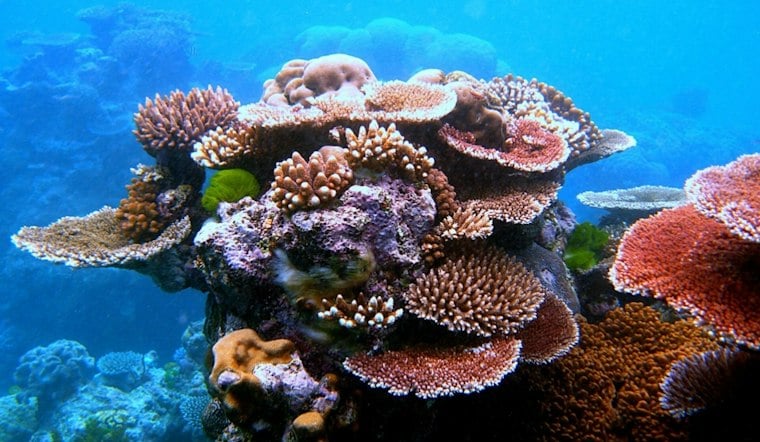
The coral reefs sitting about 100 miles off the coast of Galveston are under a bleaching watch this month, as Texas Gulf waters run roughly two degrees Fahrenheit warmer than normal following some of the hottest weeks of the summer. The Flower Garden Banks National Marine Sanctuary remained at a Level One bleaching alert as of Sunday, a warning that scientists say could still tip toward more severe coral loss if the heat lingers.
Coral bleaching is the stress response corals undergo when water gets too warm, causing them to lose their color and turn white, according to Houston Public Media. Texas Gulf waters are warming at about twice the rate of the rest of the ocean, the outlet reports, and meteorologist Jeff Masters attributed the current heat to a mix of man-made climate change and natural weather variation, including El Niño pushing warm water toward the Americas. Gulf coast ocean temperatures reached up to 87 degrees Fahrenheit this summer, well above the typical September range of 83 to 86 degrees, per the same report.
NOAA issued the Level One bleaching alert for the sanctuary in August, and Keisha Bahr, chair for coral reef and ocean health at the Harte Research Institute, said that alert level indicated significant bleaching could occur within four weeks. Level Two is the highest alert the agency assigns. Sanctuary staff told the outlet that bleaching at the Flower Garden Banks usually shows up in mid-September or early October, and that the reef could be headed for a bleaching year after more than 50 days above 85 degrees Fahrenheit.
Why This Reef Has Held On Longer Than Most
Despite the warning, sanctuary staff said the Flower Garden Banks had not seen widespread bleaching so far in 2026. Part of the reason is depth: the reef's shallowest coral caps sit within 55 to 130 feet of the surface, according to NOAA National Marine Sanctuaries, creating a thermal buffer that keeps deep-water corals cooler than shallow nearshore Caribbean reefs. The outlet's report similarly notes that greater depth helps keep the reefs cool and buffered from hot surface water.
That resilience has made the Flower Garden Banks one of the healthiest coral ecosystems in North America. According to Rice University, the East and West Flower Garden Banks maintain more than 50% live coral cover on their shallow reef caps, compared with wider Caribbean and Gulf reefs where live coral cover has dropped below 10% to 15%. Commercial snapper and grouper fishermen originally named the area the Texas Flower Gardens after spotting brightly colored corals and sponges on their lines more than a century ago, with the term “banks” added later to reflect the salt dome formations underneath, NOAA National Marine Sanctuaries notes.
Threatened Star Corals Anchor the Reef Structure
Three star coral species in the Orbicella complex, all listed as threatened under the Endangered Species Act, make up roughly 60% of the coral cover at the East and West Flower Garden Banks, per NOAA National Marine Sanctuaries. Losing those corals would impair the three-dimensional reef structure that supports Gulf fisheries. Coral reefs broadly provide habitat for about a quarter of marine species, and coral loss can ripple out to affect the fish and other species associated with those reefs, Bahr said, according to Houston Public Media.
Bahr said corals can die if the water warms too much, and that global bleaching is becoming more frequent and more severe. “The water is getting too hot too fast and staying too hot too long for corals to cope,” she said, per the outlet's report. Recovering corals regain their healthy brown, tan, green and orange colors when conditions improve, but a coral bleaching event can still result in some corals being lost outright.
The sanctuary's worst recorded thermal stress event came in October 2016, when sea surface temperatures stayed above 86°F for 85 days and nearly half of coral colonies at the East Flower Garden Bank bleached or paled, according to NOAA National Marine Sanctuaries. That event followed an unexplained localized mass mortality in July 2016. NOAA Coral Reef Watch has since expanded its global heat stress alert system to add Bleaching Alert Levels 3 through 5, categories meant to capture ocean heat accumulation beyond the traditional Level 2 ceiling.
Building a Living Insurance Policy Onshore
While NOAA tracks conditions on the reef itself, Moody Gardens operates the Coral Rescue Lab in Galveston, which rehabilitates corals from the Gulf. Biologists there maintain more than 150 live wild coral fragments representing five Gulf species, feeding them weekly with specialized plankton and amino acid mixtures, according to The Texas Tribune. The lab can feed bleached corals every day, and researchers can eventually return recovered corals to their home sanctuary once conditions stabilize.
Lab researchers are also working toward breeding and planting more heat-resistant corals for the future, the Houston Public Media report notes. That effort echoes broader statewide work: the Harte Research Institute at Texas A&M University-Corpus Christi partnered with the Texas State Aquarium in October 2024 to import nearly 300 rescued Florida corals for climate adaptation research, while Moody Gardens transferred around 70 corals to the San Antonio Zoo in May to expand the state's captive coral network.
The sanctuary's ecological value is also economic. NOAA researchers estimate the Flower Garden Banks holds annual social, ecological, scientific and economic value ranging from $6 billion to $19 billion, per the outlet's reporting. Reef damage doesn't just threaten coral colonies, Bahr and the sanctuary's own data suggest — it can ripple through other sea life and the broader economy that depends on healthy Gulf fisheries.
A Global Emergency With Local Stakes
The pressures facing the Flower Garden Banks fit into a much larger pattern. NOAA and the International Coral Reef Initiative declared the Fourth Global Coral Bleaching Event in April 2024 after ocean heat stress triggered bleaching across more than 54% of global reef waters in 53 countries and territories, according to the International Coral Reef Initiative. The Global Coral Reef Monitoring Network found last month that marine heatwaves over the past three decades have triggered the loss of at least 9.5% of the world's corals, corals that can no longer contribute to the three-dimensional reef structure important to other marine species.
The United Nations Environment Programme has warned that global warming is set to cross 1.5 degrees Celsius above pre-industrial levels within the next few years, and that corals face a low possibility of surviving this century if temperatures remain at or above that threshold. Reducing atmospheric carbon emissions would help corals withstand warming, Bahr said. Coral reefs, which have existed for more than 500 million years and are tied to medical research and new discoveries, according to Bahr, remain a resource individuals can help protect by donating to conservation funds or using less plastic.





