

























































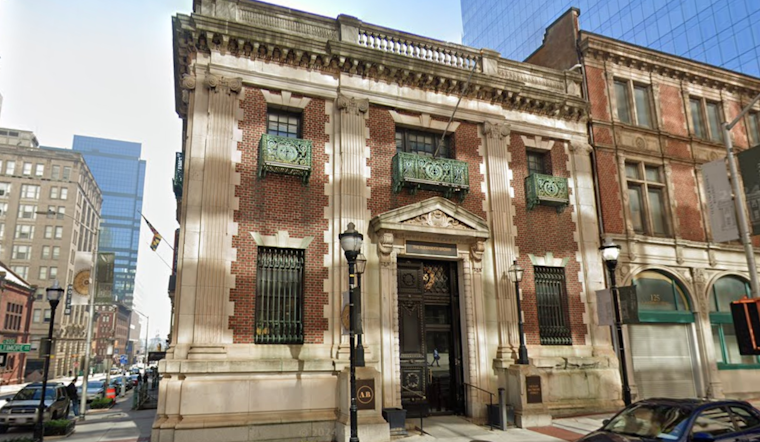
Fruition at 135th, the seafood-forward restaurant that opened inside downtown Baltimore's landmark Alex. Brown & Sons building this past March, has closed after less than six months in business. The closure, announced in an Instagram post, makes chef Shanita Sampson the third restaurant operator in under seven years to try and fail at running a full-service dining concept inside the historic 1901 building at 135 East Baltimore Street.
Sampson, who also runs HomeSweetHome Cafe' & Brunch in northwest Baltimore, opened Fruition at 135th in March, filling the 15,000-square-foot space with a menu anchored by seafood — crab balls, oysters, fried catfish and lamb chops among the offerings. According to The Baltimore Banner, the restaurant's Instagram announcement promised that “a new chapter is coming,” though details on what comes next were not provided.
Landlord Alex Griswold, whose family owns the building, told the Banner the space will be put back up for lease. But this time, he said he is targeting event venue operators for weddings, family events and business events rather than another traditional restaurant tenant — a shift that reflects just how difficult it has proven to keep a kitchen running inside the ornate former bank hall.
A Pattern of Short-Lived Tenants
Fruition's run mirrors the fate of its immediate predecessor. Zander's, also known as Zander's 1901, shut down in 2024 after just five months in operation. That restaurant had opened in late 2023 under chef Brendon Hudson and David Monteagudo of Liliahna Hospitality Group, the team behind the Mount Vernon restaurant Allora, according to Baltimore Fishbowl.
Before Zander's, the building's first food-and-drink tenant was The Alexander Brown Restaurant, which opened in February 2019 under Florida-based hospitality group Oxford Commons after an extensive interior overhaul, per The Historical Marker Database. That restaurant closed permanently in the early days of the pandemic, done in by the financial strain of COVID-19. Hoodline covered its opening in 2019, when it was among the freshest new businesses in the city, and later noted it had become a trending fine-dining destination based on customer review growth.
A Building Built to Last, Tenants That Haven't
The building itself has proven far more durable than any restaurant that has occupied it. Constructed in 1901 as headquarters for Alex. Brown & Sons, the country's oldest investment banking firm, the structure was designed in the Beaux-Arts style to be fireproof and was one of only a handful of downtown buildings to survive the Great Baltimore Fire of 1904 with its original facade, marble interior and stained-glass dome intact. That 40-foot dome is credited to Baltimore artist Gustave Baumstark, who studied under glass artists Louis Comfort Tiffany and John La Farge, according to the Historical Marker Database.
Alex. Brown & Sons itself carries outsized historical weight: founded in Baltimore in 1800 by Irish linen merchant Alexander Brown, it is considered America's first investment bank, later underwriting the nation's first initial public offering for the Baltimore Water Company in 1808 and helping finance the Baltimore & Ohio Railroad in 1827, per Raymond James. After the firm was acquired in 1997, the building spent years as a retail bank branch, first for Chevy Chase Bank and later Capital One, following a 1996 renovation that restored the original teller line, plaster moldings and marble columns.
Why Event Venues May Be the Next Chapter
Griswold's pivot toward event operators fits a broader pattern for turn-key historic spaces like this one. Venue listings on platforms such as The Knot show that operators leasing spaces like 135 East Baltimore Street typically focus on pre-booked weddings and catering partnerships rather than daily restaurant service, sidestepping the steep food, labor and inventory overhead that has repeatedly sunk full-service tenants in the building.
The struggles at 135 East Baltimore Street have played out against a downtown Baltimore commercial landscape that the Downtown Partnership of Baltimore has been actively trying to shore up. In 2025, the organization launched the Baltimore Culinary Exchange, distributing $1 million in ARPA-backed grants to help culinary businesses take over large or challenging vacant spaces. Retail occupancy across downtown's Management Authority district stood at 87.2%, with average asking rents of $21.33 per square foot, according to the Downtown Partnership's data.
Whether an event-focused lessee can finally break the building's cycle of short-lived restaurants remains to be seen. For now, one of downtown Baltimore's most architecturally significant addresses sits vacant again, its stained-glass dome and marble hall waiting for whoever comes next.





