

























































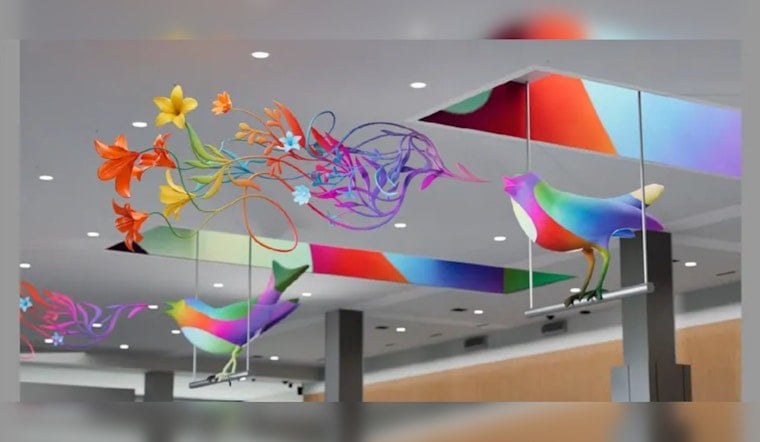
Three colorful bird sculptures, each roughly nine feet tall and ten feet long, are being fabricated for a new ceiling installation that will greet travelers above the baggage claim area at Austin-Bergstrom International Airport later this year. The piece, called The Nature of Sound, is about halfway complete and will hang permanently within the skylights of the airport's Atrium Infill project once it opens later in 2026.
The birds will stand on perches roughly 14.5 feet above the Atrium Infill's terrazzo floor, according to Austin-Bergstrom International Airport, which shared a behind-the-scenes look at the fabrication process this week. Alongside the birds, a steel sculpture called the Birdsong Soundwave, measuring 19.1 feet long, will represent flowing flowers and soundwaves overhead. The airport says the imagery could evoke the painted bunting, and the entire installation is meant to be viewed from multiple vantage points throughout the atrium and beneath the skylights.
The work is being fabricated at Smash Design in Alvin, Texas, before Austin Aviation and Art in Public Places staff install the skylight murals and bird sculptures on-site at AUS. The next step in that process involves installing the apparatus from which the bird sculptures will be suspended.
A First Collaboration Between Two Longtime Friends
The Nature of Sound is the work of artists Josef Kristofoletti and Matthew Mazzotta, who have known each other since 1999, when both were students at the School of the Art Institute of Chicago, according to the City of Austin. Despite that long friendship, the airport project marks their first official artistic collaboration. The pair has described the piece as a beautifully colored visual representation of sound using plants, birds, and their songs — one meant to reflect Austin's reputation as the live music capital of the world.
Kristofoletti previously painted Tau Ceti, a 103-foot-tall gradient spectrum mural completed in 2018 in downtown Austin that stands as the city's tallest public artwork, and created a three-story particle detector mural at CERN in Switzerland in 2010, per the World Tribune. Mazzotta brings his own track record with immersive airport art: he designed HOME, a 21-foot-tall pink flamingo sculpture installed in 2022 at Tampa International Airport that uses mirrored ceilings and lighting to simulate an underwater environment, according to research compiled by MIT's Art, Culture and Technology program. That piece was chosen from over 700 international submissions and later won a 2023 CODAaward in the transportation category.
To shape their concept for AUS, the artists gathered ideas through community engagement sessions across Austin, tabling at the airport itself, and conversations with passengers. Those sessions surfaced recurring themes — love of music, love of nature, tech versus rural tension, Austin's self-professed weirdness, and diversity — that helped inform the final design, which the Austin Arts Commission formally approved in November 2025.
Solving a Real Bottleneck, Not Just Decorating One
The artwork isn't simply ornamental; it's being built into a structure with a very practical purpose. The Atrium Infill project fills the open-air atrium above the baggage claim area to add 12,000 square feet to the Barbara Jordan Terminal's departures level, a space built specifically to expand TSA screening queueing capacity, according to Airport Experience News. The project followed record-breaking passenger volumes in 2022, when security lines frequently extended past the terminal doors during peak travel periods. Prime contractor Whiting-Turner is leading construction in partnership with design firm Corgan, with the new floor built to meet Austin Energy Green Building 3-star sustainability standards.
During construction, the terminal's landmark Barbara Jordan statue — which stands in the baggage claim area named for the pioneering Texas congresswoman — was temporarily enclosed for protection and will be re-unveiled when the new space opens, as Community Impact has reported. The $50 million project received $25 million in federal funding through the Infrastructure Investment and Jobs Act, with the remaining costs covered by airport revenue reserves and bonds, the outlet noted. Hoodline previously covered how Austin financed the broader Journey with AUS expansion through bonds rather than local taxes in its report on the $1.4B airport bond package.
Funded By Fliers, Not Taxpayers
The Nature of Sound is one of 23 public art installations planned across the Journey with AUS expansion program, and under the city's Art in Public Places ordinance, every one of those pieces is financed entirely through airport revenue — airline fees, concessions, and parking — without drawing on local taxpayer dollars, according to the City of Austin. The Art in Public Places program itself is administered through Austin Aviation and Art, Culture, Music, and Entertainment, and its staff worked alongside artists, architects, engineers, and safety teams throughout the review process for the ceiling installation.
Of the 23 artist-led teams commissioned for the expansion, the majority are based in Texas, with half calling Austin home, the city noted in its December 2025 update. That local emphasis places The Nature of Sound within a broader municipal push to keep the airport's civic infrastructure rooted in regional talent, even as the project draws on Mazzotta's national airport-art résumé. When the Atrium Infill opens later this year, the three birds will welcome passengers into the new space, suspended above a terminal floor that airport officials say was years in the making.



