

























































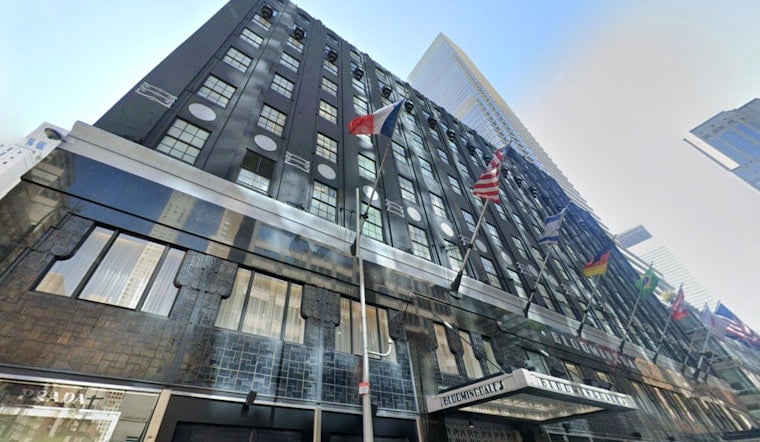
A vacant, roughly 20,000-square-foot lot across from Bloomingdale's flagship store on the Upper East Side is now on the market for $360 million, and some of New York's biggest developers are lining up to bid on it. The six-parcel assemblage at 143-161 East 60th Street has sat cleared and empty for years, but listing broker Marlon Schwarcz says offers began arriving roughly 30 days after the site hit the market, including from developers with projects on Billionaires' Row.
According to the New York Post, Schwarcz said the interested parties rank among the top 10 developers in the city, and he believes a deal could come together within about 90 days. The site last traded for $300 million in 2015, meaning the current seller is seeking $60 million more than that price, a relatively modest markup over eleven years once inflation and construction costs are considered.
A Site Haunted by the Ghost of Subway Inn
The lot's history stretches back two decades. Midtown East developer World Wide Group spent nine years assembling the six contiguous properties beginning in 2005, a process that included paying $37 million for 155-161 East 60th Street and another $8.9 million for air rights, according to historical reporting from The Real Deal. That assemblage swallowed up the beloved 77-year-old dive bar Subway Inn, which was forced out of its original home at 143 East 60th Street in late 2014 after World Wide Group refused to renew its $20,000 monthly lease, a move that triggered a public petition drive, as the Observer reported at the time.
Subway Inn relocated to survive, but it couldn't outlast the changing neighborhood forever. The bar, once famous for hosting the likes of Marilyn Monroe and Joe DiMaggio, permanently closed in December 2024 after an 87-year run, as Hoodline reported in its piece on the end of an era for the storied venue. The six buildings that once stood on the assembled lots, including Subway Inn's original address, have all since been demolished, leaving the site as bare land ever since.
Supertall Dreams That Never Left the Drawing Board
Kuafu Properties, then led by Shang Dai and Zengliang “Denis” Shan, bought the World Wide Group assemblage for $300 million in 2015, a price that worked out to roughly $1,060 per buildable square foot across the site's 283,000 buildable square feet, per The Real Deal's reporting at the time. The company financed the purchase with a $200 million debt package from Mack Real Estate Credit Strategies' Claros Mortgage Trust division.
Kuafu commissioned ambitious designs that never broke ground. Rogers Stirk Harbour + Partners drew up a 62-story, 1,000-foot residential tower for the site in 2015, and Kohn Pedersen Fox produced its own potential supertall concept. The most dramatic proposal came from Archilier Architecture in 2016, envisioning a roughly 1,240-foot supertall spanning 411,700 gross square feet, just 10 feet shorter than the Empire State Building's roof, with an inverted-taper design meant to widen upper floor plates for Central Park views, according to 6sqft. Had it been built, the tower would have ranked among New York's tallest residential skyscrapers, but none of the concepts moved forward.
Ownership Splintered Before a Shovel Ever Hit Dirt
Shang Dai left Kuafu Properties in 2016, and the East 60th Street site ended up under Shan-controlled Sumi Properties, while Dai's new venture went a different direction, as The Real Deal reported at the time. In April 2017, Sumi paid down $100 million in debt with equity and refinanced the property with a $100 million loan from Bank of the Ozarks, now known as Bank OZK, as the partner split and a cooling luxury condo market left the parcel sitting vacant for years.
Zoning for the site allows either residential or commercial development, and past marketing materials have touted the parcel as permitting a tower without a height limit, since city rules impose no as-of-right height cap provided a design satisfies setback and sky exposure plane criteria, per 6sqft's review of the zoning envelope. That flexibility is part of why the site has drawn such varied proposals, from supertall condo towers to, potentially, affordable housing.
What It Would Actually Cost to Build
Schwarcz laid out the financial stakes for prospective buyers. He said typical project capital runs about twice the acquisition price, meaning a high-end development at the site could require roughly $500 million beyond land acquisition, while an ultra-luxury project could push total investment to about $1 billion, since those projects can demand three times the original purchase price. On the more modest end, Schwarcz said an affordable housing development could cost roughly $100 million to $300 million to build out.
Whatever path a buyer chooses, Schwarcz said developers will need sufficient investors to actually pull off the project, and ultimately the sale comes down to the numbers. The seller, he added, is not desperate to make a deal, which may explain the patient, 90-day timeline he's projecting for offers to shake out.
Competition Rising Just Blocks Away
The 60th Street corridor is no stranger to supertall ambition right now. Just three blocks west, Extell Development's planned 1,162-foot, 74-story tower at 655 Madison Avenue broke ground and entered its excavation and piling phase in mid-2026, Hoodline reported in its coverage of the Madison Avenue project going underground, a development that will include 154 luxury condos alongside office and retail space.
That nearby project underscores how long and costly these assemblages can take to pay off. Extell's own experience building “The Torch” at 740 Eighth Avenue required seven years and $186 million just to assemble the necessary tax lots and air rights, a reminder that Manhattan supertalls defined as reaching 1,000 feet or higher routinely span multiple market cycles before anyone breaks ground. For 143-161 East 60th Street, which has already outlasted two ownership groups and at least three unbuilt tower designs, the question now is whether a buyer with deep enough pockets can finally turn two decades of paperwork into a finished building.




