

























































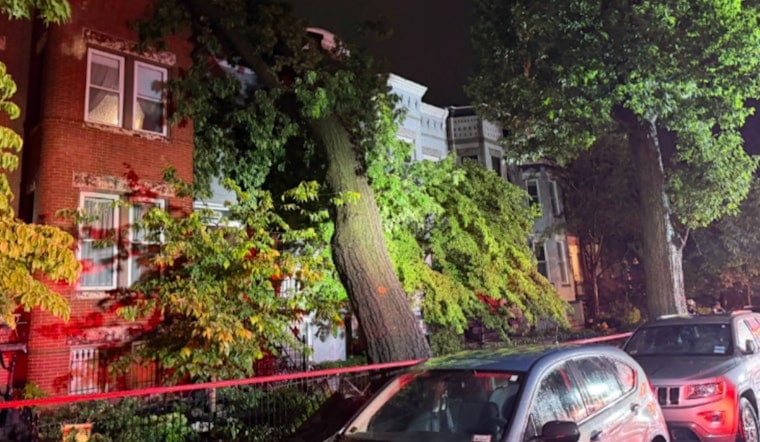
A large tree came down at 5th and F Streets NE Thursday night, blocking the roadway and sidewalks and crushing a parked car, one of several scenes of storm damage that stretched across Washington, D.C. after high winds and heavy rain tore through the region. In the 200 block of 8th Street SE, another tree fell onto a rowhouse, forcing occupants to evacuate the home. By Friday, thousands of Pepco customers were still without power as crews worked to clear debris and assess the damage.
Winds reached up to 70 mph in the District during Thursday's storm, according to WJLA, with Ronald Reagan Washington National Airport clocking a gust of 64 mph. The storm brought down trees and power lines in other parts of the region as well, and as of Friday, Pepco reported 15,968 customers without power in D.C. Regional totals were far higher: according to Capital Weather, the broader thunderstorm complex that swept through the DMV area generated wind gusts exceeding 60 mph and continuous lightning, leaving more than 150,000 utility customers without power across Maryland, Virginia and D.C. combined.
D.C. Councilmember Charles Allen reported that another street tree was leaning precariously against a home in his area, a sign that Thursday's damage was still unfolding into Friday. Allen said he had spoken with neighbors nearby and that they were okay, even as branches could continue to fall in the storm's aftermath. D.C. Fire and EMS confirmed the rowhouse evacuation on 8th Street SE, where the fallen tree left occupants unable to safely remain inside.
Why the Winds Hit So Hard
The violent gusts were driven by a so-called “ring of fire” convective pattern circling the edge of a mid-Atlantic heat dome, according to the National Weather Service and meteorologists cited by the same Capital Weather report. That pattern brought multi-day severe thunderstorm threats and localized gusts up to 70 mph, arriving just days after D.C. hit 98 degrees on September 1, its hottest that date since 1980. The same account noted that D.C. saw roughly double its normal number of thunderstorm days in August. Drought-induced stress and dry soil, rather than wet-weather saturation, may have left mature trees more prone to uprooting once the wind arrived.
This is not the first time this summer that a fast-moving storm has caught the District's aging tree canopy off guard. Just five weeks earlier, on July 28 and 29, another severe thunderstorm system slammed the region, knocking down trees, cutting power and destroying a D.C. gas station canopy, as WUSA9 reported at the time, with flash flooding also swamping streets like U Street. Hoodline covered that earlier late-summer storm as it moved through the city.
City Urges Caution as Cleanup Continues
D.C. Homeland Security and Emergency Management urged residents to remain alert Friday as crews worked through storm debris. The agency advised people to avoid walking directly beneath low-lying branches, to wear closed-toe shoes and watch their step around debris, and to avoid parking near trees that appear at risk of falling.
Homeowners dealing with damaged or leaning street trees can report them through the D.C. 311 system, while crews continue responding to storm debris.
A Canopy Under Pressure
The scale of the challenge facing city crews is considerable. DDOT's Urban Forestry Division manages public street trees across the District, inspecting them and planting new trees each year. D.C. policy also emphasizes tree-canopy growth, placing environmental and shade priorities in tension with the storm risks posed by aging, mature trees.
D.C.'s tree-preservation rules underscore the need to balance protection with public safety when trees are damaged. Storm-related outages also remain a longer-term challenge: even efforts to improve the power system do not eliminate the risk of tree-driven damage in every neighborhood.





