

























































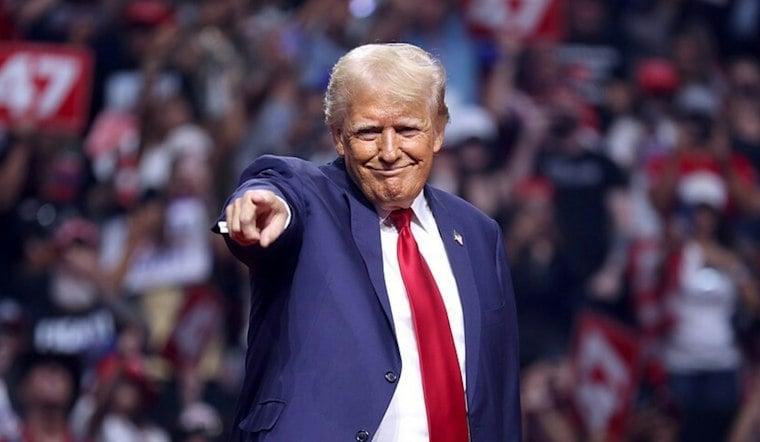
President Donald Trump stood at the Pentagon on Friday to mark the 25th anniversary of the September 11 attacks, honoring victims, survivors and first responders even as he used the solemn occasion to defend his administration's ongoing military conflict with Iran. Trump told the crowd gathered in Arlington, Virginia, that future generations will honor the heroes of September 11, 2001, while framing the current fight against Tehran as a continuation of the vigilance born that day.
The ceremony, held to remember the 2,977 people killed at the World Trade Center, the Pentagon, and aboard the hijacked plane that crashed in Shanksville, Pennsylvania, became a platform for Trump to link the 9/11 attacks to his rationale for the Iran war, according to the New York Daily News. Trump said U.S. service members are working to prevent Iran from obtaining a nuclear weapon and described the Islamic Republic as the world's number one sponsor of terror. Defense Secretary Pete Hegseth went further, tying the Iran war directly to the September 11 attacks and calling Iran an Islamic theocracy that has wished the United States death for nearly half a century.
Yet the September 11 attacks were carried out by al-Qaeda terrorists from Saudi Arabia, the United Arab Emirates, Egypt and Lebanon, and had no ties to Iran, the Daily News report notes. That history is reinforced by the 9/11 Commission's own findings, detailed by the Washington Institute for Near East Policy, which concluded that while Iran allowed several future hijackers to transit its territory without stamping their passports, investigators found no evidence Tehran's government was aware of or involved in planning the attacks. The commission noted that al-Qaeda was a Sunni terrorist network historically hostile to Shiite-led Iran.
A Family's Sacrifice Remembered
Amid the political framing, Trump recognized the family of FDNY Capt. Timothy Stackpole, who perished trying to rescue others at the World Trade Center. Stackpole's story carries added weight within firefighting circles: the captain had survived fourth- and fifth-degree burns over 30% of his body in a 1998 Brooklyn fire and endured years of rehabilitation before returning to full duty, according to the National Fallen Firefighters Foundation. He was promoted to captain on September 6, 2001, just five days before responding off-duty to Ground Zero, where he died. Trump also noted that a young family died aboard the American Airlines jet hijacked and crashed into the Pentagon, an attack that claimed 184 lives — 125 military and civilian personnel inside the building and 59 passengers and crew, per the Department of War.
Trump was joined at the ceremony by First Lady Melania Trump, Hegseth, Joint Chiefs Chairman Dan Caine, and Condoleezza Rice. Caine's presence carried its own resonance: as a D.C. Air National Guard major on the morning of the attacks, he personally oversaw the scrambling of the first unarmed F-16 fighter jets dispatched to defend Washington, dispatching pilots Marc Sasseville and Heather Penney to intercept hijacked aircraft, according to the National Guard Bureau. Trump skipped the main 9/11 memorial at Ground Zero to attend the Pentagon event instead.
Shifting War Aims Face Scrutiny
Hegseth said the United States had laid waste to the world's most prolific state sponsor of terrorism over the previous six months, part of a broader Iran conflict whose stated aims have shifted over time. Those aims have included changing Iran's Islamic regime, ending its nuclear program, barring its support for regional terror proxy groups, and ending its ability to strike neighboring countries — goals the Daily News report states have not yet been achieved.
The same day the tribute took place, CIA Director John Ratcliffe declassified 71 historical intelligence reports provided to Presidents Bill Clinton and George W. Bush before the attacks, marking the largest single release of CIA analysis concerning 9/11, according to CBS News. Those declassified assessments detail early intelligence warnings about Osama bin Laden's efforts to acquire chemical and nuclear materials, adding fresh historical context on the very day the administration was drawing a rhetorical line between al-Qaeda and Iran.
Pentagon Pushback and Congressional Limits
The commemorative tone at the Pentagon masked friction within the building itself. In August 2026, senior U.S. military service chiefs and regional combatant commanders submitted a classified assessment advising Hegseth against extending large-scale military operations in Iran, warning it risked compromising military readiness elsewhere, according to The Washington Post. The assessment reportedly reflected concerns from Army, Navy and Air Force leadership about global force availability.
Congress has also pushed back under the War Powers Resolution of 1973, which requires presidents to withdraw armed forces from unauthorized foreign hostilities after 60 days. Rep. Tom Barrett introduced an authorization proposal in May 2026 aimed at setting a firm sunset date for U.S. military action in Iran, according to background compiled on the resolution's history. During July congressional testimony, Hegseth faced intense bipartisan questioning over shifting war objectives and an $87.6 billion emergency war funding request, part of a broader $1.5 trillion defense budget proposal, as reported by PBS News. Hegseth defended the administration's strategy against lawmakers' assertions that the conflict lacked a clear exit plan.
The war's consequences have reached beyond the battlefield. The conflict led to the disruption and closure of the Strait of Hormuz, prompting a U.S. naval blockade of Iranian shipping and driving sharp increases in domestic energy prices, PBS News reported, underscoring the economic stakes tied to the fight Trump and Hegseth defended at the anniversary tribute. The overall 9/11 death toll of 2,977 — including 2,753 at the World Trade Center, 184 at the Pentagon, and 40 aboard United Airlines Flight 93 in Shanksville — remains the backdrop against which the administration continues to frame its case for the Iran campaign, according to Encyclopaedia Britannica.



