

























































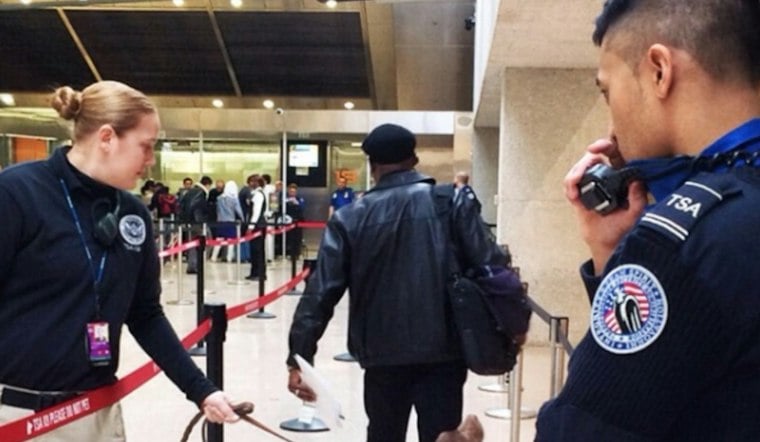
Airport travelers may notice something missing at the ID-check podium on their next trip: the chair. The Transportation Security Administration has confirmed that officers checking boarding passes and identification will no longer be allowed to sit while working, and the agency says chairs are already being pulled from checkpoints at most commercial airports across the country.
The change, first confirmed to CNN, means travel document checker podiums nationwide are losing their seating entirely, with the rollout already underway. TSA says the goal is to keep officers upright and engaged during the document-checking process, framing it as a matter of both security and customer service. As the agency put it, having officers on their feet and alert reinforces security and hospitality, per CNN's reporting.
TSA also tied the move to broader personnel standards. All officers must meet fitness-for-duty requirements to perform their national security functions, the agency told USA Today. TSA officers must meet those requirements not just to carry out national security duties but to help create what the agency describes as a welcoming, professional environment for travelers, according to the seed report from NBC 7 San Diego.
Union Says It Learned About the Policy From Its Own Members
The American Federation of Government Employees Council 100, which represents more than 40,000 TSA officers, says it found out about the chair removal the same way most travelers did — secondhand. There was no formal notification to AFGE, the union told CNN, and it has since criticized the decision as a disregard for workers' rights and safety.
The union argues chairs provide basic ergonomic and safety support for officers who stand and walk on hard surfaces all day, and that forcing document checkers to remain upright for hours while screening passengers defies workplace safety standards, according to the seed report. AFGE Council 100 has vowed to aggressively fight the policy, per that same reporting. Separate reporting on the standing-related health concerns notes that government research links prolonged standing at work to fatigue, back pain, muscle discomfort and leg swelling, and recommends letting workers alternate between sitting, standing and leaning, as View From the Wing reported.
Part of a Larger Push to Reshape TSA
TSA Administrator David Cummins has framed the chair ban as one piece of a broader modernization effort called Horizon 25, which he said includes expanding TSA PreCheck, rolling out new technology, privatizing some checkpoints and generally reworking the passenger experience, according to CNN. About 20 airports — including San Francisco, Kansas City and Sarasota, Florida — have already used private security screeners for years, USA Today notes.
The policy also arrives against the backdrop of proposed cuts to the agency's workforce. President Trump has proposed cutting more than 9,400 TSA workers and just over $1.5 billion from the agency's annual budget, USA Today reported. Separately, Trump has also proposed requiring smaller airports to shift to private security, a move Reuters said would initially cut the TSA payroll by more than 4,500 jobs, according to U.S. News.
A Year of Turmoil for TSA's Workforce
The chair announcement lands after a rough stretch for TSA staffing. Earlier this year, a partial government shutdown left TSA officers without paychecks, and hundreds of officers quit their jobs during the disruption, according to the seed reporting. Trump later issued an executive order tied to paying TSA officers, and officers were paid at the end of March as a result, before the Department of Homeland Security reopened on April 30 at the conclusion of what was reported as a 75-day shutdown.
The fallout during that stretch was visible at checkpoints nationwide. Houston airports saw TSA employee callout rates exceeding 50% on a Sunday and Monday, with Houston's William P. Hobby Airport hitting a 55% callout rate on one Saturday — the highest single-day rate reported in the city, per CNN's live coverage. Wait times at George Bush Intercontinental Airport occasionally stretched to nearly two hours amid the staffing shortages, and the Houston airport system urged Hobby passengers to arrive three to four hours before their flights, as reported by The New York Times.
New Orleans and Atlanta also saw high TSA employee callout rates. Louis Armstrong New Orleans International Airport later warned that checkpoint wait times could reach two hours during a peak weekend, as detailed by the airport's own updates. The same spring shutdown left 50,000 TSA workers without pay for six weeks, with security waits extending four hours or more in some places, per U.S. News.
Against that backdrop, the sight of an exhausted TSA officer resting his head in his palm at Dulles International Airport in March became something of a symbol for the agency's staffing strain, according to the seed reporting. Now, with chairs disappearing from checkpoints nationwide, the union representing those same officers says it intends to keep pushing back on a decision it says was made without its input.





