

























































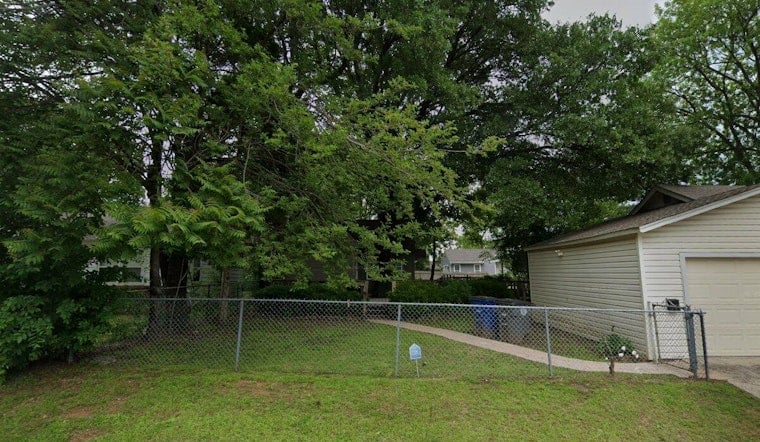
Jeremy Walker knew the sidewalk in front of his Midtown Tulsa home was buckling because of a large tree nearby, but he never expected the city to hold him responsible for fixing it. When a notice of violation showed up at his house, he had 14 days to repair the concrete or face a fine of up to $1,200, imprisonment, or both.
“How is this my responsibility? I didn't understand,” Walker said, describing his reaction to the notice, according to FOX23. He said he had assumed the city would be the one responsible for fixing the sidewalk since it sits in the public right-of-way, but that is not how Tulsa's rules work. Tulsa city code generally assigns responsibility for sidewalks, walkways, stairs, and driveways serving private property to property owners, according to the station's report.
Tulsa city code assigns sidewalk, walkway, stair, and driveway maintenance and repair to private property owners, and city officials told Walker the tree itself had caused the damage to his sidewalk, then told him he would need to remove it. Walker pushed back on the underlying logic of the whole system. “We pay the city,” he said, per the station's report, reflecting his frustration that he was taxed for infrastructure he was now being told to fix out of pocket.
A Permit Process That Took Weeks, Not Days
Walker's 14-day compliance window collided head-on with the reality of getting permission to do the work legally. He learned he needed a permit before making any repairs, but the same reporting found that obtaining one can take 60 to 90 days — a timeline wildly out of step with the two weeks the violation notice gave him. The permit itself cost $700, according to the same account, on top of whatever the physical repair would run.
The City of Tulsa described the 14-day compliance period as a standard timeline and said officials only ask homeowners to work toward addressing the problem, rather than demanding it be finished instantly. Notices generally provide 10 days to comply, with possible extensions, and failure to comply leads to a contractor work order.
Walker ultimately spent three days removing the old concrete, cutting through tree roots, pouring a new sidewalk, and shaping it around the tree himself. He estimated the total project cost between $1,200 and $1,500. A Tulsa city inspector approved his finished work despite the fact that he had done it without the permit he'd been told he needed.
City Says It Can't Easily Track How Many Others Are Affected
Walker isn't the only Tulsa homeowner caught in this bind. The FOX23 investigation identified another Tulsa homeowner who received a similar sidewalk violation, and after reporters contacted city officials about that case, the city rescinded it. When asked how many sidewalk violations have been issued in Tulsa this year, the City of Tulsa said that number would be difficult to identify. The city declined an on-camera interview for the investigation.
The scale of Tulsa's code enforcement operation is large: the city's Code Enforcement division investigates roughly 22,000 nuisance, zoning, and property maintenance violations annually across more than 18,000 cases opened through its 311 Customer Care Center, according to the City of Tulsa. Sidewalks added during neighborhood improvement projects also become the homeowner's responsibility to keep in good repair going forward, the city has said, meaning the obligation doesn't just apply to sidewalks a homeowner personally poured.
Federal Standards and the Tree-Root Trap
The friction in Walker's case sits at the intersection of two sets of rules that don't always play nicely together. Federal guidelines from the U.S. Access Board classify any vertical displacement greater than a quarter-inch at a sidewalk joint or crack as a trip hazard requiring beveling or structural repair under the Americans with Disabilities Act, with edges between a quarter-inch and half-inch needing to be beveled at a 1:2 slope. Tulsa's own property-maintenance standards include general requirements for structural maintenance.
At the same time, city guidelines say abutting owners must maintain vegetation and trees in the public right-of-way. That leaves homeowners like Walker responsible for keeping the sidewalk in condition while managing vegetation and trees in the right-of-way.
Not every crack or uneven slab rises to the level of a code violation, though. Oklahoma case law does not fix an arbitrary inch measurement for trivial defects. Contractors performing sidewalk repair work inside city rights-of-way also must secure a Right of Way Minor Construction Permit and execute a $5,000 bond with the city, according to bonding industry group BondAbility, adding another layer of cost and paperwork for anyone who doesn't do the work themselves like Walker did.
In a separate Oklahoma Supreme Court case, Town of Norman v. Teel, the court said that whether notice was sufficient to establish a city's liability for a defective sidewalk is a question of fact for a jury under the circumstances. In Zachary v. City of Sapulpa, the Oklahoma Supreme Court recognized municipal liability for negligence in failing to keep streets and sidewalks in a reasonably safe condition.
How Other Cities Are Handling It Differently
Tulsa has already built some flexibility into its sidewalk rules for new construction. In January 2020, the city amended Title 35, Section 602 to create a fee-in-lieu program letting property owners in designated “non-critical” areas pay a fee instead of building new sidewalks, with fees collected by the city. That flexibility, though, applies to new development — not to enforcement against existing homeowners like Walker facing repair notices on sidewalks that already exist.
City of Tulsa capital records show that the city's July 2022 STOC report included entries for "Sidewalk Repair/Const (Citywide)" and "Citywide - Arterial Sidewalk Improvements."
Other cities have taken a fundamentally different approach. Denver voters passed a ballot initiative shifting all sidewalk maintenance and construction duties from private property owners to city government starting in 2025, funded through a dedicated Sidewalk Enterprise Fund fee system, as Hoodline reported in coverage of a Denver sidewalk-fall lawsuit. Tulsa voters, meanwhile, recently weighed their own infrastructure funding questions in a separate August ballot measure covering a gas franchise deal and a $1.4 million sidewalk fund.
Denver's sidewalk program included construction and repair work in 2025.
For now, Tulsa homeowners remain on the hook for sidewalks running through the public right-of-way in front of their homes, navigating a system of permits, bonds, and compliance deadlines that can move far faster than the bureaucracy meant to help them meet those deadlines. Walker's ordeal, resolved only after he did the work himself and an inspector signed off, illustrates just how much can go wrong for a homeowner caught between a violation notice and a permit office.




