

























































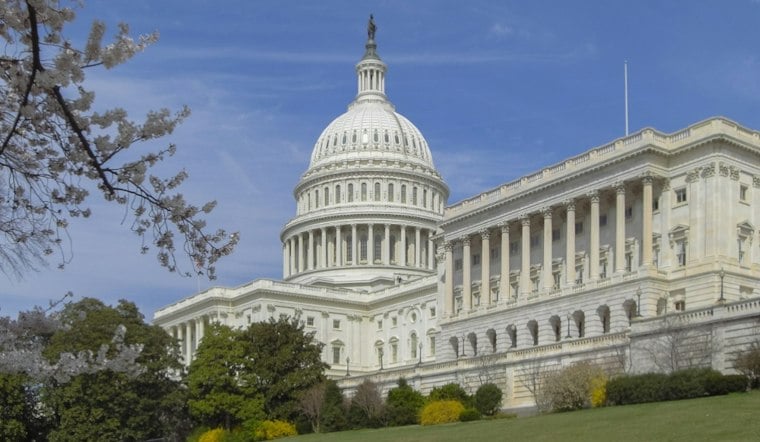
American democracy has fallen to its lowest levels in 50 years, according to a sweeping new global report, and researchers say the damage is no longer just a domestic story. The findings, released Tuesday, single out the United States as the clearest example of a broader worldwide slide away from democratic governance.
The assessment comes from the International Institute for Democracy and Electoral Assistance, a Stockholm-based intergovernmental organization founded in 1995 that now counts 35 member nations, with the United States and Japan holding observer status, according to its own entity background. Known as International IDEA, the group's annual Global State of Democracy report tracks democratic performance across 174 countries using data stretching back to 1975, and this year's edition focuses specifically on how conditions have shifted between 2020 and 2025, as reported by WFAE.
Seema Shah, who heads International IDEA's democracy assessment team, told the station that undemocratic trends had, in the past, tended to correct themselves over the last 50 years — but that pattern appears to be breaking down. Shah identified the United States as the starkest illustration of that shift, pointing to a country that historically performed strongly on rule of law and judicial independence and long served as what the report calls a bastion of democratic governance, one that actively promoted democracy abroad.
Executive Power and a Retreat From Democracy Promotion
Per the report, President Donald Trump amassed power within the executive branch throughout 2025 and used that authority to pursue personal goals and retaliation against perceived enemies, according to WFAE's account. That exercise of power, the report found, undermined the rule of law both domestically and internationally and tested long-standing alliances and multilateral cooperation.
The report also points to a broader retreat from democracy promotion as U.S. foreign policy. Trump, speaking in Riyadh, Saudi Arabia in 2025, said the United States would no longer give other countries lectures on how to live, criticizing previous administrations as interventionist, per WFAE's reporting. Researchers noted that Washington's program of democratic aid to developing countries was dismantled during this period, and the station's report says administration policies have simultaneously weakened global norms and handed rhetorical ammunition to non-democratic leaders.
A Worldwide Pattern, Not an Isolated Case
International IDEA Secretary-General Kevin Casas-Zamora framed the American decline as part of a systemic problem, stating that the rapid erosion of democracy in the U.S. is weakening judicial independence globally and fragmenting the rules-based international order, according to International IDEA. Fifty-seven percent of countries surveyed showed declines in at least one key democratic indicator, per the same report, and U.S. democracy itself declined on nearly half of the 30 indicators the organization measures.
Rule of law emerged as the weakest-performing category worldwide, and the report found that global judicial independence had dropped to a 36-year low while credible elections fell to a 30-year low, with 41 percent of surveyed nations classified as low-performing on rule of law. The report, titled Democracy in an Age of Conflict, also drew a direct line between democratic backsliding and violence: 2025 recorded 65 violent conflicts and 8 interstate conflicts, the highest figures logged since the Uppsala Conflict Data Program began tracking such data in 1946. It marked the 11th consecutive year in which net democratic declines outnumbered improvements around the globe.
Independent Trackers Reach the Same Conclusion
Other research groups have arrived at similar findings through separate methodologies. In March, the Sweden-based V-Dem Institute downgraded the United States from a liberal democracy to an electoral democracy, citing a 24 percent single-year decline in its Liberal Democracy Index that dropped the country's global rank from 20th to 51st out of 179 nations — a fall V-Dem described, according to its own press release, as faster than any established democracy has experienced in modern history. Separately, V-Dem data indicated the level of democracy enjoyed by the average global citizen has slid back to levels last recorded in 1978.
Freedom House reached a comparable verdict in its own assessment, lowering the United States' overall score to 81 out of 100 for 2025 — its lowest since the organization introduced its 0-to-100 scale in 2002, tying the U.S. with countries including South Africa, Jamaica, and Seychelles. Per Freedom House, the drop reflected worsening congressional gridlock, assertions of unilateral executive authority, and growing pressure on nonviolent expression. A Pew Research Center study published in April found that three leading indexes — V-Dem, Freedom House, and the Economist Intelligence Unit, which classified the U.S. as a flawed democracy with a 7.65-out-of-10 score for 2025 — all confirmed the same downward trajectory, according to Pew Research Center.
Where Democracy Is Recovering
Not every country moved in the same direction. WFAE reports that Poland, Hungary, and Syria were each cited in the report as examples of recent democratic resurgence, while International IDEA separately identified Bangladesh, Brazil, Poland, Sri Lanka, and Syria among nations logging measurable democratic progress. Bangladesh, for instance, advanced to mid-range rule-of-law performance after 2025 judicial and legal aid reforms that integrated digital case management and pre-case mediation to cut court backlogs, according to The Business Standard.
Even so, the report cautions that recoveries are fragile. Shah told WFAE that in 90 percent of cases, democracies that recover after a decline suffer another downturn within five years. She said candidates who promise change often cannot deliver on those promises because remnants of the old guard prevent the changes from taking hold — and, according to WFAE, Shah went so far as to say that breaking democratic laws may sometimes be required to remove those remnants.
Leadership Backdrop at International IDEA
The report arrives as India's Chief Election Commissioner, Gyanesh Kumar, holds the Chairship of International IDEA for the 2026 term, a role he assumed in December 2025 at the organization's Stockholm headquarters. Kumar represents India, and India is one of International IDEA's 14 founding members, according to the Press Information Bureau of India.




