

























































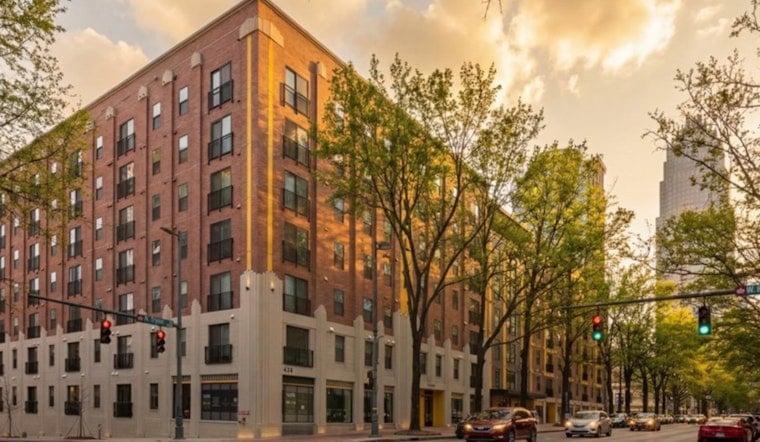
A newly completed 353-home tower in Charlotte's First Ward is putting a novel bet on the table: that income-restricted renters and luxury tenants can share the same pool deck, the same fitness center, and the same address. Trella Uptown includes 106 affordable apartments alongside 247 market-rate units, and the income-restricted residents get access to the same finishes and shared spaces as everyone else in the building, including a rooftop with pickleball courts, a pet spa, a maker space, and even a podcast studio.
The project cost an estimated $137 million to build, according to Stone Realty Group, and it came together through a dense stack of public and private money. That included $3.2 million from Charlotte's Housing Trust Fund, $6 million from Mecklenburg County, roughly $66.9 million in J.P. Morgan construction loans, and Low-Income Housing Tax Credit equity invested by Aetna. JPMorganChase supported the construction of Trella Uptown, and the bank says it has delivered financial health education to thousands of Charlotte residents over the last five years while investing more than $5 million in local nonprofit organizations and supporting 35,000 small business clients over that same period, per The Business Journals.
An Unusual Use of City Housing Dollars
City of Charlotte Housing Trust Fund dollars are typically restricted to standalone affordable projects, which is what makes Trella Uptown's $3.2 million allocation unusual — it integrated subsidized units side-by-side with market-rate luxury apartments inside a single Uptown building, according to the City of Charlotte. Of the 106 income-restricted units, 32 are set aside for households earning up to 30% of the area median income, 37 for up to 50% AMI, two for up to 60% AMI, and 35 for up to 80% AMI. Sixty-nine of those apartments are supported by project-based vouchers that cap tenant rent at 30% of household income, the city says.
Horizon Development Properties Inc. and Urban Atlantic developed Trella Uptown. Fulton Meachem, president and CEO of Horizon Development Properties, said the project reflects a commitment to communities where residents of all incomes can live, work and play. Brant Snyder, chief executive officer of Urban Atlantic, said Trella Uptown brings together thoughtful design, inclusive housing and strong local partnerships.
Brett MacLeod, a community development banker at J.P. Morgan who focuses on projects expanding housing access and neighborhood stability across the Carolinas and Mid-Atlantic region, said the project will have far-reaching impact and expand the supply of high-quality affordable homes. Ryan McGauley, chair of the Carolinas market leadership team at JPMorganChase, said the company aims to create inclusive economic opportunity for all. The JPMorganChase Institute has reported that renter affordability is declining nationally, and the Harvard University Joint Center for Housing Studies found that renter cost burdens reached a record high in 2023, per a 2025 report.
Built on the Site of a Historic Downtown Hotel
The tower rose at 426 North Tryon Street on the former site of Hall House, a property that originally opened in 1940 as the 12-story Barringer Hotel before it was converted into housing authority apartments, according to LaBella Associates. Non-profit co-developer INLIVIAN operated as the Charlotte Housing Authority for 80 years before rebranding in November 2019 to shed the stigma associated with public housing and reflect its shift into an entrepreneurial housing developer, per its own account.
That shift matters because of what has happened to Charlotte's rental market in the years since. Mecklenburg County lost more than 77% of its low-cost rental housing stock between 2015 and 2024 amid rapid redevelopment, gentrification, and rising construction costs, according to WSOC-TV. As of 2024, the county faced a deficit of 32,601 rental units affordable to extremely low-income households earning at or below 30% of area median income, the station reported.
A Regional Squeeze on Renters and Buyers Alike
The pressure extends well beyond the deeply poor. Half of all renter households in Mecklenburg County — 108,578 households — were cost-burdened in 2024 by spending more than 30% of their gross income on shelter, with 52,838 households severely burdened at 50% or more, according to Mecklenburg County Community Support Services. In fiscal year 2025, the county recorded nearly 53,000 eviction filings, a 14% increase over the prior year, resulting in roughly 34,000 granted eviction orders, per The Charlotte Ledger.
Homeownership offers little relief. By 2025, Charlotte's median home price climbed to nearly $444,000, requiring a qualifying household income of more than $146,000 — almost double Mecklenburg County's median household income, per Mecklenburg County Community Support Services. Rising home prices and high interest rates have made homeownership inaccessible to a large share of the population, while the broader U.S. housing market continues to face widespread shortages, leaving Charlotte among the metro areas grappling with persistent affordable housing challenges.
JPMorganChase, which provides banking services to more than 500,000 customers in Charlotte, frames Trella Uptown as a test of whether de-concentrating poverty inside a high-end urban high-rise can work at scale. It is one entry in a wider push across the region: Hoodline has previously reported on a city-backed senior complex near Northlake and on Charlotte City Council's vote on a Tyvola housing deal, both drawing on the same Housing Trust Fund mechanism now stretched to cover a mixed-income Uptown tower. With the county still short more than 32,000 deeply affordable units, Trella Uptown's 106 apartments are a modest dent in a much larger gap — but for the families who qualify, it means a rooftop with pickleball courts and a pet spa are now part of the deal.


