

























































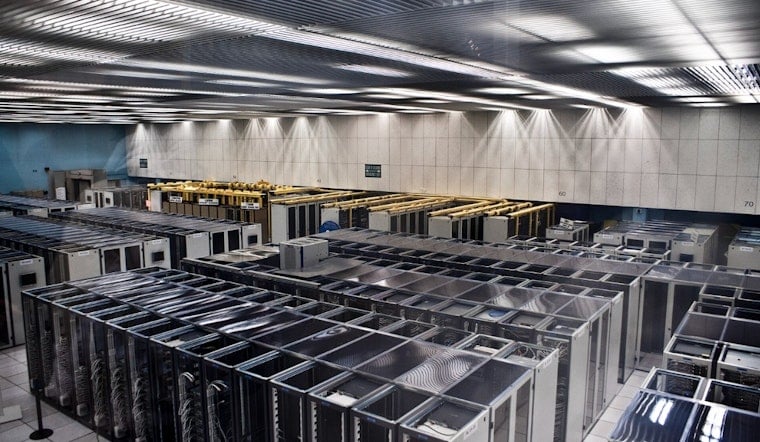
US electricity consumption is on track to set records in both 2026 and 2027, as AI data centers expand, according to the latest federal forecast. The U.S. Energy Information Administration's Short-Term Energy Outlook projects record demand in both years.
The forecast, first reported by Reuters, describes rising electricity demand alongside the rapid buildout of data centers dedicated to AI. Commercial electricity sales are projected to rise to 1,528 billion kilowatt-hours in 2026, according to the same report. Industrial power sales are forecast at approximately 1,065 billion kilowatt-hours in 2026. The West South Central region, which includes Texas, is expected to account for the largest share of the nation's electricity sales growth.
Texas Hits the Brakes on New Data Center Hookups
That regional growth comes with a catch. Texas has paused approvals for energizing large-load facilities and cryptocurrency-mining operations, per the Reuters report, as the state grapples with just how much of the demand flooding its interconnection queue is real. Governor Greg Abbott directed state regulators and grid operator ERCOT on August 3 to conduct an audit and verification process, according to WilmerHale, at a moment when data centers made up roughly 90% of the 474 gigawatts in new capacity requests sitting in the queue.
The scale of that speculative demand — described by WilmerHale as five times Texas's historical peak demand — reflects a broader industry habit. Developers frequently file duplicate interconnection requests across multiple regions to hedge against delays, according to research from Marcus by Goldman Sachs, which estimated in June that US data center power demand will double from 31 gigawatts in 2025 to 66 gigawatts by 2027. That same research found only 72% of data centers scheduled for activation within four quarters historically go online on time, largely due to grid connection bottlenecks.
Grid Operators Push Costs Back Onto Developers
Texas isn't alone in trying to separate real demand from ghost demand. PJM Interconnection, the regional grid operator serving Virginia and much of the mid-Atlantic, filed proposed rules with federal regulators in August that would require large new power users like AI data centers to contract for their own new generation capacity or face curtailment during supply shortages. The proposal addresses capacity requirements and demand reduction for large users.
Grid reliability concerns extend beyond who pays for new capacity. The North American Electric Reliability Corporation reported in July that sudden disconnections of large computational loads are creating new frequency and stability hazards, pointing to multiple 2025 events where more than 1,000 megawatts of data center load unexpectedly disconnected during transmission faults, according to Data Center Dynamics. The coverage describes computational loads failing to ride through normally cleared transmission disturbances.
Natural Gas Holds Steady as Solar Surges
Natural gas figures accompany the electricity-demand projections. Coal's share is projected at 14% in 2027, while renewables are expected to reach 27% of generation that year.
Gas production itself is expected to hit record territory. U.S. natural gas production is projected to reach 111.7 billion cubic feet per day in 2026 and 115.9 bcfd in 2027, according to Investing.com's reporting on the same EIA outlook. The outlook also covers gas sales to the power sector. Domestic gas consumption is also forecast to reach 92.2 bcfd in 2026, alongside rising production in the Permian and Haynesville shale plays.
Utility-scale solar is emerging as the fastest-growing piece of the supply picture. Solar generation is projected to surge 17% in 2026 to 341 billion kilowatt-hours and another 23% in 2027 to 418 billion kilowatt-hours, according to ESG Dive, with those gains expected to meet most new demand.
The National Numbers Mirror a Global Pattern
The tension between breakneck data center growth and grid capacity isn't confined to the US. The issue is also being discussed internationally. Data center and grid construction are both part of the broader infrastructure issue.
Future electricity demand is also part of the broader discussion. Separately, the Electric Power Research Institute has examined the potential share of U.S. electricity generation consumed by data centers by 2030, per EPRI.
The outlook also covers natural gas and electricity sales. Industrial natural-gas consumption is also forecast to reach record highs. The outlook also discusses natural-gas demand. Together, the forecasts highlight a power sector being reshaped by changing demand and supply patterns.




