

























































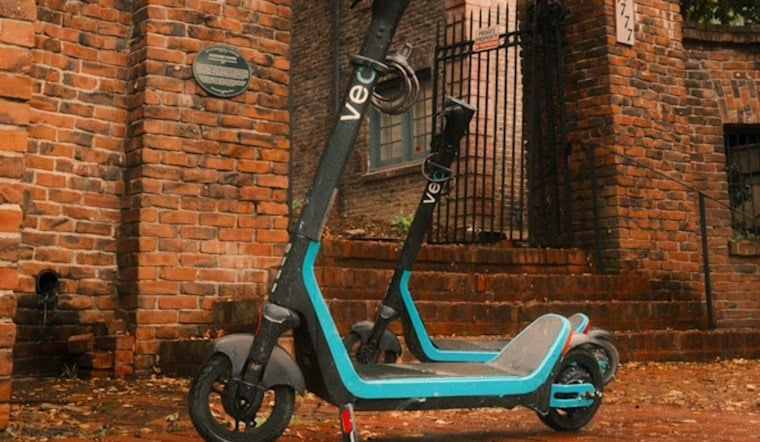
Denver scooter and e-bike riders steered onto sidewalks more than 338,000 times during the city's first quarterly reporting window for Veo. This exclusive micromobility vendor took over from Lime and Bird earlier this year. The figure comes from Veo's own required filing covering the period from the beginning of May through the end of June, and it lands even as the company's promised software tool for automatically detecting unsafe riders has yet to launch.
The numbers were first reported by Denverite, which detailed Veo's first quarterly report to the city. According to that report, Veo vehicles carried 1.34 million rides total during the period, and Veo Access members — the company's discounted program for low-income riders — accounted for roughly 42% of those trips, with about 567,000 rides logged. Denver dockless micromobility devices overall saw ridership climb 12% compared with a year earlier, the report shows.
Veo has installed audible warnings meant to alert riders when they stray onto sidewalks, along with no-parking zones and slow zones around schools, the report notes. But the planned software tool designed to detect unsafe riders and intervene has not yet launched, even though the city required Veo vehicles to include sidewalk detection technology as a condition of its contract.
A Graduated Penalty System Kicks In
Veo launched a user violation schedule on August 10, under which riders get warnings and education for their first two sidewalk-riding offenses before facing fines. A third offense triggers a $5 fine, a fourth brings a $10 fine plus a suspension, and Veo representatives have said repeat offenders will eventually be banned from the platform altogether.
Denver Department of Transportation and Infrastructure official Nick Williams said more details on the enforcement technology would come in the following weeks, estimating that additional specifics could be available within two to four weeks. Alaina McWhorter said Denver and Veo are working toward ending reckless sidewalk riding and improving the public realm.
Council Weighs In on the Compromise
Denver City Councilmember Chris Hinds, who co-sponsored the 2025 ordinance requiring sidewalk detection technology on shared scooters, called the emerging penalty framework a great compromise between micromobility riders and pedestrians. Hinds has also been a vocal critic of the pace of implementation — as reported by 9News, he said in August that Veo had failed to implement the active ride interventions it promised, after fielding more than 100 constituent complaints about scooters blocking sidewalks and pedestrian paths. Hinds noted plainly that sidewalks were never designed for anything moving at 15 miles an hour.
That criticism prompted the Denver City Attorney's Office to open a formal review of Veo's contract in August, per 9News. Under the city's license agreement, Denver holds the authority to reduce Veo's fleet cap — currently set at roughly 9,000 vehicles — suspend or terminate the contract entirely, or bring in a secondary operator if Veo fails to correct material safety violations after official notice.
The Technology Behind the Detection Push
The sidewalk detection system Veo has been building relies on onboard LiDAR sensors, GPS, and geofencing to identify sidewalk riding, issue verbal warnings, and automatically slow or end noncompliant trips, 9News has reported. Ahead of the city's July enforcement deadline, high-pedestrian zones downtown and along bike lanes were geofenced as part of that rollout. The requirement traces back to a Denver City Council ordinance passed unanimously in May 2025, which shifted responsibility for preventing sidewalk riding from municipal police directly onto private platform operators like Veo.
Denver's municipal rules were also updated this year to raise fines for scooters parked on or blocking sidewalks from $25 to $65, while penalties for blocking ADA-accessible spaces jumped from $150 to $350, with operators required to relocate improperly parked vehicles within an hour. Under state law, electric scooters carry the same legal rights and responsibilities as motor vehicles, according to the Colorado Department of Transportation, and motorists overtaking scooters on roadways must maintain at least three feet of clearance.
Rising Injuries Add Urgency
Veo recorded 10 crashes or significant safety incidents during the reporting period, according to the Denverite account of the filing. Separately, Children's Hospital Colorado has reported almost twice as many scooter injuries and three times as many e-bike-related injuries compared with previous years — a trend that echoes broader data cited by Colorado Politics, which noted the hospital's Anschutz campus treated 60 traumatic e-mobility device injury cases through August of this year alone, after logging 100 total cases combined across 2024 and 2025.
The healthcare toll isn't new to Denver. As Hoodline previously reported on a serious crash, Denver Health emergency physicians treated an average of 3.6 scooter injury patients per day between 2021 and 2022, racking up more than $10.4 million in hospital charges at a single trauma center over four years — numbers that helped drive the 2025 legislative push for sidewalk detection technology in the first place.
Veo's Denver rollout represents its largest single market, with the company expanding to roughly 9,000 vehicles here after previously operating about 4,000 in Washington, D.C. Denver residents pay $1 to unlock a Veo device and $0.25 per minute, compared with $0.39 per minute for non-residents and the $0.44 per minute non-resident riders paid under prior operators Lime and Bird. Under the Veo Access program's terms, the company must reach a 30% baseline share of rides going to low-income participants — a threshold the current 42% figure already clears.
Not every sidewalk-riding incident shows up as an abstract statistic in a quarterly filing. On June 2, someone rode a Veo scooter on the sidewalk along East Colfax Avenue, one of countless individual trips folded into the 338,620 sidewalk riding events tallied in the report. Whether Veo's still-unreleased detection software will meaningfully cut that number down remains an open question the city says it expects answered in the coming weeks.




