

























































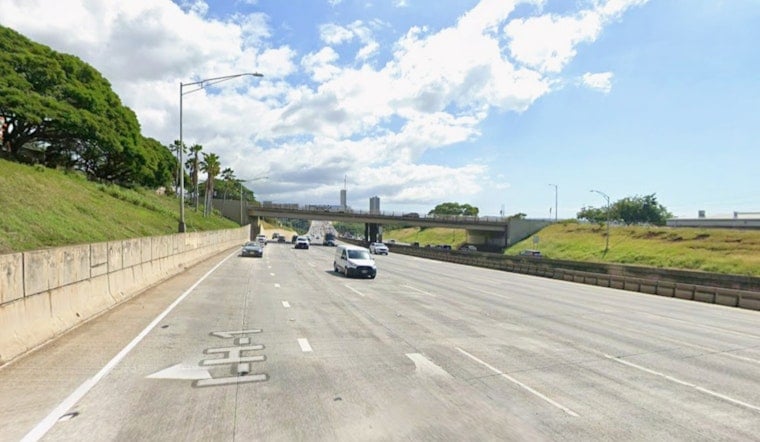
A 31-year-old motorcyclist was left in critical condition Saturday after rear-ending a stalled vehicle in the left lane of the eastbound H-1 Freeway near the Moanalua Road overpass and Waimalu exit. The rider was thrown onto the roadway and rushed to an area hospital, while the crash snarled traffic near Moanalua Road and the Waimalu exit for several hours.
According to Hawaii News Now, the stalled car belonged to a 39-year-old motorist who was not injured in the crash. That driver had been traveling with three juvenile female passengers at the time; two of the girls were not hurt, but a third reported minor injuries and refused treatment at the scene. The motorcyclist was wearing a helmet, the outlet reports, though police have not yet said whether speed, drugs, or alcohol played a role in the crash.
Emergency medical services transported the motorcyclist to the hospital, and police are investigating the collision. The station's report does not specify how long the disabled car had been sitting in the freeway's left lane before impact, or whether its hazard lights were on at the time — questions that remain open as the investigation continues.
Why Stalled Cars in Live Lanes Turn Deadly Fast
The Waimalu crash lands just weeks after Hawaii lawmakers expanded the state's Move Over Law. Act 95, signed into law in August 2026, now requires drivers to slow down and safely change lanes when approaching any stationary vehicle displaying hazard lights, flares, or caution signs — not just emergency vehicles — under Hawaii Revised Statutes § 291C-27. Lawmakers pushed the expansion after repeated roadside strikes involving stranded motorists and tow operators.
The danger posed by stalled vehicles in active lanes isn't theoretical. Citing data from the U.S. Department of Transportation and NHTSA, the Hawaii Department of Transportation notes that roughly 20% of traffic crashes nationwide stem from a primary incident, and the odds of a secondary collision climb 2.8% for every minute a hazard sits in a live lane. To combat that risk, HDOT runs a 10-vehicle Freeway Service Patrol sponsored by GEICO across 33 miles of Oahu freeways, including the H-1, clearing an average of 9,000 roadside incidents a year.
Two-Wheeler Riders Bear an Outsized Toll
Hawaii's helmet law only requires riders under 18 to wear one, meaning the 31-year-old motorcyclist's helmet use in this crash was a personal choice rather than a legal mandate for adult operators. That distinction has remained part of state safety debates since 2025, when Hawaii logged an 18-year peak of 129 traffic deaths statewide — 82 of them on Oahu — with 39 of those victims riding motorcycles, mopeds, or scooters, according to state transportation data reported by Honolulu Civil Beat.
State officials found that more than 90% of Hawaii's fatal crashes in 2025 traced back to driver behavior, with speed a factor in 58% of the state's traffic deaths — the highest speed-involved fatality rate in the nation, per Civil Beat's reporting. Preliminary Hawaii Department of Transportation figures show 58 traffic fatalities statewide between January 1 and September 2, 2026, including 25 on Oahu, with 14 of those deaths involving motorcycle, moped, or scooter riders.
There is a silver lining buried in the numbers. Honolulu Police Department traffic records show Oahu's overall road fatalities have fallen sharply this year, with 25 deaths recorded through late July 2026 compared to 46 over the same stretch in 2025, as reported by KHON2 News. Even so, two-wheeler riders continue to make up a disproportionate share of the state's most severe crashes.
Under standard Honolulu Police Department procedure, the Traffic Division's Vehicular Homicide Section leads on-scene investigations whenever a crash involves critical injury, death, or potential felony traffic offenses — a protocol that has applied to several recent Oahu freeway crashes involving motorcyclists. Hawaii law also treats leaving the scene of a collision that causes serious injury or death as a Class B felony, carrying up to 10 years in prison and $25,000 in fines under Hawaii Revised Statutes § 291C-12, though nothing in the current reporting indicates any party fled the Waimalu crash.
A Pattern of Freeway Tragedies
Saturday's crash is the latest in a string of serious motorcycle incidents Hoodline has tracked on Oahu's highways this year. In August, a hit-and-run near Pearl City left a 25-year-old H-1 construction worker hospitalized in critical condition. Earlier in the summer, a Kapolei teen died in a high-speed ejection crash on a Kalaeloa on-ramp, and a fatal U-turn crash on Kapiolani Boulevard in Moiliili claimed another rider's life. Those cases came amid what Hoodline previously described as a deadly weekend that saw two riders die in late-night crashes across the island.
Police have not released further details on the condition of the motorcyclist or announced any charges in connection with Saturday's crash. The investigation into what caused the collision, and how long the stalled vehicle sat in the freeway's left lane beforehand, remains ongoing.





