

























































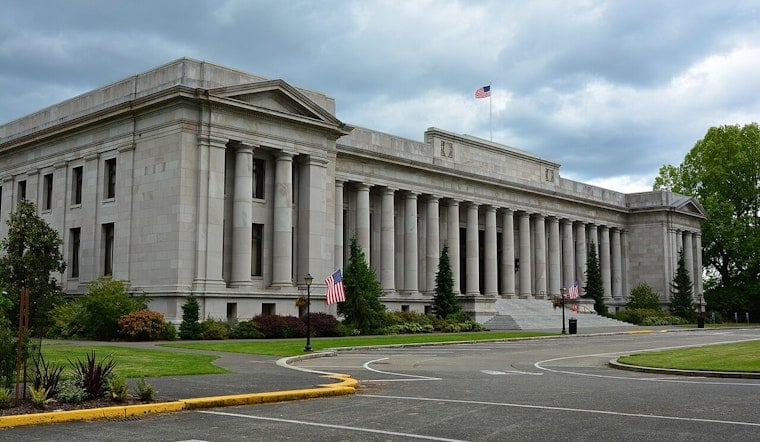
Washington lawmakers have spent years redacting and withholding public records under a claimed constitutional privilege, and now the state's highest court has agreed to decide whether that practice can stand. The Washington Supreme Court accepted review of the case after two Court of Appeals rulings this year found that a so-called legislative privilege, rooted in separation of powers, shields lawmakers' internal deliberations from disclosure.
The dispute traces back to public records requests that revealed lawmakers had used legislative privilege to redact documents tied to a legislative staff unionization bill, a bill establishing Chinese American History Month, and the state's capital gains tax, according to The Seattle Times. Other withheld documents involved the redistricting commission's open meetings law violation. Jamie Nixon, who previously served as communications director for the 2021 Washington State Redistricting Commission, and the Washington Coalition for Open Government filed suit against the Legislature over the practice, and the state is the defendant in both that case and a related one.
Lawmakers maintain the privilege exemption is rooted in the state constitution and say it is necessary to shield deliberations while bills are being written. In its March 10, 2026 ruling, Division Two of the Court of Appeals defined legislative privilege as an individual right belonging to each lawmaker, one that also covers legislative aides acting on a member's behalf, according to court records. Under that framework, one lawmaker waiving privilege on a document does not compel colleagues to release their own copies of it.
Two Lawsuits, One Constitutional Question
The appeals court also upheld two Thurston County Superior Court rulings that had sided with lawmakers, finding legislative privilege necessary both to protect the integrity of the Legislature's decision-making process and to maintain boundaries between branches of government. Nixon and the Washington Coalition for Open Government formally petitioned the state Supreme Court for review on April 8, 2026, following the appellate court's decision. A parallel challenge brought by open-government advocate Arthur West met the same fate on February 24, 2026, when Division Two rejected his lawsuit in a companion ruling; that case is also expected to go before the Washington Supreme Court.
The Washington Coalition for Open Government welcomed the high court's decision to take up its case. Mike Fancher, speaking for the coalition, said the appeals court ruling failed to recognize that the people are the primary stakeholders, adding that people retain their right to know what elected and appointed representatives are doing. Nixon put it more bluntly, saying elected officials cannot be accountable to the public while claiming the public cannot see how they conduct public business. The Washington Coalition for Open Government maintains that legislative privilege does not exist as a legal doctrine at all.
A Privilege Born From a 2019 Loss
The current fight has roots in a decision that once looked like a decisive win for transparency advocates. In December 2019, the Washington Supreme Court ruled 7-2 in the *Associated Press* case that individual lawmakers and their personal offices are agencies subject to the Public Records Act, after the Associated Press and other Washington media outlets sued the Legislature. That ruling forced lawmakers to begin releasing emails, calendar entries, and sexual harassment reports they had previously withheld. According to a joint 2023 report from McClatchy and Cascade PBS, lawmakers had long sought a legislative privilege exemption, and state lawmakers began quietly using the privilege starting in 2021 to shield records from the public, following earlier attempts to undermine the Public Records Act.
Those earlier attempts included a 2018 episode still remembered by transparency advocates. State lawmakers introduced and quickly passed legislation exempting themselves from disclosing public records, moving the bill through in under 48 hours without public hearings, according to Courthouse News. Then-Governor Jay Inslee vetoed the bill after his office received more than 17,000 constituent communications opposing it, even though lawmakers had initially passed it with veto-proof majorities before asking him to strike it down.
The 1972 Mandate Voters Approved
The Public Records Act at the center of the dispute did not originate in the Legislature at all. It was created by a citizen-led initiative, Initiative 276, which Washington voters passed by an overwhelming majority in 1972, according to the Washington Coalition for Open Government. Transparency advocates argue that judicially created privileges cut against the spirit of that voter mandate, while lawmakers counter that Article II, Section 17 of the state constitution, the Freedom of Debate clause, along with separation-of-powers principles, justifies withholding internal deliberations so bills can be written candidly.
The Washington Supreme Court has not yet set a date for its review of the case, leaving the ultimate question unresolved for now: whether the constitutional privilege lawmakers claim can override the disclosure requirements voters embedded in state law more than five decades ago. Whatever the court decides will determine how much of the Legislature's internal work, from bill drafting to staff communications, the public is entitled to see going forward.




