

























































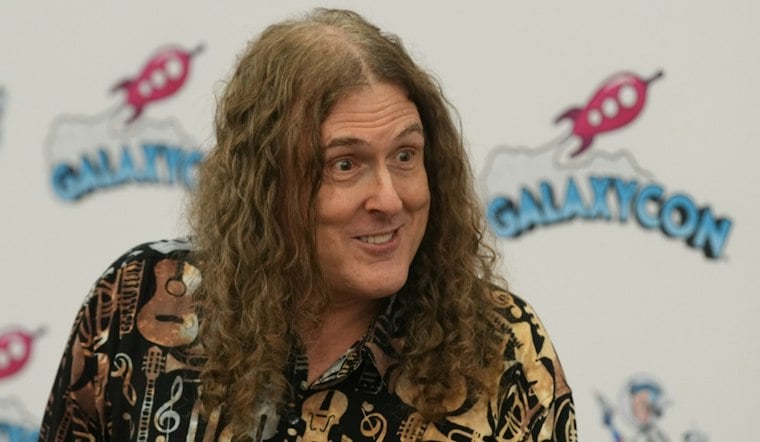
A mile-wide asteroid discovered in 1981 now carries the name of one of pop culture's most enduring satirists. The International Astronomical Union has formally designated asteroid 1981 EC26 as 14331 Alyankovic, honoring musical comedian Weird Al Yankovic, and the news arrived with a personal touch: a postdoctoral researcher at Houston's Lunar and Planetary Institute handed him a commemorative plaque in person while he passed through Arizona on tour.
A Career-Long Fan Leads the Naming Bid
The push to put Yankovic's name in the sky was led by Dr. Allison McGraw, who is affiliated with the Lunar and Planetary Institute and who already has an asteroid of her own, 20092 Allisonmcgraw, according to Consequence. McGraw has said “White and Nerdy” spoke to her as a nerdy child, while “Our Friend Dirt” is a favorite among geoscientists. Steve Desch of Arizona State University, Tim McCoy of the Smithsonian, and Melissa Brucker of University of Arizona Spacewatch also took part in the naming bid. McGraw presented Yankovic with a plaque commemorating the honor in Tucson on September 20, timed to his stop on the Bigger & Weirder 2026 Tour, which Hoodline first detailed in its tour announcement coverage last November.
Decades of Quiet Orbiting Before the Naming
The rock itself has been circling the sun since long before it had a name that would make anyone smile. Discoverer Schelte J. Bus recorded asteroid 1981 EC26 on March 2, 1981, at Australia's Siding Spring Observatory, part of a prolific career that has yielded more than 1,600 minor planet discoveries, according to the Arizona Daily Star. Bus has also discovered comets and asteroids named for science fiction writers Arthur C. Clarke and Isaac Asimov. The newly named 14331 Alyankovic spans roughly one mile in diameter and travels through the main asteroid belt between Mars and Jupiter at about 42,000 miles per hour on a 3.8-year orbit around the sun, the paper reports.
Getting a living person's name attached to a celestial body is not a quick process. The process for naming an asteroid after a living person has requirements and can take years to finalize.
Why the Asteroid Is Hard to Spot
Do not expect to find 14331 Alyankovic by glancing up on a clear night. The asteroid carries an absolute magnitude of 16.3, making it roughly ten thousand times fainter than the magnitude 5 or 6 threshold of stars visible to the naked eye under dark skies, per Space.com. Spotting it takes a good telescope rather than a backyard glance skyward.
The official IAU naming citation, published September 7 in the WGSBN Bulletin, states that “generations of scientists have been inspired by his comedic musical works, including 'It's All About the Pentiums' and 'White and Nerdy,'” Consequence reported. The IAU has also named an asteroid after mathematical satirist Tom Lehrer, one of Yankovic's own comedic influences.
Joining a Small Club of Musical Namesakes
Yankovic's four-decade catalog has long leaned into space and science themes, from the Star Wars parody “The Saga Begins” to “Attack of the Radioactive Hamsters from a Planet Near Mars” and “Sir Isaac Newton vs. Bill Nye,” Space.com notes. His work has resonated with science and planetary-science communities. The IAU has stated that names for small bodies have historically drawn from mythological characters and accomplished people across many fields. Yankovic now joins a select roster of musicians honored this way, including asteroids named for Freddie Mercury, all four Beatles, Elvis, Aretha Franklin, and Dolly Parton, as documented by the seed report from WLKY.
Every proposed name for a celestial body ultimately requires sign-off from the International Astronomical Union before it becomes official, a process that applied here just as it does for any other minor planet designation. For now, 14331 Alyankovic keeps circling harmlessly in the belt between Mars and Jupiter, far too faint to see without help, but permanently on the books as a tribute to a career built on turning pop hits into punchlines.





