

























































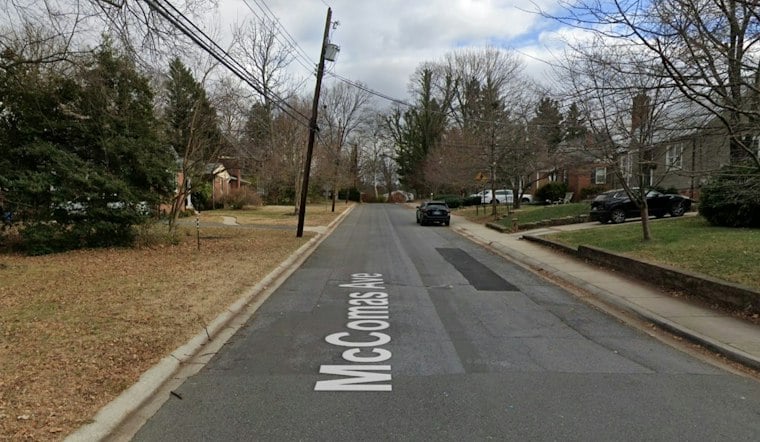
Montgomery County officials and residents gathered in Wheaton this week to mark the completion of the first segment of the McComas Avenue Greenway, a stretch running from St. Paul Street to Georgia Avenue that now features new sidewalks, bright-white painted crosswalks, sharrows and intersection markings designed to slow traffic and protect people on foot.
The project, according to WTOP News, aims to improve walking and biking safety in the Wheaton area. Chris Conklin, director of Montgomery County's Department of Transportation, said the finished stretch has no dedicated bicycle facilities on the road itself but that traffic speeds are now lower as a result of the redesign. The greenway's boundary actually stretches further than McComas Avenue alone, extending into portions of Douglas Avenue, Windham Lane and Drumm Avenue between University Boulevard and McComas Avenue, according to county project mapping.
John Foley, a neighborhood resident with a 10-year-old daughter, told the outlet the project added a sidewalk that did not previously exist on his stretch of the corridor. He said the changes have altered driver behavior in the area, with the new markings and crosswalks apparently encouraging drivers to slow down.
A Corridor Bordering a School for Medically Fragile Students
Part of what makes the greenway's completion notable locally is its proximity to Stephen Knolls School, a public school in the Kensington-Wheaton area serving students with severe disabilities and complex medical needs. At the ceremony, the podium was across the street from the school, according to Moderately MoCo. Residential corridors surrounding special education facilities can face heightened traffic safety concerns during student drop-off and pickup, and the new sidewalks and slower speeds are intended to address that risk directly.
Montgomery County Council President Natali Fani-Gonzalez, who represents the Wheaton neighborhood, said pedestrian networks should connect people of all abilities and called sidewalks critical for both people walking and people using wheelchairs. She described the McComas Avenue project as part of a countywide effort to make transportation safer for pedestrians and cyclists.
What Comes Next for the Greenway and Nearby Bikeway
Joseph Moges, chief of MCDOT's division of transportation engineering, said a second phase of the project plans to improve the intersection at Georgia Avenue. That intersection sits near where the planned Amherst Avenue cycle track will extend toward downtown Wheaton; the bikeway is located east of Georgia Avenue, and the county already operates bus lanes in the area.
The Amherst Avenue Bikeway itself involves designing and constructing a 1.1-mile, two-way cycle track on westbound Amherst Avenue between Windham Lane and Arcola Avenue, creating a main active-transit corridor in the Wheaton Central Business District, according to Montgomery County MCDOT. The corridor is meant to run parallel to Georgia Avenue, offering cyclists a protected route that bypasses heavier vehicular traffic downtown.
Part of a Larger Bicycle and Pedestrian Network Push
The Wheaton greenway fits into a much larger buildout across Montgomery County. As of August 2026, the county had constructed more than 17 miles of bike-friendly pathways since 2022, bringing its active network to 112 miles of bike lanes, shoulders and cycle tracks, with another 20 planned projects expected to add 18 more miles, per MoCo Show.
Wheaton falls within the county's Mid-County region, and the county's Vision Zero report discusses the High-Injury Network, according to Montgomery Planning.
The Vision Zero Backdrop
Montgomery County became the first county government in the United States to adopt a Vision Zero policy back in 2016, setting a target to eliminate all traffic fatalities and severe injuries on public roadways by 2030, according to Montgomery Parks. The agency's traffic safety guidelines emphasize the role of vehicle speed in crash survival. That principle underpins the rationale for speed humps, diverters and lower posted limits along residential greenways like this one.
The stakes behind that push are stark: the county's Vision Zero effort focuses on preventing severe and fatal traffic injuries. In July, MCDOT began systematically lowering posted speed limits across residential neighborhood streets and downtown boulevards in Wheaton and Silver Spring, reinforcing the physical changes now visible on McComas Avenue.
The effort is also grounded in Maryland's 2030 goal and data-driven planning: the state aims to eliminate all traffic fatalities and serious injuries on public roads by 2030. This week's Wheaton ceremony marks another concrete step in the longer campaign to redesign the county's most dangerous streets before more people get hurt.





