

























































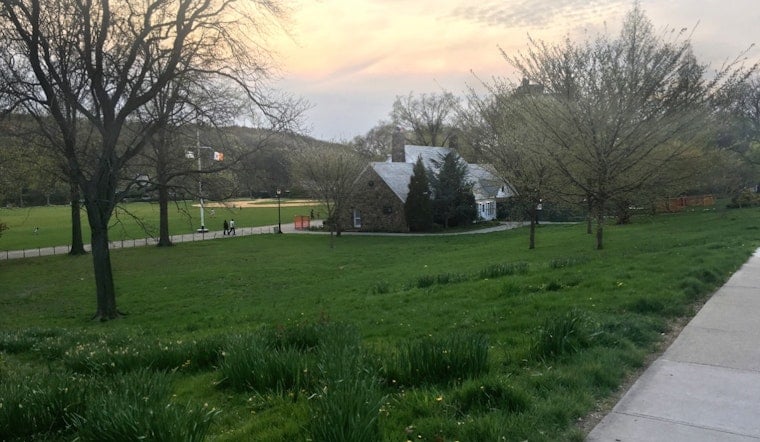
A whistleblower alleges that a broken sewer line beneath The Stone House, a wedding venue and steakhouse perched on Clove Lake in Staten Island's Clove Lakes Park, has been spewing raw human waste into the water for years — even as families paddle boats across it and kids cast fishing lines from its banks. The claims center on a city-owned building that has hosted the restaurant since 2014, and on a state investigation now examining whether sewage has been discharging into the lake undetected.
According to the New York Post, which first reported the whistleblower's account, the New York State Department of Environmental Conservation is investigating a potential sewage discharge into Clove Lakes Park. The state agency's involvement follows a dye test conducted by the city's Department of Environmental Protection this past Tuesday, in which glowing green dye — and, in a separate pour, red dye — was flushed down Stone House toilets and into the sewer main crossing the lake. Per the whistleblower, both colors of dye later emerged in Clove Lake itself, and the dye test revealed the sewer was contaminating the water.
The DEP has said lake management falls under the city's Parks Department, while characterizing the pollution problem itself as now a state issue. That jurisdictional split sits atop a messier paper trail: a 2022 licensing agreement for the restaurant included repairs to drainage structures, plumbing and utilities, and allocated $200,000 toward that work, with the operator required to fix two failing manholes within the first year. A July 2026 amendment to that licensing agreement reportedly stated that both the vendor and the Parks Department knew a sewer line had collapsed.
A Sewer Problem With a Two-Decade Paper Trail
The whistleblower says parkgoers have used the polluted lake for more than 20 years, and that the restaurant's plumbing troubles go back nearly that far. A plumber for the restaurant reportedly reported frequent pipe stoppages back in 2006, along with dishwasher blockages and mud pulled from the pipes at that time — details that, if accurate, suggest the sewer's problems predate the current controversy by two decades.
The Stone House's operator, Peter Botros, signed a lease agreement requiring him to fix the sewer line, according to the whistleblower's account. That same source alleges the vendor paid dramatically reduced rent in exchange for covering the repair work himself. Despite the alleged knowledge of a broken line, the restaurant continued to rent paddle boats to parkgoers on the lake, the whistleblower said — a detail underscoring the gap between what was reportedly known internally and what was disclosed to the public enjoying the water.
Fishing, Boating and an Unclear Test Record
Clove Lake is used for fishing and boating, drawing families and anglers to a lake system that CityNeighborhoods.NYC notes is the largest of three connected bodies of water in the 198-acre Clove Lakes Park, feeding into Martling Lake and then Brooks Lake via Clove Brook before eventually reaching the Kill Van Kull. The whistleblower did not mince words about what that means for lake users right now, saying kids are fishing and families are rowing boats through sewage.
Yet the actual public-health testing record remains murky. Clove Lake has an unclear testing status for bacteria related to human waste, and neither the DEC nor the DEP has provided fecal coliform test results for the lake, according to the Post's reporting. That gap leaves open the central question of how much bacterial contamination, if any, has been formally documented — even as the sewer was found likely collapsed at multiple points, per the whistleblower.
A Repair That Could Mean Draining the Lake
Fixing the underlying problem may not be simple. A lake repair would likely require completely draining the lake, according to a source cited in the reporting, though that same source said the fix could potentially use a dam instead of complete drainage. Either option points to a disruptive, costly undertaking for a lake that sits inside one of New York City's 51 designated Forever Wild Nature Preserves — a status that, as NYC Photo Journeys notes, marks the park's waters as among the city's most ecologically sensitive.
The Post's reporting also raises questions about past oversight. Lynda Ricciardone, former Staten Island Parks Department borough chief, allegedly knew about the polluted lake and took no action, according to a source, as did Joseph Homsey, her deputy and successor. The Post could not reach Ricciardone for comment, and the vendor, Homsey and the Parks Department did not respond to the outlet's requests for comment. The Post also notes that Parks Department toilets previously polluted a creek at Clove Lakes Park, according to a report from The New York Times.
Standard Rules for Vendors on City Parkland
Under typical NYC Parks Department concession license agreements, commercial vendors operating on parkland are required to secure all necessary DEC and DEP environmental permits and hold full responsibility for facility maintenance and utility repairs, according to archived NYC Parks and Ben Kallos records. That framework helps explain why the 2022 licensing agreement placed repair obligations, and reduced rent tied to those repairs, on the restaurant's operator rather than on the city directly — even as the DEC's investigation and the state's civil penalty structure under Environmental Conservation Law § 71-1929, which allows fines up to $37,500 per day for unauthorized discharges, place ultimate regulatory authority with the state.
The broader infrastructure challenge is substantial: according to a New York State Department of Environmental Conservation report, repairing, replacing and updating the state's municipal wastewater infrastructure is conservatively estimated to cost $36.2 billion over the next 20 years. The New York State Department of Environmental Conservation's New York Ocean Action Plan says aging sewage conveyance, wastewater-treatment and stormwater infrastructure supporting heavily developed areas is often overburdened during storms.
Clove Lakes Park has been the site of recent community advocacy before. In January 2025, city workers dismantled a controversial metal bridge fence along the Martling Avenue Bridge after backlash, restoring clear views and fishing access — a moment Hoodline covered in a piece on the fence's removal. The lake at the center of the current sewage allegations was originally created in 1825 when a mill dam was built on Clove Brook, with the surrounding valley later used for commercial ice harvesting before the city acquired the land for parkland in the 1920s, according to the Hidden Waters Blog.



