

























































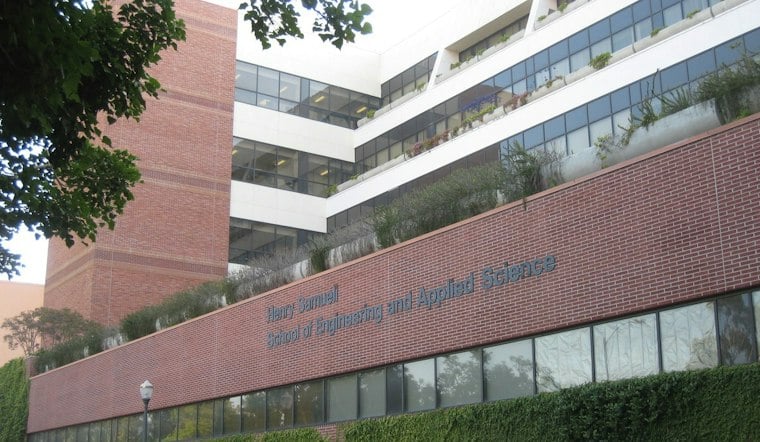
A 32-foot, 1,600-horsepower hydrogen race car that just rewrote the land-speed record books rolled into Westwood on Friday, parking itself amid UCLA students, engineering faculty and climate-tech founders for an afternoon dedicated to hydrogen's future. The JCB Hydromax, fresh off a provisional average of 406.320 mph at Utah's Bonneville Salt Flats, served as the centerpiece of “The Hydrogen Frontier: Engineering a Clean Energy Future,” a free public event held from 1 to 5 p.m. at UCLA Samueli School of Engineering.
The event was hosted by UCLA Samueli School of Engineering together with the Semel Healthy Campus Initiatives Center, and it drew together students and industry representatives for a look at how hydrogen-powered technology might address environmental challenges, shape business and contribute to a healthier planet, according to the school's event listing. Alongside the Hydromax, the showcase featured climate-tech company Mote, UCLA's BruinRacing teams and the university's Chem-E-Car organization, all part of an afternoon meant to connect engineering innovation with public health, as reported by the Los Angeles Daily News.
A Record Still Awaiting Official Sign-Off
The Hydromax's headline achievement happened weeks earlier in Utah, where British manufacturer JCB sent the car across Bonneville's flying kilometer at a provisional FIA average of 406.320 mph, according to Motor1. Wing Commander Andy Green, the driver behind the run, posted 400.623 mph on his first pass and 412.135 mph on his second, numbers that together set a new benchmark for hydrogen-powered vehicles. JCB's own promotional materials note the figure is subject to official ratification by the FIA, so the record remains provisional rather than finalized.
Under the hood — or rather, under that elongated aluminum shell — sit two production-based hydrogen internal combustion engines tuned to a combined 1,600 horsepower, per the same Motor1 report. The achievement eclipses the previous FIA-recognized hydrogen internal-combustion benchmark of 185.5 mph, set by the BMW H2R back in 2004, according to a statement carried by Business Wire. It also outran the 350.092-mph mark set by JCB's own diesel-powered Dieselmax, Motor1 notes, and bested a 368.347-mph average the Hydromax itself posted in an earlier warmup appearance at Bonneville Speed Week.
Two Decades After Dieselmax, JCB Returns to the Salt Flats
The Bonneville run marked something of a homecoming for the British construction and agricultural equipment manufacturer, which first chased land-speed glory there with Dieselmax in August 2006. The businesswire.com statement frames the Hydromax's record as JCB's return to the salt flats two decades later, this time swapping diesel for hydrogen. The FIA, in that same statement, described the achievement as showcasing the potential of hydrogen combustion for the future of sustainable mobility.
JCB has leaned on that framing in its broader messaging, arguing that while battery-electric power works for compact machines, it isn't practical for bigger equipment — which is why the company says it turned to hydrogen as an alternative, clean, zero-carbon fuel, according to the manufacturer's own sustainability materials. The Hydromax's cross-country tour, which brought the experimental race car to UCLA's Westwood campus on Friday, is built around that pitch to student engineers and the public alike.
Students and Startups Share the Spotlight
The Hydromax wasn't the only hydrogen story on display. Climate-tech company Mote joined the lineup to showcase its work developing technology to convert biomass waste into biohydrogen and permanently storable carbon dioxide, according to the UCLA Samueli event listing. UCLA's BruinRacing teams and the American Institute of Chemical Engineers' Chem-E-Car program also participated, giving student engineers a chance to present their own projects alongside the visiting record-setter.
Organizers built the afternoon around a video showcase, a panel discussion and Q&A, followed by vehicle demonstrations and a reception, per the school's published schedule. Beyond the speed and horsepower numbers, UCLA Samueli framed the event as a chance to explore connections between environmental conditions, food systems, brain health and overall well-being — tying the engineering showcase to the Semel center's public-health mission.
For the students involved, the afternoon offered a rare chance to stand next to a vehicle that had just rewritten hydrogen land-speed history while making the case that their own research, from biomass conversion to student-built race cars, fits into the same larger push toward cleaner transportation technology.





