

























































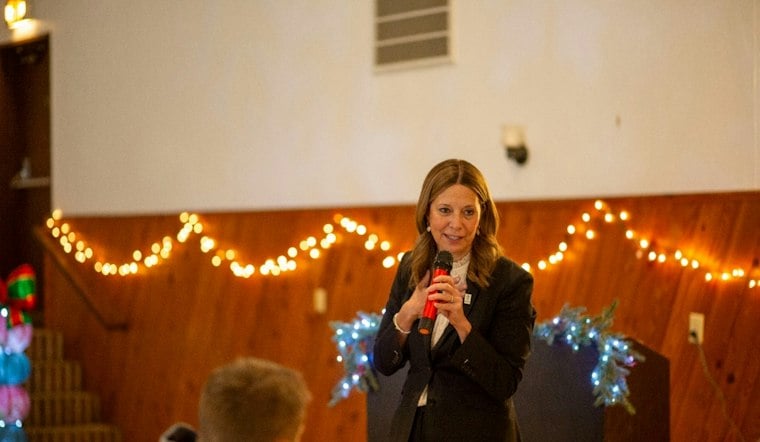
Amy Acton wants every public school kid in Ohio to eat breakfast and lunch for free, and she says the state can pay for it without raising taxes. The Democratic gubernatorial candidate said this week she would push to provide free school meals statewide if elected, reviving a debate that has simmered in Columbus since pandemic-era meal programs expired.
Acton is running against Republican entrepreneur Vivek Ramaswamy to replace term-limited Gov. Mike DeWine, according to The Columbus Dispatch, which first reported her proposal. All Ohio students received free meals for two years during the COVID-19 pandemic through federal funding, a benefit that disappeared once those emergency dollars dried up — leaving families to absorb cafeteria costs once again.
The price tag for making that benefit permanent isn't small. The Hunger-Free Schools Ohio coalition and the Ohio Department of Education and Workforce have estimated that universal free breakfast and lunch for all public K-12 students would cost between $300 million and $330 million annually, with breakfast alone running about $50 million a year, according to the Toledo Blade.
How Acton Says She'd Pay for It
Acton contends that cost can be covered by redirecting state dollars currently flowing into Ohio's expanded private school voucher program, per 10TV. Her argument is that voucher expansion has diverted public revenue into private school tuition, money she says would be better spent feeding kids in the state's public schools.
The proposal isn't a standalone idea — it's part of a broader working families platform aimed at easing cost-of-living pressures, which also includes an expanded state child tax credit and homestead property tax exemptions, the Statehouse News Bureau reports. Affordability has become a central theme for both candidates as the general election nears.
The Scale of Child Hunger in Ohio
The need behind Acton's proposal is substantial. Feeding America's 2026 Map the Meal Gap study, analyzing 2024 data, found that 20.1% of children in Ohio — more than 534,000 kids — face food insecurity, with hunger present in all 88 Ohio counties.
That pressure has intensified recently. Following federal cuts to the Supplemental Nutrition Assistance Program under H.R. 1 in July 2025, more than 50,000 children in Ohio lost access to SNAP benefits between July 2025 and May 2026, an 8.7% decline in child enrollment statewide, according to the Center for Community Solutions. Thirteen Ohio counties saw child SNAP participation drop by more than 10% in under a year.
Existing State Policy and Republican Pushback
Ohio already covers meal costs for a narrower group of students. Under the state's FY 2024–2025 budget bill, HB 33, signed in July 2023, Ohio reimburses schools $0.30 per breakfast and $0.40 per lunch to eliminate copays for students who qualify under federal reduced-price income guidelines, according to the Ohio Department of Education and Workforce.
Expanding that to every student, regardless of income, has run into resistance from Republican leadership. Ohio House Speaker Matt Huffman rejected calls to include universal free school meal funding in the state budget last year, arguing that parents who can afford meals should pay for them and citing concerns over cafeteria food waste, per the Statehouse News Bureau.
Ramaswamy's own education platform leans in a different direction, focusing on expanding private school voucher choice, merit-based teacher pay, and nutrition standards rather than state-funded universal meals, according to WOSU. That contrast surfaced again at a recent campaign town hall in Wauseon, where local school board leaders pressed Ramaswamy on how expanding private school vouchers affects funding for rural and suburban public school districts, the Toledo Blade reported. Public school officials in northwest Ohio have raised concerns over districts' reliance on local property tax levies as state voucher spending expands.
How Ohio Compares Nationally
Ohio wouldn't be breaking new ground if it adopted universal free meals — at least eight states, including California, Maine, Colorado, Massachusetts, Minnesota, New Mexico, Vermont, and Michigan, have already enacted permanent statewide universal free school meal programs, according to Newsweek. California was the first to adopt the policy permanently in 2022 after federal pandemic waivers expired.
Whether Ohio joins that list now rests on the outcome of a governor's race where school funding has become one more flashpoint in the larger fight over public dollars, private vouchers, and who gets to decide how kids are fed and educated across the state.





