

























































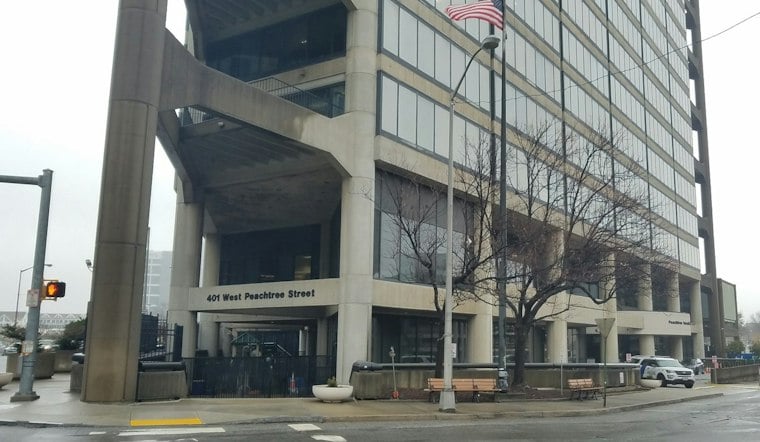
A courtroom at Atlanta's 401 West Peachtree immigration court built to seat only a couple dozen people had roughly 70 names on the docket one recent Tuesday morning, part of a nationwide shift toward what advocates call “mega master” hearings that are reshaping how immigration cases move through the system. Judges in the building are now working through dockets that can swell to nearly 100 people in a single sitting, a sharp jump from the 20 to 40 cases that used to be typical on an average day.
The shift is playing out for people like Isabel, a Lawrenceville home health aide who came to the United States from Nicaragua five years ago and is seeking asylum, according to WABE. She was told to return to court in one month with an attorney, but she says she needs $3,000 just to start securing legal representation and expects the full cost of her case to reach $12,000. Isabel fears she cannot return to Nicaragua if she is ordered deported, the outlet reports.
Finding a lawyer on that timeline is its own obstacle. The Georgia Asylum and Immigration Network is currently closed to new client intakes and has no realistic timeline for reopening, while Asian Americans Advancing Justice–Atlanta also cannot take on new clients right now, though the organization can still provide a list of trusted private attorneys. Groups like KIND and FIRC, which exclusively represent unaccompanied minors, were not relevant to the respondents at the West Peachtree hearings that morning. Having an attorney can more than double a person's chances of a judge granting immigration relief, per the same account.
Inside a Morning Docket Built for Speed
Sonia Otero, a paralegal with Asian Americans Advancing Justice–Atlanta who has tracked hearings for more than a year through the Court Watch program, observed a morning mega master session at the West Peachtree building. She said missing a number, missing a person, or misunderstanding a judge could lead to an immediate removal order. During the proceedings, Judge Amy Fairchild Haer instructed a Department of Homeland Security representative to file Form I-213, a DHS record used to document a deportable or inadmissible noncitizen and serve as a charging document, in several cases.
Respondents used Webex to connect with their attorneys during hearings, and unrepresented respondents received packets listing pro bono attorneys in the area. Those seeking more time to find lawyers were told to return to court on October 21, 2026. Missing a hearing altogether can lead to a removal order issued in absentia, meaning the case is decided without the person present. Judge Fairchild Haer also rescheduled one respondent's hearing after a filing fee went unpaid, and moved a juvenile case because those cases are heard at the Ted Turner Drive courthouse. At one point, a security guard said the hallway needed to remain clear.
Advocates Say the Pace Threatens Due Process
Vanessa Dojaquez-Torres said many people appearing in mega master hearings may lack attorneys or proper notice, and that people may not be prepared while courtrooms lack sufficient seats. Gregory Chen said mega master hearings erode fair legal process and argued that legal rights should not be decided by what he described as mass hand-raising exercises. Advocates broadly worry that rapidly processing large numbers of people will lead to more removal orders, with some describing the hearings as an assembly line rushing people into a mass deportation process.
Immigration courts are part of the Department of Justice, which sits under the executive branch and holds the authority to hire and fire immigration judges. The Department of Justice has said it is restoring integrity to the immigration system by hearing cases fairly, expeditiously, and uniformly, while the Executive Office for Immigration Review has said unnecessary delay harms people with meritorious claims and the public seeking removal of cases lacking merit. EOIR has said it is adding new immigration judges and will make scheduling adjustments to handle cases in a timely and lawful manner.
A Pattern Beyond Atlanta
The Trump administration has pushed deportation numbers to record levels as immigration courts nationwide increase the size and speed of their dockets, with mega master calendar hearings — groups of nearly 100 people appearing before a single judge for administrative check-ins — increasingly noticed by advocates since May 2026. In Chicago, courts began holding similar hearings that spring, cramming between 100 and 185 people into a single judge's morning call, up from an average of about 30 beforehand, according to WBEZ. One Chicago courtroom nicknamed for its tight quarters seats only about 25 people but had 143 called in on a single morning.
The station's analysis, drawing on EOIR data reviewed by Mobile Pathways, found that 58% of the 10,370 people assigned hearings in Chicago in June were ruled absent. Nationally, about 60% of immigrants called to court in June still showed up, down from 78% the previous October, the report found. Median notice time for Chicago hearings fell to just 34 days in June, down from 229 days in May, and EOIR told the outlet that as it continues adding new immigration judges, it will keep making scheduling adjustments intended to clear backlogs.
Separately, federal data from the Executive Office for Immigration Review show the stakes of who ends up deciding these cases. A total of 279 immigration judges were fired or resigned during fiscal years 2025 and 2026, according to TRAC Reports, even as 192 new judges and 53 temporary judges joined the bench this year. Nationally, the asylum grant rate had fallen to 5.5% by June 2026 while the denial rate climbed to 94.1%, TRAC found, with asylum case completions topping 14,000 in both March and June after the hiring surge.
Public Access and Oversight Questions
Court monitoring itself has become a flashpoint in Georgia. The Georgia Asylum and Immigration Network launched its Court Watch program in 2024 so attorneys and advocates in the South could track trends in immigration judges' bond decisions, according to WABE. The group said its volunteers were barred from virtual bond hearings at the end of February, after it shared information with a federal court about a sudden increase in negative outcomes for immigrants at the Stewart Immigration Court in Lumpkin, Georgia.
A spokesperson for EOIR said observers remain able to attend immigration court hearings in person, and GAIN legal director Adriana Heffley stressed that the hearings are open to the public by law. GAIN's court watchers previously documented stark swings in judicial behavior: as reported by WABE, Alizeh Sheikh said that in February, one judge began denying 100% of cases while another judge's denial rate jumped from 26% to 80%. The volunteers had been trained to log details like an immigrant's country of origin, case factors, and bond outcomes and amounts as part of the broader monitoring effort.





