

























































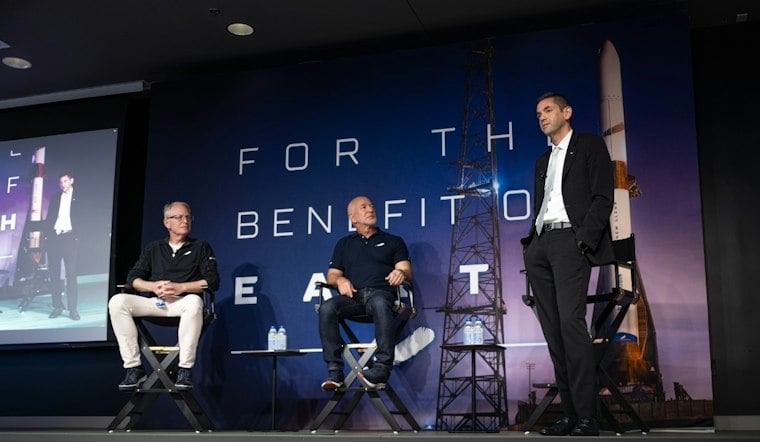
For the first time in its 26-year history, Blue Origin is taking money from investors outside founder Jeff Bezos — and CEO Dave Limp says the interest has been intense. Limp said the company's first-ever outside capital raise is oversubscribed but still has not officially closed, a striking shift for a rocket company that, until now, had been bankrolled entirely by the Amazon founder.
Limp made the comments as Blue Origin works to rebuild a launch pad that was heavily damaged earlier this year, according to CNBC. He described bringing in outside investors as a significant shift for the company as it looks to expand operations and bring new technologies online. Limp did not confirm final figures for the round, even as outside reports have circulated specific numbers.
Those reports diverge. A Yahoo Finance report put the raise at $10 billion at a roughly $140 billion valuation, matching a Wall Street Journal figure cited by CNBC, while a separate account carried by The Globe and Mail described the financing as valuing the company at $130 billion instead. Bezos himself is putting in a fresh $2 billion of his own money alongside the new outside capital, and additional commitments could still grow the round further, according to the same Yahoo Finance report.
Rebuilding After a Launch Pad Explosion
The funding push comes as Blue Origin works to recover from a rough stretch for its New Glenn rocket. New Glenn reached orbit on its debut flight in 2025 and landed its booster successfully on its second mission that same year, but its third mission in April delivered mixed results: the booster landed again, but an AST SpaceMobile satellite was deployed into the wrong orbit and ultimately lost, per CNBC.
Then, on May 28, a hot-fire anomaly destroyed the test vehicle and damaged Launch Complex 36 in Florida, according to the same Yahoo Finance article. Blue Origin is now repairing that damage around the clock, and Limp told CNBC that roughly 1,000 people are working the pad in shifts — 500 during the day and 500 at night. The company's stated plan is still to return New Glenn to flight before the end of 2026, though a firm launch date has not been set.
A Bigger Vision for Cape Canaveral
Blue Origin is also pressing regulators to let it fly far more often. The company is seeking FAA approval to raise its licensed New Glenn launch rate at Launch Complex 36 from 12 flights a year to 50, according to Florida Today. Limp told the outlet that Cape Canaveral currently sees about 100 flights a year across all operators, but predicted that number would eventually climb to 1,000, and then to 10,000. CNBC separately reported that Blue Origin's broader ambition is a launch cadence that ramps from hundreds to thousands of missions per year.
To free up resources for those larger programs, Blue Origin paused its New Shepard tourist flights this year, the Yahoo Finance report noted. The company currently employs about 15,000 people as it chases what Limp described to CNBC as a 100-year vision: building an economy in space and eventually moving heavy industry off Earth.
Two Satellite Projects and an Orbital Data Center Bet
Alongside the funding and launch-pad news, Blue Origin has unveiled two satellite constellation plans central to that vision. TeraWave, disclosed as a planned communications service for enterprise, data center and government customers, would involve more than 5,400 satellites in low Earth orbit. Project Sunrise, disclosed in March 2026, envisions roughly 56,000 satellites capable of handling artificial intelligence computing directly from space, according to CNBC.
The company plans to deploy heavy orbital data centers into sun-synchronous orbit using New Glenn rockets, where solar power would provide a constant energy source, and connect those data centers into TeraWave to send results back down to Earth — an arrangement Blue Origin describes as enabling access to effectively infinite compute. TechCrunch has reported that outside experts believe such orbital data-center projects are unlikely to become operational until the 2030s.
Blue Origin is not alone in chasing that bet. SpaceX has filed for permission to launch a million satellites for use as a distributed data center, while Starcloud has proposed a network of 60,000 spacecraft to the FCC for space-based computing, according to TechCrunch. SpaceX also completed a historic initial public offering in June 2026, a milestone CNBC says has helped fuel wider investor enthusiasm for space companies this year.
Why Outside Money Now
Limp told CNBC that having an external company valuation helps employees understand what Blue Origin is actually worth, framing the funding round partly as a tool for attracting and retaining talent as the company competes for engineers in a crowded space industry. That framing underscores the stakes of the still-unclosed round: Blue Origin is betting that outside capital, not just Bezos's checkbook, will carry it through its next phase of growth.



