

























































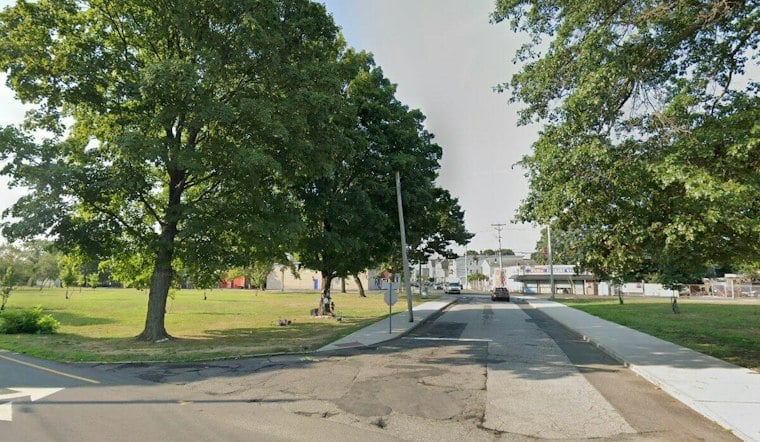
A rotating aluminum sculpture honoring Gustave Whitehead, the Bridgeport man some say beat the Wright brothers into the sky, is once again spinning above the intersection of Fairfield Avenue and State Street Extension in the city's West End. The artwork had been missing from its perch for an estimated three to four years, stored away in a municipal warehouse while the granite fountain beneath it sat broken and forgotten.
The sculpture returned to display in late summer 2026, according to Connecticut Post, which reported that Bridgeport first installed the elevated piece in 2012, depicting Whitehead's bird-like experimental airship above a granite fountain. The sculpture's base carries an inscription that reads simply, first in flight, Gustave Whitehead. At the time of the original installation, then-Mayor Bill Finch said the city intended to “set the record straight” about Whitehead's place in aviation history.
City maintenance supervisor Luis Burgos told the paper the sculpture had long been taken down every winter for its own protection, since its light-gauge aluminum and stainless steel construction cannot withstand snow loads. About three years before publication, the sculpture was damaged while in storage and took roughly a year to repair. Burgos attributed the extended delay in returning it to display to maintenance staffing and workload, the same account notes.
A Documentary Crew Reignites Local Interest
The renewed push to get the sculpture back on its pedestal traces partly to a film crew that came to Bridgeport over the summer to shoot a documentary on Whitehead, which rekindled interest in restoring the replica to its West End location. Resident Eve Parsons, who estimated the sculpture had been down for at least three to four years, joined fellow residents Galen Murray and Nicole Nelson in urging Mayor Joe Ganim's administration to address the monument and its appearance. Parsons said Bridgeport's main entrance needs beautification, framing the sculpture's return as part of a broader civic facelift.
Sculptor Russell Bledsoe said back in 2012 that the piece was intended to attract attention and prompt people to learn about Whitehead, a goal that still animates supporters more than a decade later. Murray described the sculpture's return as a good interim step and said the symbolism could help local youth take pride in their origins and dream big, the Connecticut Post reported.
The Fountain Below Remains Broken
While the sculpture itself is spinning again, the fountain beneath it remains inoperative, often filled with dirty rainwater and litter rather than water. The fountain's plumbing was vandalized and destroyed at some point, and its control box was damaged in a separate vehicle accident, while the granite surrounding the fountain bowl was damaged in yet another crash. Murray called the fountain discussion unresolved because of public facilities' financial limits, according to the same report, and Parsons said she wants additional improvements at the intersection beyond simply returning the sculpture.
Why Bridgeport Keeps Fighting for Whitehead
Whitehead, a former Bridgeport resident, has long been credited by local boosters with aeronautic trailblazing, though the claim that he flew before the Wright brothers remains disputed. The Wright brothers made their celebrated flight in December 1903, and Bridgeport chose to honor Whitehead in 2012 despite the dispute over his claimed early flight. The foundational claim rests on an August 18, 1901 report in the Bridgeport Sunday Herald, which said Whitehead flew his No. 21 monoplane half a mile at 50 feet over Fairfield on August 14, 1901 — an account HistoryNet notes mainstream historians remain divided on, since no clear photographs of the aircraft in flight accompanied the story.
That local pride eventually reached the state capitol. In June 2013, Connecticut Governor Dannel Malloy signed House Bill 6671 into law, revising state statute to recognize Whitehead instead of the Wright brothers on the state's official Powered Flight Day, according to FLYING Magazine. The move drew momentum from a March 2013 foreword by Paul Jackson, editor-in-chief of Jane's All the World's Aircraft, who endorsed researcher John Brown's findings and declared that Whitehead flew two years before the Wright brothers, as Smithsonian Magazine reported; Jane's corporate publisher later issued qualifications about the editor's personal foreword in 2015.
Connecticut's legislative move did not go unanswered. Both the Ohio and North Carolina state legislatures introduced and passed formal resolutions repudiating Connecticut's claims and reaffirming the Wright brothers as the true pioneers of powered flight, with lawmakers from both states holding joint announcements to defend their respective First in Flight and Birthplace of Aviation claims, according to the CT Mirror. The Smithsonian Institution, meanwhile, remains bound by a 1948 agreement with the estate of Orville Wright that requires the museum to identify the 1903 Wright Flyer as the first controlled powered aircraft or risk forfeiting ownership of the artifact, a contract that National Geographic traces back to earlier disputes between the Wright family and the Smithsonian over Samuel Langley's Aerodrome.
Orville Wright himself pushed back on Whitehead's claims decades earlier. In 1945, Wright published a rebuttal titled The Mythical Whitehead Flight in U.S. Air Services Magazine, arguing that key witnesses cited in the 1901 news reports had later signed affidavits denying they saw the flight, according to the Yankee Institute. Whitehead died in 1927 and is buried at Lakeview Cemetery in Bridgeport, where local supporters added a new headstone in 2014 explicitly reading First in Flight - 1901, per Patch.
Local educator and pilot Andy Kosch tried to settle the aerodynamic question himself, building a full-scale replica of Whitehead's Condor No. 21 monoplane and successfully flying it in December 1986 at Sikorsky Memorial Airport near Bridgeport, according to Car Talk. The 1901 Condor No. 21 was designed with roadable folding wings and twin engines meant for ground travel to launch sites, a sharp contrast to the Wright brothers' 1903 Flyer and its fixed biplane wings and launch rail, Business Insider has reported. More recently, Bridgeport and Fairfield officials held a joint 2017 ceremony declaring August 14 as official Gustave Whitehead Day alongside Whitehead's descendants and aviation advocates, with Mayor Joe Ganim and then-Fairfield First Selectman Mike Tetreau taking part in the dedication at Jennings Beach.
For now, the sculpture's return gives West End residents something tangible back on their skyline, even as the fountain underneath waits for funding and the century-old aviation dispute shows no sign of resolving.





