

























































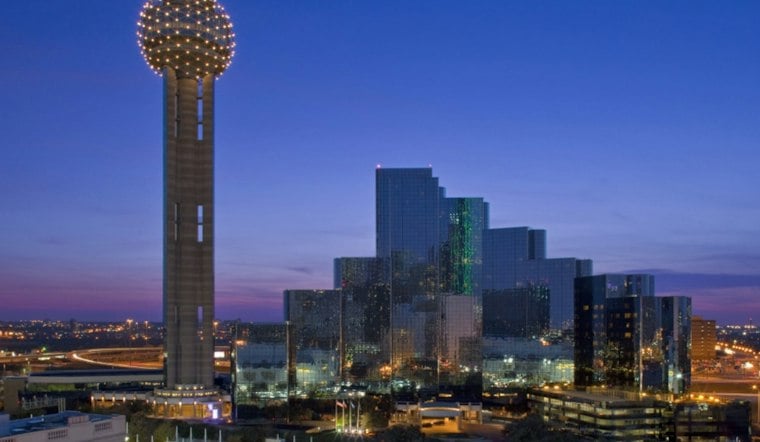
A Dallas startup has quietly slipped computing equipment into the guts of the Hyatt Regency Dallas at Reunion Tower, using the heat those servers throw off to help warm the hotel's water instead of letting it go to waste. The company, WATTER, announced the live deployment on October 13, 2026, calling it the first stop in a commercial rollout that it says will eventually span three sites.
According to finance.yahoo.com, the system hosts AI computing inside the hotel itself and captures server waste heat for reuse in the property's domestic hot-water system. The same report notes the Hyatt Regency Dallas deployment is the first of three planned sites, and that WATTER already has a pipeline of more than 200 hotel properties across two ownership groups lined up behind it. Who those properties are, or when they might come online, has not been disclosed, per the Dallas Express.
How The Heat Gets Reused
Hunter Hunt, who serves as president, CEO and chairman of Hunt Energy Company and Hunt Oil Company, said the installation uses waste heat from distributed compute to pre-heat water going into a boiler, and that doing so lowers natural gas consumption and cost at Reunion, per the same account relayed by finance.yahoo.com. Hunt also said the setup reduces some of the infrastructure demands typically associated with a traditional data center. WATTER's broader pitch is that the arrangement lets property owners offset water-heating costs while opening up a new source of revenue, though no figures on actual savings or payouts at the Hyatt have been made public.
WATTER co-founder and CEO James Hancock framed the strategy simply: a hotel, he said, can be viewed as infrastructure hiding in plain sight. The idea is to place AI computing systems inside existing buildings that already have available electrical capacity and steady hot-water demand, rather than building a dedicated data center from scratch. That distributed model, the company says, spreads computing equipment across buildings like hotels instead of concentrating it inside a single purpose-built hyperscale campus.
Who Owns The Building
The Hyatt Regency Dallas, which has 1,120 rooms and is managed by Hyatt Corporation, sits on a site owned by Hunt-Reunion, Inc., a subsidiary of Hunt Realty Investments, according to huntrealty.com. That same entity also owns the neighboring Reunion Tower. WATTER itself traces back to that same corporate family: founded in 2024 and based in Dallas, it is a spinout of Hunt Innovative Technologies, part of the Hunt Energy organization.
The company's funding history runs through familiar names, too. WATTER emerged from stealth with a $5 million seed round, led by Hunt Innovative Technologies and Dallas-based 17Shoals Inc., according to Dallas Innovates. Hancock, who leads the company, previously worked as a NASA data scientist and founded Parasanti, per the outlet's reporting.
A Grid Under Scrutiny
The Hyatt announcement lands as Texas grid operators are taking a harder look at the appetite of large-scale computing. The Electric Reliability Council of Texas has issued a request for information to developers of data centers rated at least 25 megawatts that are pursuing interconnection to the ERCOT system, according to ercot.com. The request seeks details on those projects' dependence on grid power, their use of on-site generation, any public financial assistance or tax benefits received, and their water sources and consumption. ERCOT says it plans to work with the Public Utility Commission of Texas to analyze the responses and publish a report by December 10, 2026.
Whether the Hyatt installation factors into that review at all is not established by WATTER's announcement, and the company has not said whether the deployment reaches the 25-megawatt threshold that triggered ERCOT's inquiry. What is clear is that WATTER's entire pitch runs counter to the hyperscale model drawing that scrutiny in the first place — distributing smaller computing loads into buildings that already exist, rather than concentrating demand in massive new campuses built solely to run servers.
What Remains Unknown
For all the detail in WATTER's rollout announcement, several basic numbers are missing. The company has not disclosed the Hyatt deployment's computing capacity, its electricity draw, what the installation cost, any measured natural-gas savings, how much revenue the hotel's owners might see, or who is actually buying the AI computing capacity running inside the building. Those gaps leave the claimed gas and cost savings resting on Hunt's own account rather than independently measured results.
For context on what waste-heat recovery can theoretically deliver in a hotel setting, a separate simulation study of a 100-bed hotel in Tabriz estimated annual natural-gas savings of roughly 6,700 to 8,333 cubic meters and carbon-dioxide reductions of 12.7 to 15.8 tons per year, according to sciencedirect.com. That research, conducted in a different city on a different hotel entirely, offers a rough sense of scale rather than any prediction for what the Hyatt Regency Dallas might actually save.





