

























































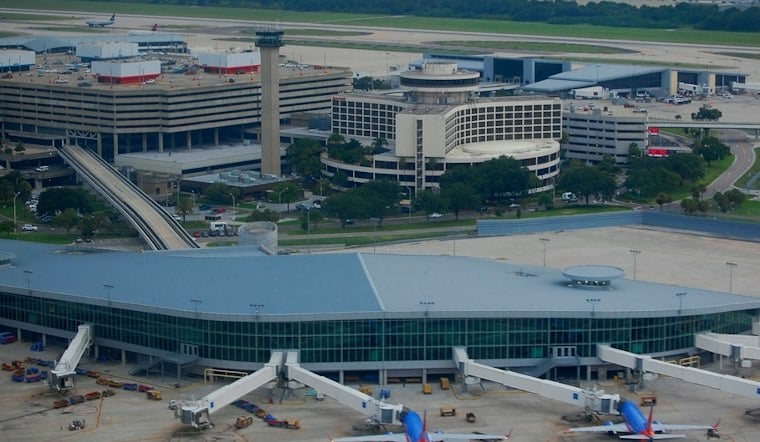
FlyUSA has opened a 50,000-square-foot hangar and private owners-only lounge on the north side of Tampa International Airport, a facility large enough to fit roughly 20 light, midsize, and heavy jets and equipped with a specialized tail door built to handle aircraft up to the size of a Boeing 737. The new hub now houses 20 of the company's 30 regional aircraft and supports about 30 employees, marking a deliberate break from the airport's two existing fixed-base operators.
According to a PR Newswire release detailing the opening, FlyUSA built direct fueling and aircraft ground-movement capabilities specifically for the Tampa location, meaning its own employees now fuel and move aircraft based at the facility rather than relying on outside handlers. Charter clients still arrive and depart through traditional FBO facilities, but FlyUSA says it handles ground services directly during high-volume periods such as holiday weekends. Previously, general aviation traffic at Tampa International ran exclusively through Signature Flight Support and Sheltair Aviation, both on the airport's southeast side near International Plaza.
An Owners-Only Lounge and a Career Ladder for Line Crews
The hangar's lounge is reserved exclusively for FlyUSA aircraft owners and includes individual owner lockers and a conference room, the release notes. CEO Barry Shevlin said the setup prioritizes FlyUSA's owners and keeps the facility running more smoothly than a shared arrangement would allow. Shevlin added that the company now offers line-team members a career path toward becoming FlyUSA pilots or maintenance technicians, something he said isn't available at a standard FBO and helps the company compete for talent.
Shevlin said he expects the hangar-and-lounge combination to become a blueprint FlyUSA replicates in other markets, and that the facility's size should help the company expand into managing larger aircraft simply because it has room for them. The Tampa hangar is described as one of the region's only corporate facilities able to accommodate a Gulfstream G700 or Bombardier Global 7500, two of the largest business jets flying today.
Fleet Growth Outpacing Hangar Space Nationwide
FlyUSA said the Tampa expansion was built to address capacity constraints caused by its growing regional fleet, and the company isn't alone in feeling the squeeze. Hangar developer Sky Harbour has reported that construction nationally has not kept pace with growth in the private aircraft fleet, leaving some markets with long waits for suitable space, and Shevlin said the shortage is especially acute for buyers of newest ultra-long-range aircraft like the G700, since those jets simply do not fit in most hangars built more than five years ago.
That squeeze shows up in the numbers. Paramount Business Jets reported that 2026 private jet activity was driven by an 11.5% surge in fractional ownership departures while traditional corporate flight departments contracted by 8.9%. The industry also faces capacity constraints. Global business jet departures hit 1.95 million in the first half of 2026, up 4% year-over-year, with North America accounting for nearly 72% of that activity, according to Paramount Business Jets, citing WINGX.
A Company Scaling Fast, With Legal Friction Behind the Growth
FlyUSA, co-founded in 2020 by Shevlin and President William Holtz, generated nearly $80 million in annual revenue, employed 100 people, and ranked at No. 45 on the 2025 Inc. 5000 list of fastest-growing U.S. companies, per South Florida Business & Wealth. Before private aviation, Shevlin built Tampa-based IT services firm Vology from $1 million to $175 million in annual revenue before selling it to private equity in 2019, the same outlet reports. The Tampa opening marks FlyUSA's third consecutive appearance on the Inc. 5000, and the company has set a long-term goal of managing 100 aircraft and reaching $500 million in annual revenue by 2032.
The rapid growth hasn't come without friction. A former charter broker filed suit against FlyUSA and Shevlin in Pinellas County Circuit Court in August 2026, alleging wrongful termination and a deliberate effort to squeeze out minority shareholders and withhold equity payouts, according to the Tampa Bay Business Journal. The newspaper described the August case as a second lawsuit, following an earlier dispute involving a company founder.
A Multi-Airport Footprint Across Pinellas and Hillsborough
Beyond Tampa International, FlyUSA operates as the exclusive FBO at Clearwater Executive Airport, where it broke ground in July 2026 on a $13.7 million, two-story, 18,000-square-foot terminal that will eventually house its corporate headquarters and a flight simulator, replacing a temporary double-wide trailer installed in 2004, per WUSF. A single facilities management team now supports both the Tampa and Clearwater sites, and the company holds a ground lease in Lakeland, Florida, where it plans to bring online another 50,000-square-foot hangar in late 2028 or early 2029, likely for longer heavy-maintenance checks, while Tampa remains FlyUSA's primary maintenance and owner base.
Clearwater Executive Airport sits at 71 feet above sea level, making it the only public-use airport in Pinellas County located entirely outside a designated flood zone, a geographic quirk that positions it as a storm-resilient operational base.
Competing Hangar Projects Across Florida's Crowded Market
Florida's business-aviation market includes rival FBOs such as Sheltair Aviation at Tampa International Airport.





