

























































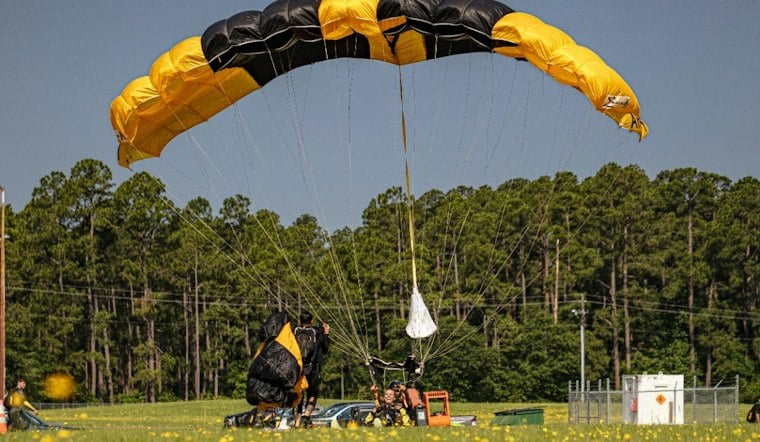
A highly decorated Army special operations soldier based at Fort Bragg has died from injuries suffered during an airborne training exercise in Nevada. Sgt. 1st Class Andrew Frakes, 34, was killed on September 22, 2026, after the incident, which remains under investigation.
A Career That Took an Unusual Turn
Frakes was a North Carolina resident assigned to U.S. Army Special Operations Command, which is based at Fort Bragg, according to The Charlotte Observer. Fort Bragg sits roughly 75 miles southwest of downtown Raleigh, per the same report, and officials there confirmed Frakes was killed in a training accident but have not released specifics of what went wrong. An investigation into the incident is underway, the base said.
Born in Georgia and an Eagle Scout, Frakes was accepted to the U.S. Military Academy at West Point in 2011, following in the footsteps of his father Mark Frakes, a 1982 West Point graduate, according to the Globe Gazette. He graduated from West Point in 2015 and went on to serve as an officer in the 10th Mountain Division before making an uncommon career move: resigning his officer commission to enlist in the 75th Ranger Regiment, as reported by Military Times. He went on to complete Assessment & Selection and the Operator Training Course in 2023, officially joining Special Operations Command that same year.
Decorations and Deployments
Per the Observer's report, Frakes served in 1st Battalion, 75th Ranger Regiment, and deployed to the Middle East and Africa during his career. He was recognized as a freefall parachutist and freefall jumpmaster, earning the Military Freefall Parachutist Badge, the Military Freefall Jumpmaster Badge, the Ranger Tab, the Pathfinder Badge, the Master Combat Infantryman Badge, and the Air Assault Badge, among other credentials cited by the Observer.
His decorations also included Combat C Devices, campaign medals from Afghanistan and Operation Inherent Resolve, the Afghanistan Campaign Medal with one bronze service star, and the Inherent Resolve Campaign Medal with two bronze service stars, the outlet reported. Frakes left behind a child, with a second due in March, the Observer noted.
Command Pays Tribute
Lawrence Gil Ferguson, commanding general of U.S. Army Special Operations Command, said Frakes represented the finest qualities of the nation's special operations forces, according to the Observer. Ferguson said Frakes performed at the highest echelons of the military and added that his loss is felt deeply across the special operations community.
U.S. Army Special Operations Command officially identified Frakes in a release issued through DVIDS on Sept. 26, confirming he died following the Nevada airborne training event. Official investigations into the jump remain active under USASOC oversight, and the command has not released additional details about what happened.
A Pattern of Training Risk
Frakes' death adds to a sobering body of data on the risks tied to military airborne training. Preliminary loss reports from the U.S. Army Combat Readiness Center indicate the Army has averaged roughly one soldier fatality per year from military parachuting mishaps since fiscal year 2019, according to Army Safety data. A Government Accountability Office report released in November 2024 found that nearly 90 percent of reported training accidents across all severity classes involving Special Operations Forces between fiscal years 2012 and 2022 occurred within the United States, underscoring how much risk is embedded in domestic training rather than combat deployments.
Other recent Army investigations point to how procedural failures can turn routine jumps fatal. A safety investigation into the September 2024 death of 82nd Airborne Division Spc. Matthew Perez determined that an improperly tied main parachute knot and missed jumpmaster checks directly caused the accident, according to Task & Purpose. Department of Defense casualty data published by Army University Press found that between 2006 and 2021, 76 percent of U.S. military fatalities occurred during non-overseas contingency operations, with training and non-combat accidents representing 32 percent of all deaths.
Military freefall jumps, in particular, carry elevated technical risk compared with traditional static-line airborne insertions. After a surge in freefall skydiving fatalities among special operations personnel, U.S. Special Operations Command instituted a mandatory three-month pause on all freefall jumping in late 2015 to overhaul doctrine, equipment, and jumpmaster re-qualification standards, Task & Purpose has reported. More recently, the 75th Ranger Regiment has collaborated with military research institutes to test instrumented mouthguards during freefall and parachute landing falls, aiming to measure head impact forces and improve safety protocols, according to Army University Press.
Fort Bragg's Name, and a String of Losses
Fort Bragg was officially renamed Fort Liberty in June 2023 under a federal mandate before Defense Secretary Pete Hegseth ordered the post reverted back to Fort Bragg in early 2025 to honor World War II Silver Star recipient Army Pfc. Roland L. Bragg. The installation has been at the center of several recent Hoodline reports on service members' deaths, including a training death tied to the base in June and a Fayetteville highway crash that killed a 26-year-old soldier in August.
Frakes' death also follows a separate case reported by Hoodline in September, in which a Spring Lake widow grieved after her husband became a local casualty tied to conflict with Iran. As of this report, Fort Bragg has not released further specifics on the Nevada training accident, and the investigation into Frakes' death remains ongoing.



