

























































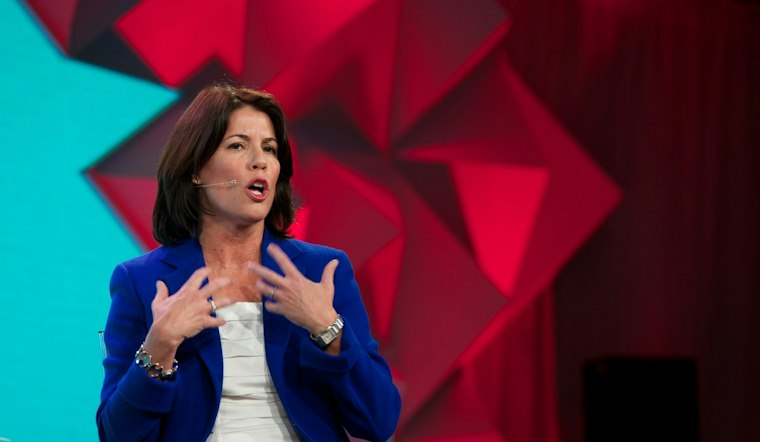
Rhode Island's governor's race looked all but settled after Helena Foulkes crushed incumbent Dan McKee in September's Democratic primary. But with early voting set to begin Wednesday, a new poll shows independent Ken Block still has a pulse, trailing Foulkes by nine points in a race that suddenly looks more competitive than many expected.
The Emerson College/WPRI poll of 800 likely voters found Foulkes leading Block 44 percent to 35 percent, according to The Boston Globe. Republican Aaron Guckian trailed far behind at 10 percent, while 9 percent of voters remained undecided. Among voters who said they were leaning toward a candidate, Foulkes held a wider advantage over Block, 48 percent to 38 percent, per the same poll.
Foulkes enters the general election fresh off a lopsided primary win. She spent $6 million to defeat McKee, ultimately beating him by 25 points in a contest shaped largely by voter fury over the prolonged closure of the I-195 Washington Bridge in Providence — the same discontent that, as The Guardian reported, made McKee the first sitting Rhode Island governor to lose a primary since 1994. McKee had tried to attack Foulkes over her record on opioids during her time as a CVS executive, but it wasn't enough to save him.
A Governor's Race Suddenly Worth Watching
Pollster Joe Fleming told the Globe that a head-to-head race would look very different, but with Guckian still in the mix, Block needs to pull votes away from Foulkes rather than simply consolidating the opposition. Fleming said he doesn't expect Guckian's support to collapse significantly before November 3, which keeps the race a genuine three-way contest down the stretch.
That dynamic has put real pressure on Guckian, even as his campaign has struggled financially. As of October 5, Guckian's campaign reported less than $7,300 on hand, according to the Globe's reporting — a stark contrast to his two wealthier rivals. Guckian, a former special assistant to Governor Donald Carcieri and former executive director of the Rhode Island Dental Association, won the GOP nomination with 50.6 percent of the primary vote on a platform of state spending restraint. He has resisted pressure from fellow Republicans to drop out and clear the way for Block.
Both Foulkes and Block are millionaires, and both campaigns list more than $3 million in outstanding personal loans, the Globe reported. Foulkes and her allies plan to direct hundreds of thousands of dollars toward television and mail attacks against Block in the campaign's final stretch.
Favorability Gap Could Define the Finish
Despite trailing in the horse race, Block actually polls better on favorability. The Emerson/WPRI survey found 46 percent of voters view him favorably versus 19 percent unfavorably, with 26 percent neutral. Foulkes, by contrast, is viewed favorably by 38 percent and unfavorably by 39 percent, with 20 percent neutral — a split verdict that suggests her primary victory hasn't fully translated into general-election goodwill.
Block, who has run for governor twice before, received 6.5 percent of the vote as the Moderate Party candidate in Rhode Island's 2010 race — the last time an independent won the governorship, when Lincoln Chafee claimed the office with 36.1 percent in a four-way contest, according to Ballotpedia. Block also lost the 2014 Republican primary to Allan Fung. In April, he described his current momentum as something new, saying, “I am experiencing politics for the first time with momentum.”
Block also carries a national profile from his post-2020 election work. He was hired by Donald Trump's presidential campaign to evaluate voter fraud claims after the 2020 election, ultimately determining there was no evidence of fraud that would have changed the outcome — findings he later laid out in his 2024 book Disproven, according to The Washington Post.
What's Driving Voters to the Polls
Taxes and state spending topped voters' list of concerns heading into 2027, cited by 20 percent of respondents in the Emerson/WPRI poll. Housing costs followed at 17 percent, electric and utility bills at 16 percent, and jobs and the economy at 14 percent. Those pocketbook concerns have loomed over a race already shaped by infrastructure anger, including frustration over Rhode Island's roads — a September report from the Rhode Island Public Expenditure Council found 48 percent of the state's urban principal arterial road miles were rated in poor condition in 2024, the worst share in the nation, as Hoodline reported in its coverage of the truck toll debate.
Early voting and mail ballots are expected to account for more than 20 percent of the total vote this cycle. In-person early voting officially opens Wednesday, 20 days ahead of the November 3 election, allowing registered voters to cast ballots at local municipal boards of canvassers using electronic pollbooks, per the Rhode Island Board of Elections. Rhode Island Secretary of State Gregg Amore announced Monday that election officials had tested and sealed more than 600 voting machines and trained over 2,200 poll workers statewide, according to Rhode Island Current.
Jasjit Gotra and Christopher Reynolds, two other candidates in the race, are polling in the low single digits, leaving the contest as effectively a three-way fight among Foulkes, Block, and Guckian. With undecided voters still in play and Guckian unlikely to fold, the next three weeks of television ads and ground-game spending could decide whether Rhode Island elects its first independent governor since Chafee or hands Foulkes the office Democrats fought hard to reclaim.





