

























































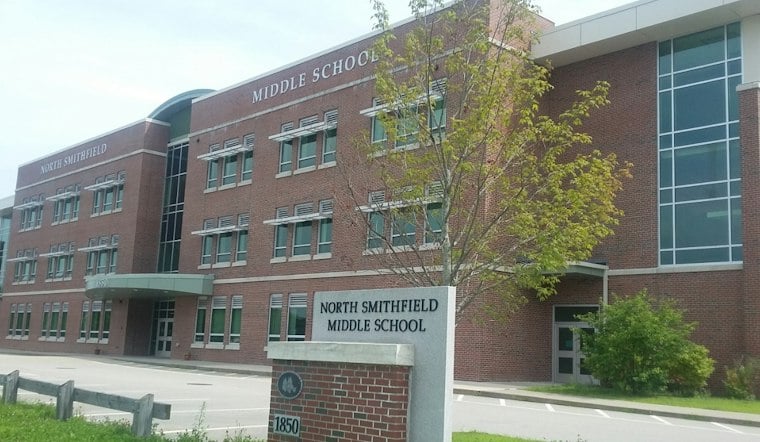
North Smithfield Public Schools is moving forward with a permanent fix for PFAS contamination found in one of two wells that supply drinking water to the high school and middle school campus, after years of elevated readings in a well that draws from ground near the artificial-turf football field. The proposed system would install three carbon filters inside the campus pumphouse, but officials still can't say for certain what's putting the so-called forever chemicals into the water in the first place.
Two Wells, Two Very Different Readings
The campus relies on two wells, and the difference between them has driven the entire remediation effort. According to upriseri.com, Well 1 has tested consistently low, between zero and three parts per trillion of PFAS, while Well 2 has typically measured between 30 and 60 parts per trillion, with one reading topping 80. Since 2023, the district has blended water from both wells to keep what actually reaches students and staff below Rhode Island's 20-parts-per-trillion limit, the same outlet reports.
That blending strategy has worked so far. The The Valley Breeze previously reported the school drinking-water entry point measured 14.6 parts per trillion, comfortably under the state compliance standard. But it's an interim measure, not a permanent solution, which is why the district entered into a legally binding consent agreement with the Rhode Island Department of Health on Feb. 15, 2024, to remediate PFAS levels at the junior and senior high schools, per a North Smithfield Public Schools update. The district operates its own drinking-water system and is licensed as a public water system by RIDOH, that update notes, and while the state hasn't required the schools to stop using the water, it has asked the district to take remediation steps, according to ecoRI News.
The Proposed Fix: Three Filters in Series
The treatment plan presented at a special school committee meeting on Oct. 6 calls for installing three granular activated carbon filters inside the existing pumphouse at 412 Greenville Road, along with piping, pressure tanks and instrumentation, according to ecoRI News. The system would principally rely on Well 1, whose PFAS level sits below the state safety threshold. Robert Ferrari presented well-study results and treatment-plan details at that meeting, explaining that a three-vessel sequence connected in series maximizes PFAS capture and catches any leakage in subsequent vessels, with fresh carbon loaded into the third vessel. The design also calls for a short operating cycle meant to prevent the system from absorbing potential radon decay products or other hazardous material.
Ferrari said the pilot plan behind the design ran for eight weeks and aimed to consistently achieve treated water with non-detectable PFAS6, with the ultimate goal being no detectable PFAS at all. The corrective-action plan lists Feb. 15, 2027, for installation, though that date could shift since the project still needs Rhode Island Department of Health approval and must then go through a public bidding process, upriseri.com reports. The district has access to up to $650,000 in federal funds for the remediation work, per earlier Valley Breeze reporting.
What's Feeding Well 2 Remains Unresolved
Even as the treatment system moves toward installation, it won't answer the central question hanging over the campus: what's actually contaminating Well 2. The well draws water from the ground near the artificial-turf football field, and wastewater entering the campus treatment system has shown PFAS concentrations as high as about 200 parts per trillion, Ferrari said at the meeting, per the same account. He said he personally believes it's probable that the on-site wastewater system's leach field influences Well 2, though he stressed more information is needed before drawing firm conclusions.
Beth Newberry, chair of the Groundwater Protection Committee, raised a separate possibility at the meeting: crumb rubber and used turf blades sitting on the ground near a brook under the athletic field. “Could be a contributing factor, might not be at all. I'm not an environmental scientist,” she said, according to the same upriseri.com report. No vote was taken on the contamination-source questions or related proposals at the meeting, the outlet notes.
State officials have acknowledged the turf question remains largely unexamined statewide. Artificial-turf fields hadn't yet been directly studied as PFAS-targeted sites because they're less prevalent than other suspected sources, according to NRI NOW. Separately, The Valley Breeze has reported that PFAS concentration in a well 150 feet downgradient of the artificial turf doubled between 2019 and sampling taken in June, and that the former track at the school was removed in July 2021 with the turf field installed that November.
Stakes Beyond the Schoolyard
If the leach field turns out to be influencing Well 2, the implications could extend past campus property. Ferrari noted that nearby houses use well water, and if Well 2 is affected by leach-field PFAS, neighboring homes could be affected too, the upriseri.com report states. Addressing that would require town- or state-level action, or homeowners arranging their own water sampling, since schools can only address the issue on school property.
Rhode Island's broader PFAS testing regime began in 2022, when the state sampled roughly 474 public water systems, according to NRI NOW. The 20-parts-per-trillion standard applied statewide was originally set that year as a combined maximum contaminant level covering six PFAS compounds, per the Rhode Island Department of Health. The World Health Organization describes PFAS, often called forever chemicals, as a large group of human-made chemicals that break down very slowly and can persist in the environment.





