

























































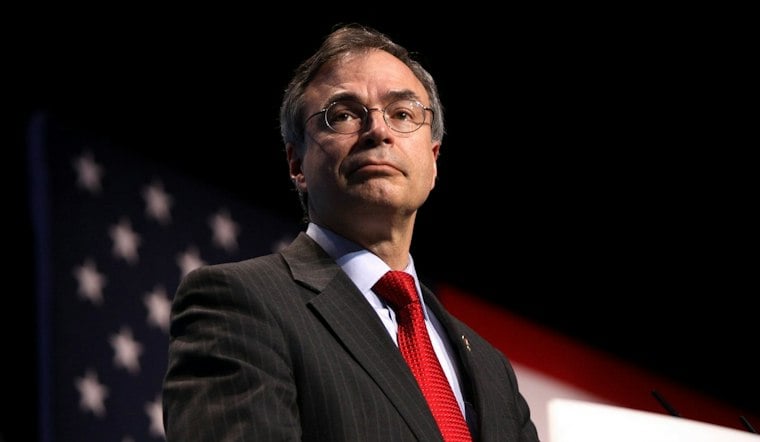
After the debate, Harris invited reporters into a separate room for questions and answers, where he wrongly told a journalist that recording their interaction without permission was against the law. The exchange capped a tense 90-minute forum at the Chesapeake Grove Intergenerational Center, where Harris and Democratic challenger Dan Schwartz clashed over diesel prices and immigration enforcement before finding rare agreement on a statewide ballot measure.
The confrontation came after Harris had already grown visibly agitated during the debate itself, according to The Baltimore Banner, after audience members laughed at his explanation for rising diesel fuel prices. The forum, hosted by the League of Women Voters, drew an overflow crowd of roughly 200 people and was repeatedly interrupted by audience outbursts, prompting moderators to pause proceedings and ask for civility. Debate rules barred Harris and Schwartz from addressing each other directly, with the candidates instead responding to questions submitted by attendees, according to the Maryland Daily Record.
Diesel Prices and a Russia Deal Take Center Stage
One audience question centered on a Trump administration deal with Russian leadership concerning diesel, per the debate question cited in the Maryland Daily Record's account. Schwartz criticized the arrangement to lift sanctions on Russian diesel, pointing to Russian cooperation with Iranian forces that have killed U.S. troops. Harris countered that rising diesel prices stem from Democratic environmental regulations, a claim that drew the laughter which appeared to rattle him for the remainder of the night.
Harris told the audience at one point that they were being rude and objected to the interruptions, while League of Women Voters of the Mid-Shore president Glenna Heckathorn asked both candidates to urge their supporters to remain civil. Schwartz urged the crowd to hear out both candidates, and Harris maintained that his own supporters were not interfering with Schwartz's remarks. The diesel fight followed Harris's own stalled effort in Congress: as Hoodline reported in September, his proposal to suspend federal gas and diesel taxes for three months never came to a vote before the House left for recess.
Immigration Policy Splits the Candidates
The two candidates offered starkly different visions on immigration enforcement affecting the Eastern Shore's seafood and agricultural industries, according to WBOC. Schwartz said legal Haitian workers under Temporary Protected Status on the Shore are currently hiding in their homes out of fear, while Harris advocated phasing out TPS in favor of temporary work visa programs such as H-2A and H-2B. Audience questions also touched on how deportation enforcement could affect the poultry industry, aging bridge infrastructure, and offshore wind as a path to meeting Maryland's energy needs, per the Maryland Daily Record.
Schwartz, who has 14 years of experience at a national organization of state financial regulators, used the debate to criticize Harris's role in cuts to healthcare, food assistance, and Chesapeake Bay funding. He said Harris presided over a farm bill that cut billions of dollars in aid to hungry children across 11 counties, and argued the congressman should work for district residents rather than the president or his billionaire associates. Harris, seeking a ninth term after more than two decades in office, countered that he had delivered for the 1st District through support for fire companies, water towers, waste systems, and the local hospital.
Rare Agreement on Redistricting and Executions
Despite their sharp disagreements, Harris and Schwartz found common ground opposing Question 3, the statewide ballot measure that would set looser standards for drawing Maryland's congressional maps. The Maryland General Assembly proposed the constitutional amendment, which critics view as an attempt to gerrymander Harris out of office. Schwartz said Democrats must win the seat fairly and squarely rather than having it handed to them by redrawn lines two years before the next census, adding that he believes he can win by focusing on cost-of-living challenges and the uncertainty created by federal cuts.
The amendment would clarify that requirements like compactness, contiguity, and respect for political boundaries apply only to General Assembly districts, effectively reversing a 2022 Anne Arundel County Circuit Court ruling that held state constitutional districting requirements applied to congressional districts, according to Ballotpedia. A September poll found 40% of likely voters opposed the amendment, with 57% expressing general opposition to drawing congressional maps to favor one political party, per WBAL-TV.
The candidates also agreed that executions should not be live-streamed, after Trump administration officials were reported to be considering live-streaming the execution of Nidal Hasan, who was convicted of killing 13 people at Fort Hood, Texas, in 2009.
A District Still Rated Solid Republican
Schwartz has sought to build cross-party appeal in the historically conservative district, securing an endorsement from former Republican Congressman Wayne Gilchrest, who represented the 1st District from 1991 to 2009 as a moderate known for Chesapeake Bay environmental advocacy. Harris, who chairs the House Freedom Caucus and the House Appropriations Subcommittee on Agriculture, Rural Development, and the Food and Drug Administration, won his June Republican primary with 79.7% of the vote.
Schwartz has sought to build cross-party appeal in the historically conservative district, securing an endorsement from former Republican Congressman Wayne Gilchrest, who represented the 1st District from 1991 to 2009 as a moderate known for Chesapeake Bay environmental advocacy. Harris, who chairs the House Freedom Caucus and the House Appropriations Subcommittee on Agriculture, Rural Development, and the Food and Drug Administration, won his June Republican primary with 79.7% of the vote.





