

























































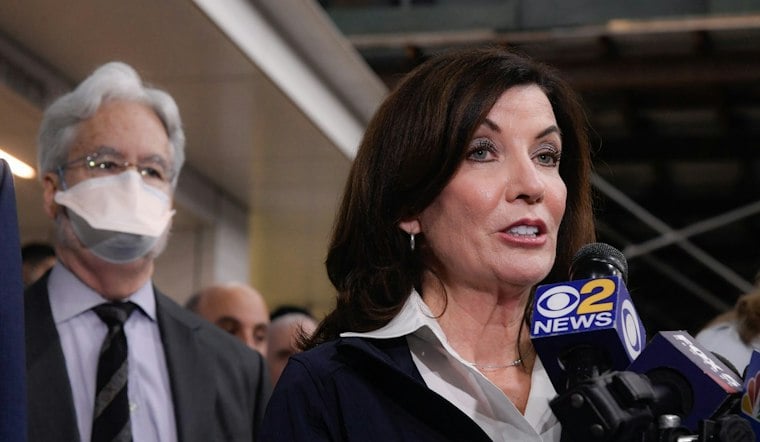
New York has lost roughly 1 million residents to other states since 2020, and the two candidates vying to be the state's next governor are offering starkly different theories on how to stop the bleeding. Governor Kathy Hochul is betting on billions in public money for projects like Micron's semiconductor plant near Syracuse, while Nassau County Executive Bruce Blakeman wants to strip away regulations and taxes to keep private companies from leaving in the first place.
The contrast sits at the center of the second installment of New York State of Unaffordability, a podcast and article series from WNYC and Gothamist examining the economic hardships driving residents out of the state and the competing fixes the two candidates are pitching. Reporter Jimmy Vielkind notes that New Yorkers have largely resettled in Florida, New Jersey and Connecticut in search of lower living costs. Hochul, who became governor in 2021, is seeking a second full term, while Blakeman, the Nassau County Executive, is her Republican challenger.
Since taking office, Hochul has directed billions of dollars toward upstate New York's semiconductor industry, anchored by Micron Technology's planned memory-chip factory in the town of Clay. Micron has pledged to create 50,000 jobs and is eligible for up to $5.5 billion in state incentives, according to the Gothamist report. That state commitment builds on New York's 2022 Green CHIPS law, which created up to $10 billion in performance-based tax credits over 20 years through the Excelsior Jobs Program, according to the New York State Senate. The state incentives sit alongside a separate $6.1 billion direct federal grant the U.S. Department of Commerce finalized for Micron's Clay and Boise, Idaho facilities in December 2024.
A Syracuse-Area Student Finds Her Footing
For 32-year-old Kate Ebersbach, the Micron buildout is less an abstraction than a career pivot. Ebersbach moved back to her childhood home outside Syracuse and is now studying electromechanical technology at Onondaga Community College. She told Gothamist she fell in love with the semiconductor industry and is preparing for a career change, driven by a desire for greater income and stability.
Syracuse's population shrank by more than one-third between 1950 and 2020, a decline that frames why Hochul has pitched the Micron project as a turning point for the region. In July, Hochul said the project would hire thousands and create opportunities for local families and young people. Blakeman and his GOP allies, meanwhile, have credited former President Donald Trump and Onondaga County Executive Ryan McMahon with the Micron project and other domestic-manufacturing investments, per the same Gothamist report.
Childcare Gaps Could Slow the Buildout
Even as the Micron project advances, Central New York faces capacity bottlenecks that could complicate the promised hiring surge. A 2025 study by the Maxwell School of Citizenship and Public Affairs at Syracuse University found that only 35% of infants and toddlers in Onondaga County could secure licensed childcare slots, an infrastructure shortfall that looms over the town of Clay ahead of the plant's buildout. The Learning Experience has planned a regional expansion, Hoodline has reported previously.
Blakeman's Deregulation Pitch
Blakeman has pitched a different route entirely: reduce regulations so private companies choose to stay and expand on their own, without large public subsidies. He has said he would legalize natural gas hydrofracking, which Gov. Andrew Cuomo initially banned by executive action in 2015 over concerns about environmental effects, including impacts on New York City's reservoirs. But that proposal faces a steeper legal climb than reversing an executive order — the state legislature codified the fracking ban in the FY 2021 budget in April 2020, according to the Natural Resources Defense Council.
Blakeman has also criticized Hochul's year-long moratorium on large data center developments. Hochul issued Executive Order No. 62 in July, establishing a nationwide-first one-year pause on state environmental permits for new hyperscale data centers while utility regulators study power grid and water impacts, according to law firm White & Case. Public comments on the review's scope were scheduled for late October. Blakeman argues New York should instead make itself inviting for businesses to locate or remain in the state.
Dueling Numbers on Taxes and Jobs
Blakeman's campaign has leaned on comparative rankings to make its case. The American Legislative Exchange Council ranked New York 50th among all states for economic development climate, a figure the campaign has cited repeatedly; ALEC's own methodology evaluates states across 15 policy variables, including top marginal tax rates and labor regulations. The campaign has also pointed to a study finding that New York City millionaires pay the country's highest combined state and local tax rate — for 2026, the state's top rate of 10.9% combined with the city's 3.876% produces a maximum marginal rate of 14.776%, according to Valur.
Underlying both campaigns' arguments is a mixed economic picture. State officials reported New York's GDP grew nearly twice the national average over the summer, and the state's unemployment rate stood at 4.3% in August, just above the national rate of 4.1%. Yet New York state labor officials recently activated a statutory off-ramp under Labor Law Article 19 § 652 after a six-month decline in statewide nonfarm employment, freezing scheduled 2027 minimum wage increases at $17.00 downstate and $16.00 upstate, Hoodline has reported, even as job growth held steady in suburban counties like Long Island. Census Bureau estimates analyzed by the Empire Center show New York lost a net 137,000 residents to domestic migration between July 2024 and July 2025, pushing cumulative net population loss since 2020 to roughly 120,000.
Hochul this month said Blakeman supports unfettered industry, an accusation Blakeman has denied. Voters will settle the dispute on Election Day, November 3.




