

























































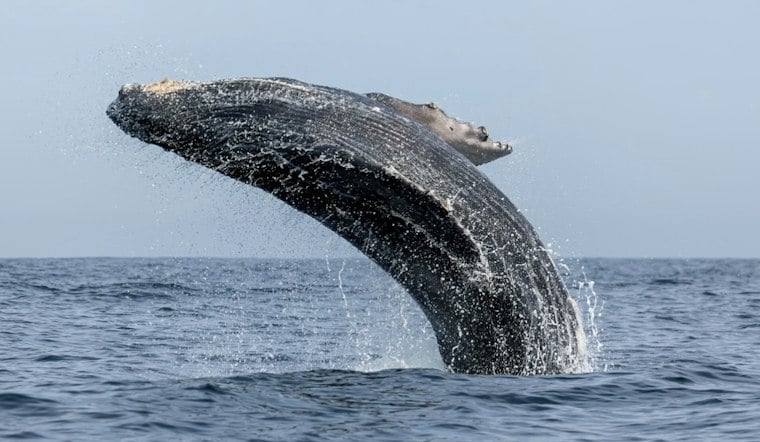
A fishing boat off Moriches Inlet got an unwelcome visitor this week when a humpback whale surged out of the water and slammed into the vessel, sending a jolt through everyone aboard but leaving no one hurt. The encounter, caught on video, shows small fish leaping from the surface moments before the whale breaches and strikes the boat broadside.
The collision happened off the coast near Moriches Inlet in Suffolk County, according to WABC-TV, which reported that fishermen had a close encounter with the whale while boating in the area. The outlet reported that nobody aboard the boat was injured. Experts cited in the report said the whale appears to be a juvenile engaged in lunge feeding, a behavior in which whales surge rapidly through schools of fish to catch prey.
According to those experts, the whale was not attacking the boat — it was simply in the whale's path as the animal pursued its next meal. That distinction matters because it reframes a dramatic, viral-looking moment as an accident of shared space rather than aggression.
A Pattern of Close Calls Off Long Island's South Shore
The Moriches Inlet strike comes just days after two juvenile humpback whales became stranded on sandbars off Fire Island National Seashore on October 8: the Saltaire whale, which had been chasing redfish, and the Ocean Bay Park whale. The Saltaire whale swam free as the tide rose, while the Ocean Bay Park whale freed itself before noon, as Hoodline previously reported. Taken together, the two episodes point to a cluster of whale activity along Long Island's South Shore in early October.
That activity traces back to a bigger ecological story. The resurgence of humpback whales off Long Island is closely tied to the recovery of Atlantic menhaden, an oily prey fish whose numbers rebounded after the Atlantic States Marine Fisheries Commission imposed coast-wide catch limits in 2012, according to The Nature Conservancy. As menhaden populations rebuilt, humpbacks returned to New York Harbor.
Why Lunge-Feeding Whales Are Hard to Avoid
Because menhaden swarm in dense surface schools, feeding whales burst upward through the water with little warning, a dynamic documented in a 2022 study on humpback foraging in the New York Bight published in Frontiers in Marine Science. The research found that surface lunge-feeding puts whales at greater risk of vessel strikes and noted concerns about shipping traffic. NOAA Fisheries' “See a Spout? Watch Out!” guidance similarly warns boaters to steer clear of surface bubble clouds, the telltale rings whales blow to trap fish, because they signal a humpback is about to surface violently from below.
A strikingly similar incident played out in July 2024 off Portsmouth, New Hampshire, when a lunge-feeding juvenile humpback chasing menhaden landed on the stern of a 23-foot fishing boat, capsizing it and throwing two fishermen into the water, as reported by The Guardian. That case underscored how small recreational boats can end up directly in the path of feeding whales with almost no time to react.
Those rules exist against a sobering backdrop. NOAA Fisheries has maintained an active Unusual Mortality Event for humpback whales along the U.S. Atlantic coast since January 2016.
The South Shore's whale sightings have become part of a broader comeback story. In July, the local research organization Gotham Whale documented its 500th individual humpback whale, a milestone in the species' regional comeback. As that population grows alongside recreational and commercial boat traffic, encounters like the one near Moriches Inlet appear increasingly likely to keep happening.





