

























































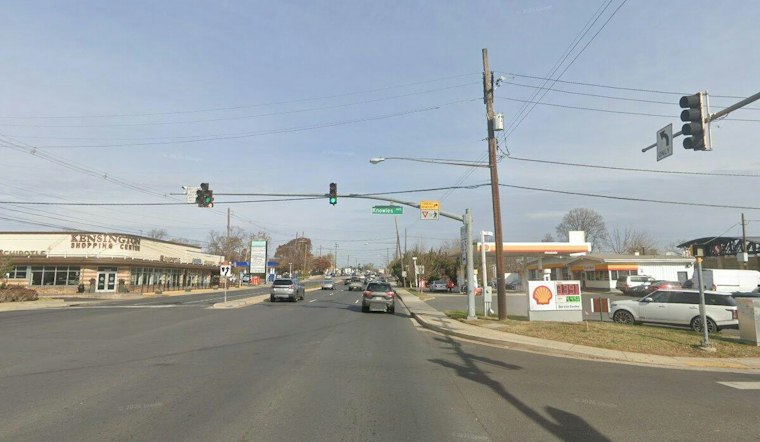
A man riding an electric scooter suffered serious but non-life-threatening injuries Thursday night, October 8, 2026, after he was struck by a vehicle at the intersection of Connecticut Avenue and Knowles Avenue in Kensington, Maryland. Montgomery County police responded to the crash scene at 9:47 p.m., and the injured rider was taken to a hospital for treatment.
The crash, first reported by WJLA, involved a vehicle and the e-scooter at the busy Kensington intersection. Police say the driver involved in the crash has since been located, though the station's report does not detail what, if any, charges or citations may follow. Key questions remain open, including whether vehicle speed, right-of-way issues, or scooter lighting played any role in the collision.
A Long-Flagged Danger Zone
A Long-Flagged Danger Zone
That designation matters because High Injury Network corridors are prioritized for targeted enforcement and engineering redesigns under the county's Vision Zero initiative. Montgomery County was the first county in the nation to adopt a Vision Zero policy, back in 2016, with a goal of eliminating traffic fatalities and severe injuries by 2030. The county's Fiscal Year 2024 Vision Zero annual report recorded an 11% overall reduction in fatal and severe crashes compared to pre-COVID baselines, driven largely by a 28% drop in severe incidents along High Injury Network corridors.
Speed Is the Difference Between Survival and Tragedy
Connecticut Avenue through Kensington carries posted speed limits of 30 to 35 mph, and vehicle speeds often climb higher during off-peak evening hours — exactly the kind of conditions present when the crash happened near 10 p.m. That matters enormously for anyone riding a small, lightweight device like an e-scooter. Maryland Department of Transportation safety data cited in local planning studies shows a vulnerable non-motorist struck by a vehicle at 25 mph faces a 25% risk of severe or fatal injury, a risk that jumps to 50% at 33 mph and 75% at 41 mph.
Part of a Troubling Countywide Pattern
The Kensington crash lands amid a broader surge in e-scooter collisions across Montgomery County. The county's July 2026 Crash Data Update recorded 28 e-scooter-involved crashes during the first six months of 2026, four resulting in suspected serious injuries — an increase of 11 crashes over the same period in 2025. During that same six-month window, the county logged 232 pedestrian-involved crashes, including 9 fatalities, and 62 cyclist-involved crashes, with pedestrian collisions up 12% year over year.
The spike isn't unique to Montgomery County. Consumer Reports withdrew its recommendations for all adult e-scooters this month, citing climbing top speeds between 20 and 28 mph, elevated headfirst fall risks, and the absence of mandatory federal manufacturing safety standards, as previously reported by Hoodline. The advocacy group has pushed federal regulators and manufacturers to establish mandatory build standards for the devices. Montgomery County's own shared micromobility program, which allows dockless e-bikes and scooters from vendors including Lime, Spin, and Bird for riders 18 and older, caps rental device speeds and requires upright parking that doesn't block pedestrian crossings — though it remains unclear whether the scooter involved in the Kensington crash was a shared rental or privately owned.
Montgomery County began tracking e-scooter crashes as a distinct category starting in 2024, separating them from broader cyclist and pedestrian statistics, which has made it easier to see trends like the one now unfolding along corridors such as Connecticut Avenue. For now, the driver involved in the October 8 crash has been located, but whether speed, right-of-way, or lighting contributed to the collision remains under investigation.





