

























































In 2006, Lita Albuquerque’s Stellar Axis: Antarctica placed 99 ultramarine spheres on Antarctic ice, with each sphere aligned to a star. The project received support from a National Science Foundation grant, according to the Anderson Collection at Stanford University.
Antarctic projects and environmental review
The National Science Foundation says its Antarctic Artists and Writers Program was established to increase public understanding and appreciation of Antarctica and human activity there. The Antarctic Treaty Secretariat says the Environmental Protocol requires impact assessments for Antarctic activities, with the level based on potential impacts. The project account cited above does not specify which assessment applied to Stellar Axis: Antarctica or what site-restoration conditions were in place.
Albuquerque was born in Santa Monica in 1946 and grew up in Carthage, Tunisia, and Paris, France. Since the early 1970s, her work has included sculpture, poetry, painting, multimedia performance, and site-specific projects, reports See Great Art. The outlet also notes her association with Light and Space and Land Art, and that she represented the United States at the International Cairo Biennale, where she received its top prize.
Land art across remote landscapes
Albuquerque first made Spine of the Earth on a Mojave Desert lakebed in 1980, using powdered pigment and sacred geometry. Palm Springs Art Museum lists versions dated 1980, 2024, and 2026, linking the work’s history to documentation, performance, and reconstruction. The museum says the work remains connected to its place and time in its exhibition materials.
Land art, documentation and reconstruction
The Utah Museum of Fine Arts notes that land artists were drawn to the vast spaces of the American West and typically documented earthworks with photographs, films, and maps for gallery exhibition. That is broader context, not evidence of how Albuquerque’s work was documented: the museum’s dates identify later versions, but the materials cited here do not explain precisely how the original site work relates to each later version.
Albuquerque also uses a fictional figure to connect earthly and cosmic settings. Najma, an astronaut from the 25th century in the artist’s unpublished manuscript, is depicted in the 2023 sculpture Najma Returns (Guardian of the Earth). The films 20/20: Accelerando (2016) and Liquid Light (2022) follow the character across those settings, according to the museum announcement.
Cosmos with Particle Horizon (2014) shifts the focus from a landscape to the human body: a cast of Albuquerque lies beneath projections of stars at the North Pole, South Pole, and equator. The multimedia installation also includes spoken passages from her unpublished manuscript, the museum says in its announcement.
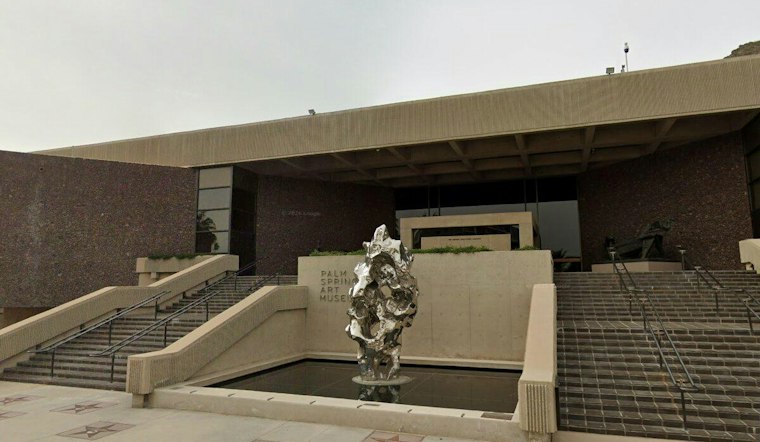
From October 16, 2026, through May 3, 2027, Palm Springs Art Museum will present Lita Albuquerque: Cosmic Land. The museum describes it as the first survey to bring together paintings, sculptures, installations, and films from nearly six decades of her work. Dates and details appear on the museum’s exhibition page.




