

























































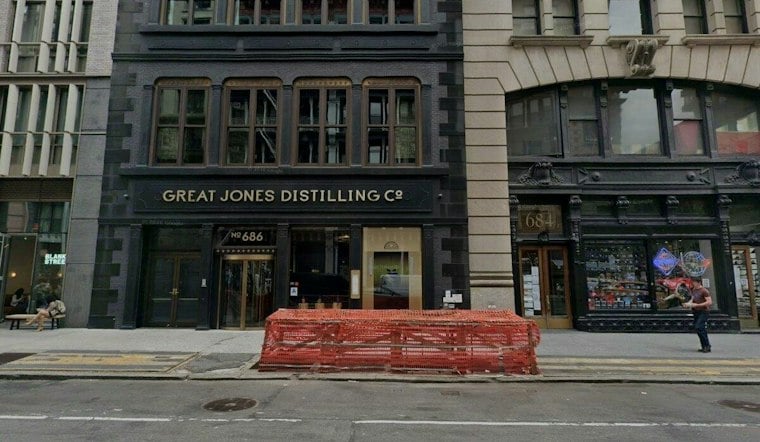
Great Jones Distilling Co., the only whiskey distillery operating in Manhattan, has shut down its 28,000-square-foot Broadway venue unexpectedly this month, closing a visitor center that included a restaurant, retail shop, speakeasy and tasting rooms until further notice. The closure lands at a strange moment for the industry it represents: Americans are drinking less than at any point in generations.
A Six-Year Build Undone in Weeks
The distillery, located at 686 Broadway, had cleared a mountain of bureaucratic hurdles in 2021 to become Manhattan's first whiskey distillery since 1939, according to the New York Post. Getting there took six years and roughly $21 million in investment, the Post reports, and the physical build-out was no small feat either: as Alcohol Professor detailed, builders had to drop a floor down five feet and encase a 500-gallon copper Vendome pot still inside a two-story explosion-proof glass chamber just to satisfy fire codes and zoning rules that bar distillation above a building's second floor. Great Jones said the whiskey itself will keep selling online and in retail stores even as the physical venue goes dark.
Neither Great Jones nor its parent company, Proximo Spirits, responded to requests for comment from the Post. A Proximo spokesperson previously told The Spirits Business that the decision to close Great Jones followed a review of beverage-industry trends, market conditions and company strategy. Great Jones was founded by Juan Domingo Beckmann, chief executive of Jose Cuervo maker Proximo, which initially supplied the venue's whiskey from liquid distilled and aged at Black Dirt Distillery in Warwick, New York, a facility Proximo acquired in 2018, per Alcohol Professor.
A Distributor's Collapse Hits Home
Proximo's troubles trace in part to the implosion of Republic National Distributing Company, the nation's second-largest wine and spirits distributor, which filed for Chapter 11 bankruptcy in Grand Prairie, Texas this past summer. Court documents reviewed by the Post show RNDC owed Proximo $94 million, making the Jose Cuervo maker the distributor's single largest creditor. Separate filings examined by the Drinks Business put the total owed across RNDC's top 30 unsecured creditors above $300 million, part of a bankruptcy that, per VinePair, left the distributor carrying liabilities between $1 billion and $10 billion and more than 100,000 creditors after suppliers representing more than $3 billion in annual revenue left RNDC.
Proximo is owned by Becle, Mexico's largest spirits producer, according to the Post's reporting. Michael Correra of the Metro Package Store Association, which represents wine and liquor stores across the New York metro area, has predicted that more liquor stores will close simply because fewer people are drinking.
The Nation Is Drinking Less Than It Has in Decades
A Gallup poll published in August found that the share of American adults who say they drink alcohol had fallen to its lowest level since 1939, the same year Manhattan last had an operating whiskey distillery before Great Jones opened. The polling firm separately reported that self-reported adult drinking held at a record-low 54% for a second straight year, down eight points from 62% in 2023, according to Gallup News. Just over half of Americans, 51%, now say they believe even moderate daily drinking is harmful to their health.
That shift away from alcohol isn't limited to traditional spirits. Gallup also found that 17% of U.S. adults, and 20% of active drinkers, consumed non-alcoholic beer, wine or spirits alternatives over the past year, with nearly 40% of those users saying they'd increased that consumption. Meanwhile the craft distilling sector has been shrinking nationwide: active U.S. craft distillers fell to 2,131 in August from 3,069 just two years earlier, a 30.6% plunge that made 2025 the first year on record where closures outpaced new openings, according to data from MMCG Invest.
Bourbon Country Feels the Squeeze Too
The pain has reached beyond New York. Brown-Forman, which owns Jack Daniel's and makes Woodford Reserve and Old Forester, laid off 12% of its workforce — about 650 employees — last year amid weak demand for its whiskies, the Post reports. Kentucky bourbon makers broadly were hit by declining sales tied to trade disputes and a generation of younger drinkers simply not drinking as much.
Industry-wide, distilled spirits supplier revenues dipped 2.2% in 2025 to $36.4 billion even as ready-to-drink canned cocktails surged 16.4% to $4 billion in sales, per the Distilled Spirits Council of the United States. New York's craft distillers were already feeling the strain before Great Jones closed: an April 2024 survey by the New York State Distillers Guild found that 33% of respondents were unsure and 17% said they would close, following the closure of 20 state distilleries in recent years, according to the New York State Assembly. That industry had been built in large part on the state's 2007 Farm Distillery Act, which reduced licensing costs for farm distilleries. For now, Great Jones says its whiskey will remain available online and on store shelves — even with the lights off on Broadway.





