

























































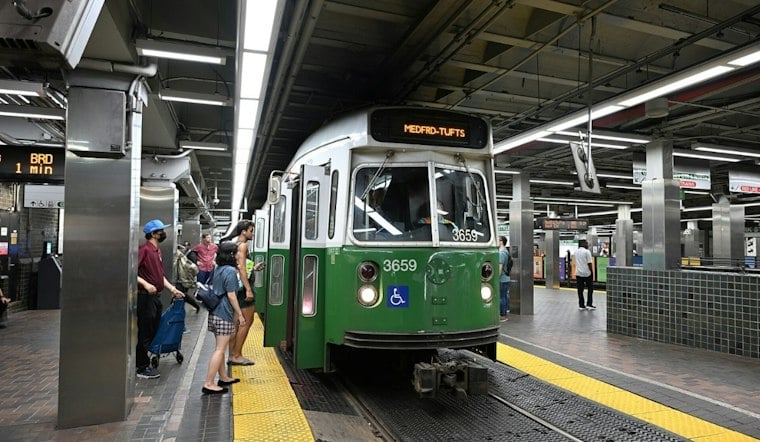
The number of warnings and citations shows how the MBTA’s fare-checking program is being enforced, but not whether it has improved payment rates or revenue. MassLive, which reported the latest full-year totals, said the team had issued 200 formal written warnings and three citations since checks began in September 2025. The 16-member Fare Engagement team costs the T roughly $2.39 million a year.
Enforcement Counts Don’t Settle the Revenue Question
According to MassLive, the MBTA says fare checkers began conducting checks at subway stations and onboard vehicles on September 8, 2025. A first offense results in a written warning; only repeat violators face fines. Roughly 120 of the 200 warnings were issued in the program’s first eleven months, through late August 2026, and about 80 more in the following month. MassLive tied the increase to the agency ending its prior practice of letting riders pay at a fare box without paperwork. Three repeat offenders were cited in that later stretch, bringing the total citations since the program began to three.
Other outlets have published somewhat different snapshots of the same effort. Streetsblog Massachusetts reported that fare checkers had issued only 117 warnings as of Aug. 12, 2026, and zero fines over the team's first year, while WHDH put the figure at 152 written warnings in the last year with no rider fined.
Why So Few Citations
The MBTA's own fare-evasion policy explains part of the gap: a first offense within a three-year period results only in a formal written warning, with citations reserved for repeat violations. Fines then run $50 for a first, second or third citation and $100 for a fourth or subsequent one, under the agency's posted policy. Riders can appeal or request a hearing within 60 days of a citation, and the MBTA says fines may be waived or reduced for financial hardship.
Streetsblog's reporting notes that the T itself cautions that “quantifying fare evasion is highly complex, and quantifying the effect of fare engagement personnel on fare evasion is even more so.” That complexity shows up in the agency's own data: an MBTA report published in July, per the same outlet, found that fare checkers appeared to modestly improve contactless payment rates at Green Line street-level stops, and that “fare engagement” rates ticked up slightly across all four rapid-transit lines after checkers appeared at gated stations — though the changes were described as small.
Revenue and Payment Changes Are Difficult to Attribute
The MBTA’s fare revenue has varied across the years cited in public reporting: NBC Boston reported about $671 million collected in fiscal 2019, while officials forecast about $403 million for fiscal 2025. The latter is a projection, not a final result, and the figures do not show how much the fare-checking team contributed. They also do not establish a change in ridership over that period.
Payment options changed during this period, too: the MBTA announced that contactless payments would be accepted onboard buses and Green Line trolleys, as well as at gated subway stations, beginning Aug. 1, 2024. The July MBTA report discussed above found only modest changes in payment behavior associated with fare checkers; the available findings do not isolate the effects of the new payment options or connect either change to systemwide revenue.
Gates Boost Commuter Rail Numbers
Hardware may be doing more than headcount. The MBTA installed fare gates at South Station and Ruggles within the past year, and Keolis reported a roughly 33% increase in passengers activating commuter rail tickets for travel to and from South Station compared with the previous year, according to MassLive. At Ruggles, ticket activations climbed 44% from the prior year, and on-board ticket sales at South Station jumped 15% after the gates went in. North Station got similar gates back in 2022. The T plans to add gates at Back Bay early next year, though a portion of the South Station gates has been covered by weather protection about 10% of the time since February, and commuter rail riders can still bypass the gates by tailgating or jumping them.
The stakes behind the push are not small. The MBTA estimated back in 2019 that it was losing $10 million to $20 million a year in uncollected commuter rail revenue, or roughly 4% to 8% of potential revenue, compared with a 3% loss rate the agency has described as the transit industry standard even for highly secured, gated systems. Green Line riders present a particular challenge: most above-ground stops lack fare gates entirely, and the Boston Region Metropolitan Planning Organization has estimated that roughly two-thirds of above-ground Green Line riders never interact with a fare box, compared with about one in eight riders systemwide on rapid transit.
Riders and Officials Weigh In
MBTA General Manager Phillip Eng has defended the broader push, saying “the public has a right to expect us to do our part and to ensure revenue is collected.”
State Inspector General Jeffrey Shapiro has gone further, arguing the problem runs deeper than headline numbers suggest. “The scale of uncollected fares and resulting lost revenue has been greatly understated over the years,” Shapiro has said. The MBTA, which averages more than 900,000 weekday riders across a system that includes about 1,100 buses and 250 Green Line vehicles, charges $2.40 for subway rides and $1.70 for bus fare — prices that underscore how much revenue can slip away even at a small evasion rate across hundreds of thousands of daily trips.
A Cautionary Tale From the Bay Area
The MBTA's experience echoes findings from BART's fare-enforcement program in California. A May 2025 report found that fines from fare-evasion citations on BART covered only a fraction of the expenses incurred by its fare-checking program, according to Axios. A Center for Policing Equity study cited in that report found BART's fare-evasion-specific enforcement was not measurably connected to reductions in reported physical-safety or public-disorder crimes, and calculated that only 6% to 12% of BART's proof-of-payment citations were ever actually paid. From 2018 through 2023, BART's highest annual revenue collected from violations reached just $86,613, in 2019 — a fraction of the $2.2 million BART allocated to inspection officers and the $25.5 million it spent on sworn law enforcement in 2023. BART has said its newer, jump-resistant fare gates significantly deter evasion and cut down on rider-officer interactions, a hardware-first approach that mirrors the direction the MBTA now appears to be testing at South Station and Ruggles.
The fare engagement team, hired and trained beginning in October 2024, spent much of its early work focused on rider education and is reportedly testing handheld devices to check recent taps and payment histories in the field. The MBTA has reported fare collection increases of up to 35% at stations where representatives were stationed during the program’s early weeks, and separately said representatives boosted payment rates at northern Green Line stations by about 35% in late 2024. The agency has said fare revenue came in at least $30 million higher than expected last year, but has not disclosed how much, if any, of that gain came from the fare engagement program.





