

























































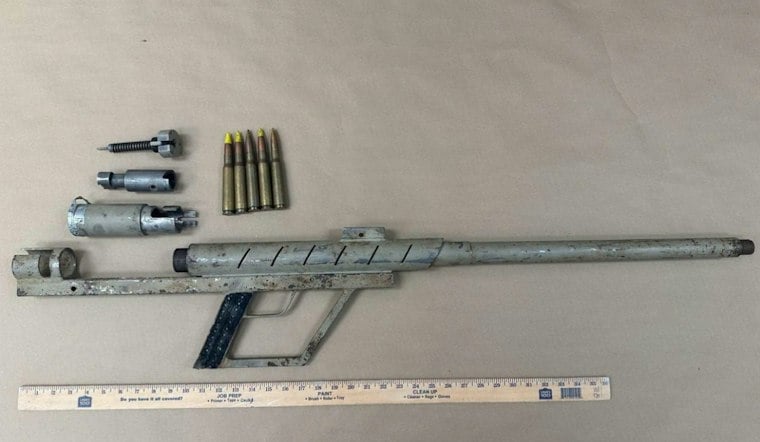
Menifee police seized a fully functional homemade .50-caliber rifle capable of firing Browning Machine Gun rounds while responding to a call for service at a home in southwest Riverside County. The person found with the weapon was prohibited from possessing firearms or ammunition, and police arrested and booked that person on multiple charges without releasing a name.
According to KTLA, officers discovered the gun while handling the call in Menifee, and the firearm came loaded with several .50 BMG rifle rounds, per the police release cited by CBS Los Angeles. Police said the rifle lacked several important safety components typically found on commercially manufactured firearms, which officers believed increased the risk to anyone who tried to operate it.
Bomb Squad Called In to Clear the Weapon
Because of the homemade build and the missing safeguards, Menifee officers didn't handle the firearm alone. The Riverside County Sheriff's Department's Hazardous Device Team responded to assist personnel in safely examining and clearing the weapon, the department said in its release. That kind of specialized response underscores just how unpredictable an unregulated, self-assembled firearm chambered for .50 BMG rounds can be in untrained hands.
Police have not identified the suspect taken into custody, and the exact charges filed have not been made public. What is confirmed is that the person was legally barred from possessing guns or ammunition at all, let alone a weapon of this caliber, and was arrested and booked on multiple counts as a result.
Why Homemade .50-Caliber Guns Draw Extra Scrutiny
Weapons like this one sit at the center of a broader enforcement push in California. State guidance from the California Department of Justice, Office of the Attorney General states that, subject to certain statutory exceptions, a person may not possess, manufacture, distribute, transport, import, sell, give or lend a .50 BMG rifle. Separate department materials addressing assault weapons and .50 BMG rifles make clear the state treats this caliber class as its own distinct legal category.
Self-made firearms more broadly have also drawn specific state requirements. A consumer alert from the same department notes that anyone possessing a self-manufactured or self-assembled firearm without a serial number had to apply to the Department of Justice for a unique serial number by January 1, 2019. A more recent department bulletin dated January 30, 2026, lists unlawfully possessing assault weapons or .50 BMG rifles among the violations it addresses, reflecting continued state attention to this category of weapon.
Federal data adds further context on why untraceable, privately made guns worry investigators. The Bureau of Alcohol, Tobacco, Firearms and Explosives says investigating crimes involving unserialized privately made firearms can make it difficult to trace a weapon's origins and link it to related crimes, and the agency reports that roughly 45,240 suspected privately made firearms were recovered by law enforcement nationwide between 2016 and 2021. A related ATF analysis found that 142 trafficking investigations, or 44.9% of those examined in its study, involved the trafficking of privately made weapons regulated under the National Firearms Act.
It remains unclear whether the rifle seized in Menifee carried a serial number or had otherwise been legally registered, and no court filing or case disposition has been made public. For now, the case stands as a reminder of how seriously local and state authorities treat weapons built outside the usual manufacturing and registration process, especially when they land in the hands of someone already barred from owning a gun.





