

























































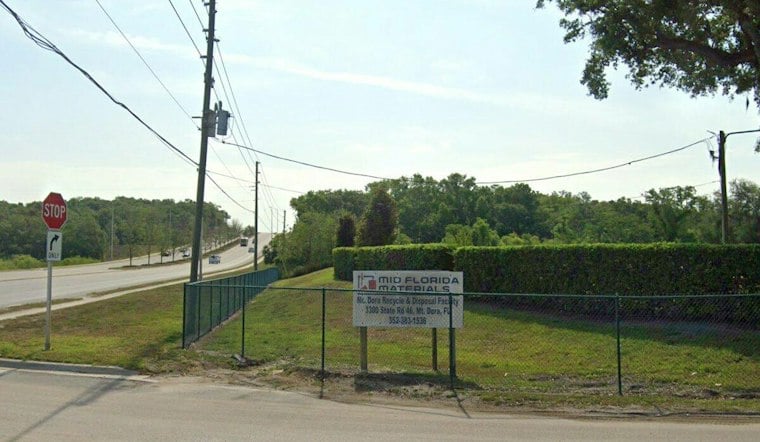
Mount Dora City Council approved a $675,010 preconstruction agreement with Wharton-Smith Inc. on October 6, moving forward on a planned $105.6 million expansion of Wastewater Treatment Facility No. 2. The approval advances planning for the expansion; it is not approval of the full construction project. The project is meant to roughly double the plant's permitted capacity, but it won't settle the lingering question that has frustrated residents for years: what's causing the persistent foul smell hanging over parts of the city.
The preconstruction deal, reported by WKMG ClickOrlando, puts Wharton-Smith in charge of planning through a construction management at risk arrangement, though the city council has not yet approved a final construction contract for the full $105.6 million project. The Sanford-based firm has a track record in the city already, having previously completed Mount Dora's Fire Station No. 35, according to Wharton-Smith Inc. The treatment plant sits at 2099 James P. Snell Drive near State Road 46 and U.S. Highway 441, per the same account.
Why the Plant Needs More Room
The expansion would raise permitted capacity from 1.5 million to 3.5 million gallons per day. City planning documents cited by the station show the plant processed an average of roughly 754,000 gallons per day in 2024, with future demand projected to climb to about 2.114 million gallons per day. The projection reflects the city's planning for future demand.
Commercial investment has followed the residential boom along the same corridor. A $12.4 million sale of the Tri-Cities Shopping Plaza along U.S. Highway 441 in March, reported by the Orlando Business Journal, underscored the pace of development near the treatment site — growth that city officials expect to eventually help pay for the sewer upgrade through developer impact fees.
What the Upgrade Actually Includes
The planned project includes biological odor treatment and activated-carbon filtration, along with covered treatment areas, new screening and grit-removal equipment, expanded biological treatment, and upgraded filtration and disinfection systems. It also calls for sludge-handling improvements, reclaimed-water storage and pumping upgrades, three rapid-infiltration basins, and a new 16-inch pipeline connecting the existing sprayfield to the treatment facility, per ClickOrlando's reporting. Construction is expected to run from September 2027 to March 2030, with the city estimating completion that year.
A Landfill, Not the Plant, in the Crosshairs
Despite the scale of the upgrade, Mount Dora officials maintain the treatment plant itself is not the source of the widespread odor residents have reported across the community. That position is backed by an October 2024 engineering study from Kimley-Horn, which concluded the city's wastewater plant and collection system were “highly unlikely” to be the source of the smell, as reported by the Tampa Bay Times.
A separate $270,000 odor evaluation completed in 2025 by Halff Associates and V&A Consulting Engineers, jointly funded with $135,000 contributions each from Mount Dora and Lake County, pointed instead to the nearby Mid-Florida Materials landfill as the likely source of persistent odors in southeastern Mount Dora, according to Lake and Sumter Style. Investigators did not access the landfill property itself, and they found that calm winds can worsen odor conditions by limiting how the smell disperses. Air quality testing during that study detected peak hydrogen sulfide concentrations reaching 1,300 parts per billion along the landfill's boundary, compared with levels under 200 parts per billion near the municipal wastewater plant, as noted by FOX 35 Orlando.
State Scrutiny and a Legal Fight Over the Aquifer
The Florida Department of Environmental Protection issued odor warning letters and violation notices to the landfill as early as 2019 and again in 2023 for failing to resolve off-site nuisance smells, according to FOX 35 Orlando's reporting from earlier last year. In December, Mount Dora and Lake County escalated the fight, filing a joint petition against the Florida Department of Environmental Protection and landfill owner Hubbard Construction Company challenging an extension of the landfill's environmental resource permit through 2030 over unresolved stormwater management concerns.
Lake County officials also raised warnings that stormwater runoff and potential leachate from the landfill threatened Wolf Branch Sink, a geologic feature where surface water drains directly into the Floridan Aquifer — the region's drinking water source. That environmental concern broadened the dispute well beyond air quality and helped explain why county leaders joined the city's legal challenge, per FOX 35 Orlando.
Residents Still Smelling Trouble
The debate isn't just playing out in engineering reports and courtrooms. SmellMyCity users submitted three odor complaints the morning this story published, including a sewer-like odor rated 4 out of 5 at 6:15 a.m., another rated 4 out of 5 at 6:32 a.m., and a fifth-out-of-five rating at 7:59 a.m. The complaints reflected residents' ongoing odor concerns.
Aida Gregory, who has lived in Mount Dora for 11 years, said she notices the odor every day and reported watery eyes and a runny nose she believes are connected to it, though ClickOrlando notes no medical connection between reported odors and symptoms has been established. Another resident, identified only as Amy, offered a different view, saying Mount Dora's growth should help cover the cost of infrastructure. “Mount Dora is booming,” she said.
City's Past Fixes and Unanswered Financial Questions
Mount Dora has already taken steps at the plant level to address odor concerns. The city installed a carbon biofilter costing approximately $500,000 in the summer of 2022 and added a chemical process in August 2023 to neutralize hydrogen sulfide entering the wastewater plant. The city council also entered a consent order with the Florida Department of Environmental Protection in November 2023. Mount Dora says it monitors odor at all four corners of the facility, reviewing monitor data weekly, and collects information from odor loggers placed throughout the community.
As for financing the $105.6 million expansion, the city plans to cover remaining construction costs through impact fees from new developments after securing grants, and it has not identified a specific wastewater rate increase tied to the project. City officials said future utility rate adjustments would be considered through a broader study of the utilities fund's financial needs. The city did not provide ClickOrlando a detailed breakdown of grant, developer-fee, or borrowing amounts or repayment terms. One likely funding source is the Clean Water State Revolving Fund, a program administered by the Florida Department of Environmental Protection that offers below-market-rate loans and potential principal forgiveness to municipalities upgrading wastewater infrastructure.





