

























































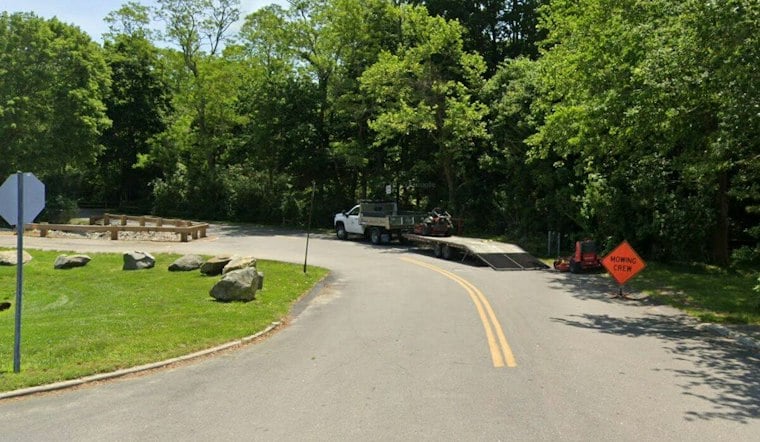
Two Narragansett residents stood before the Town Council Monday night and asked members to rescind or reject a request for proposals that could bring a 54-unit development to two town-owned lots. Both speakers argued that wetlands, vernal pools and the surrounding Narrow River watershed make the 2.6-acre site unworkable for dense construction. The council took no action on the matter at the meeting.
The pushback came during open forum, a portion of the meeting where residents may speak for up to three minutes on topics not already on the agenda, as reported by Uprise RI. The two parcels, identified as N-L Lot 22 and N-O Lot 5, were listed in a Town Council agenda proposing an RFP, according to the Town of Narragansett, which noted the parcels had already been flagged for wetlands before being referred to the Town Council for the formal proposal process. Narragansett issued Request for Proposals No. B26020 in June, and a developer presented materials for a 54-unit plan during an Oct. 19 council work session held at 5:30 p.m.
Wetlands and a Watershed Take Center Stage
A resident who lives on Cornell Road told the council his concerns were about site viability rather than opposition to housing itself, per Uprise RI's account of the meeting. He pointed to a 2023 precedent just four miles away, where Narragansett's Planning Board unanimously rejected a private proposal for 10 duplexes on six acres off Old Boston Neck Road, citing high water tables, watershed constraints, environmental limitations and traffic hazards, according to ecoRI News. The resident argued that the town itself had previously told a court that the nearby private land was environmentally unviable for high-density building, though he said it was Rhode Island's comprehensive permit law that ultimately compelled the town's action on that lot. He also raised traffic safety concerns about the intersection of Boston Neck Road and Old Boston Neck Road, and said the developer's 54-unit plan was ill-suited to what he described as a single-family ranch-home neighborhood. He told the council that the other developer's plan had misplaced wetlands from across the street and used incorrect street names, and he urged members to rescind the RFP outright.
Both Boston Neck Road parcels sit within the Narrow River Special Area Management Plan district, where the Coastal Resources Management Council enforces enhanced buffer requirements and strict protections for coastal and freshwater wetlands, per the Rhode Island Department of State. The SAMP designation covers critical resource areas spanning Narragansett, North Kingstown and South Kingstown. A wetland delineation and environmental assessment report dated May 5, 2026 describes the parcel interiors as dominated by protected freshwater wetlands and verifies active vernal pools, identifying one such pool on the site, Uprise RI reported.
A Direct Abutter Pushes Back on the Numbers
The second resident to speak is a direct abutter of the two lots. She said she was baffled that neither developer had conducted a survey before presenting to the council, and asked that both firms be required to do so. Based on walking the property and observing water flow at the road corner, she said she believes there are actually two vernal pools on site rather than the one identified in the official delineation — a distinction she offered as her own observation rather than a confirmed finding.
She listed several reasons to reject both proposals: the wetlands and vernal pools, the site's critical-concern and natural heritage designation, stormwater and infrastructure constraints including parking and underground sewage, and what she called a mismatch between the proposed density and the surrounding neighborhood. She told the council she had emailed a letter laying out her objections to the council and town manager the previous Friday, and she floated an alternative — using the former town library building for affordable housing rather than leasing it out.
Why the Town Is Under Pressure to Build
Narragansett's predicament traces back to a statewide mandate. Rhode Island's Low and Moderate Income Housing Act requires municipalities to maintain at least 10% of their year-round housing stock as low- and moderate-income units, a 1991 law that allows developers to bypass local zoning through comprehensive permits when towns fall short, according to the Charlestown Citizens Alliance. Narragansett's deed-restricted affordable units represented roughly the same share of its housing stock as Charlestown's, which the alliance reported at 3.5%. Just four of the state's 39 municipalities met the 10% benchmark that year, according to ecoRI News.
Local market pressures compound the problem. A housing study commissioned by the town and authored by Crane Associates described URI students as driving demand for nine-month rentals, even as more than half the town's housing stock was classified as seasonal or vacant in the 2020 Census, per The Public's Radio.
The Town Council scheduled no vote on the Boston Neck Road lots at Monday's meeting, leaving the fate of the RFP and the competing developer proposals unresolved. Uprise RI's account of the meeting was based on a full transcript summarized with the help of an LLM, and the outlet cautioned that transcription errors could introduce inaccuracies.





