

























































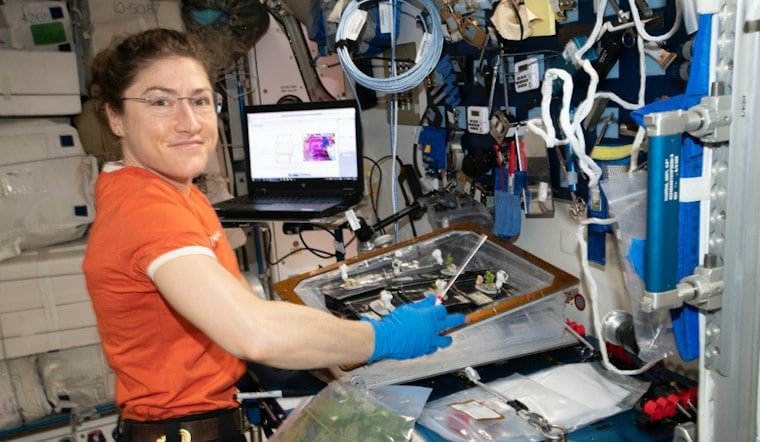
Christina Koch, the astronaut and engineer who once spent 328 consecutive days aboard the International Space Station, is trading her flight suit for a leadership desk. NASA engineer and astronaut Christina Koch will serve as the agency's acting deputy chief engineer beginning on Sunday, Nov. 1, a role that will see her help oversee engineering standards, technical reviews and mission readiness across NASA's crewed and robotic missions and projects.
According to a NASA announcement, Koch's appointment follows the retirement of Katherine Van Hooser, who will conclude more than 35 years of service to NASA on Oct. 21. The move also marks a career pivot for Koch, who will transition into management astronaut status as part of the new role. Per NASA's own description of that category, management astronauts remain employed at the agency but are no longer eligible for flight assignment — meaning Koch's record-breaking run in space is, for now, behind her.
A Three-Time NC State Graduate Headed for Deep Space
Koch's path to NASA ran squarely through Raleigh. She earned a bachelor's degree in electrical engineering from North Carolina State University in 2001, followed by an additional bachelor's degree in physics in 2002 and a master's degree in electrical engineering in 2002, according to The New York Times. NC State leaned into that connection in August, dedicating its Engineering Building II as Koch Hall, a facility that houses the university's Department of Electrical and Computer Engineering, as NC State News reported.
Before she ever left Earth, Koch built a career in engineering. She began at NASA as an electrical engineer at Goddard Space Flight Center in Maryland and later worked at the Johns Hopkins University Applied Physics Laboratory, where she contributed to instruments for the Juno spacecraft, which studies Jupiter, and NASA's Van Allen Probes, which investigated Earth's radiation belts. NASA selected her for its astronaut program in 2013 as one of eight candidates, the Times reported.
A Record-Setting Stretch in Orbit
Once in the astronaut corps, Koch spent 328 consecutive days aboard the International Space Station in 2019, setting the record for the longest single spaceflight completed by a woman. During that stay, she also participated in NASA's first all-female spacewalk alongside fellow astronaut Jessica Meir, and she and her crewmates supported hundreds of experiments aboard the station. As NC State News noted, Koch became the first woman to leave low Earth orbit and the first woman to travel to and around the moon.
The dossier of her career includes a more recent, if slightly tangled, chapter. NC State News describes Koch's record-breaking experiences on the Artemis II mission in April, while the Times, reporting earlier in the year, described her as one of two mission specialists on Artemis II who was slated to become the first woman to venture into deep space around the moon. Artemis II is described as having completed the first crewed flight around the moon in more than 50 years. In a 2023 NASA video introducing the Artemis II astronauts, Koch said returning to the moon is “actually a beacon for science… a beacon for understanding where we came from,” per the Times.
What the New Role Means Going Forward
Jared Isaacman said Koch has experience developing complex systems on the ground and trusting them in space, a framing that speaks to why NASA is tapping her engineering background for the deputy chief engineer post rather than another flight slot. The agency continues to pursue returning astronauts to the moon, developing lunar infrastructure and advancing future exploration technologies, and Koch's new post places her inside the engineering apparatus that will help steer those efforts rather than aboard the spacecraft carrying them out.
For NC State, the timing lines up with a summer of celebrating its most famous engineering alumna, from the dedication of Koch Hall to renewed attention on her academic record at the university. For NASA, the transition closes the book on a spaceflight career defined by endurance records and historic firsts, even as Koch moves into a role shaping the standards the next generation of astronauts will fly under.





