

























































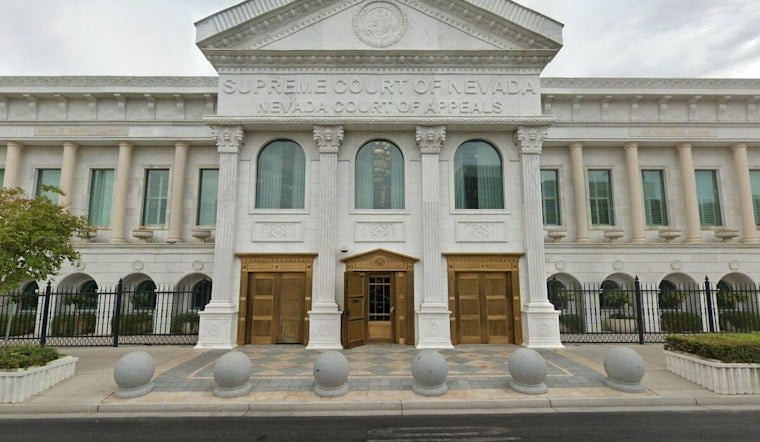
Nevada's Supreme Court has unanimously rejected Sparks police's push for a blanket confidentiality rule for open criminal case records, a ruling that grew out of a Reno woman's fight to see records about the officer who allegedly copied intimate photos from her phone. The justices found that Sparks had presented no compelling reason to rewrite decades of Nevada Public Records Act jurisprudence, leaving any new blanket exemption up to the Legislature rather than the courts.
A Traffic Stop That Sparked a Records Fight
The case traces back to a 2023 traffic stop in which then-Reno police officer Tyler Baehr took Erica Bluth's phone, viewed her photo gallery and, according to the court's opinion, used his own phone to capture intimate materials he found there, as reported by the Las Vegas Review-Journal. Sparks took over the criminal investigation, and Bluth later filed public records requests with both Sparks and Reno seeking reports, body-camera footage and communications that contained her name.
Reno identified 40 potentially responsive emails, and Bluth asked for 14 of them. Reno refused to turn them over, citing active litigation concerns, and Sparks denied a similar request from Bluth on the same grounds. Bluth and her attorney sued both cities, and in February 2025 Washoe County District Judge Barry Breslow ordered that she receive redacted records pertaining to her. Sparks appealed, arguing the judge had abused his discretion by ordering even partial disclosure, and asked the state's high court to reverse the order entirely.
Hundreds of Images and a Federal Indictment
The scope of the underlying investigative file helps explain why Sparks fought so hard to keep it sealed. Sparks Senior Assistant City Attorney Mariah Northington revealed during the proceedings that the criminal file contained more than 700 images, including numerous nude photos of potentially unidentified victims, which the city argued made redacting the records overly complex, according to This Is Reno. A federal grand jury had already indicted Baehr on two counts of deprivation of rights under color of law, alleging he unlawfully seized phones during traffic stops in December 2023 and August 2024 to view and copy private, sexually explicit photos and messages, per the Department of Justice. Baehr made his initial appearance in Reno federal court after a joint investigation by the FBI and the Sparks Police Department.
The city's financial exposure has already materialized on one front. Reno agreed in February 2026 to pay $99,000 to each of two female drivers, for a total of $198,000, to settle civil lawsuit claims, the same outlet reported.
Arguments Before the Court
At oral arguments in Las Vegas on August 6, Northington told the justices that Sparks considers open and active criminal cases categorically confidential and urged the court to establish an objective legal standard backing that position, per the Review-Journal's reporting. The Las Vegas Metropolitan Police Department, the City of Las Vegas and the City of North Las Vegas all backed a rule treating open and active criminal cases as confidential. The Nevada Attorney General's office supported confidentiality, citing the need to protect sensitive investigations, according to This Is Reno.
On the other side, Maggie McLetchie represented the Review-Journal, the Nevada Press Association and the Nevada Open Government Coalition. She argued the proposed rule would hand law enforcement unilateral control over releasing public records and would greatly erode public trust.
Decades of Precedent on Police Files
The ruling builds on a line of Nevada cases stretching back 35 years. In the 1990 decision Donrey of Nevada, Inc. v. Bradshaw, the Nevada Supreme Court established that criminal investigative reports are not statutorily exempt in their entirety, requiring courts to balance privacy interests against public access case by case, according to the Reporters Committee for Freedom of the Press. More recently, the court reaffirmed in March 2023's Las Vegas Review-Journal v. Las Vegas Metropolitan Police Department that government entities bear the burden of proof under the Nevada Public Records Act and cannot categorically shield entire investigative files, finding Metro had failed to establish any exemption justifying total withholding.
A Narrower Line for Internal Affairs Files
With the state's high court declining to carve out a blanket exemption itself, the burden now shifts to the Nevada Legislature if law enforcement agencies and their unions want a broader secrecy rule written into law, likely setting up a future fight in Carson City.




