

























































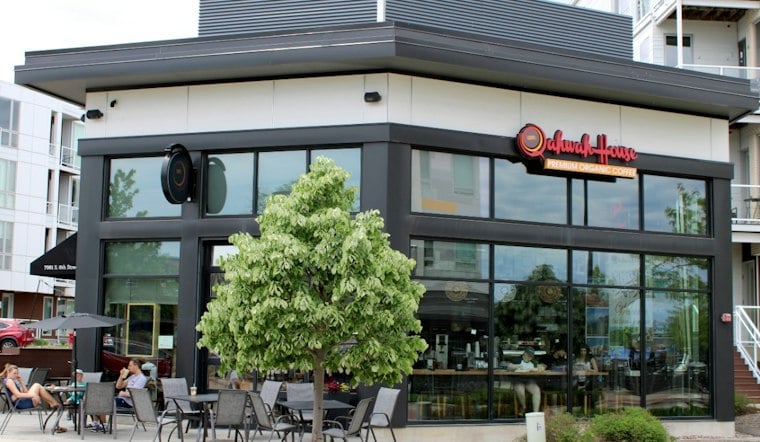
New Haven's coffee map is filling in fast with a distinctly Yemeni flavor. Arwa Coffee opened on Orange Street, M2 Mocha followed on Ashmun Street, and now Jabal Coffee House and Qahwah House are both aiming for a fall debut downtown — bringing the city's Yemeni cafe count to four in less than a year.
That pace of growth is notable even by national standards. As Yale Daily News reports, Arwa Yemeni Coffee opened on Orange Street last December, with M2 Mocha arriving on Ashmun Street in May — though the New Haven Independent has reported M2's opening as April, placing it about six months after Arwa. Either way, New Haven has seen two Yemeni cafes open within the past year, according to the Yale Daily News, and two more are on the way.
Arwa Coffee sits at 335 Orange St., co-owned by Valeed Hussain and his brother, Salman, according to the New Haven Independent. Hussain, who is Pakistani, told the Yale Daily News he was inspired to bring the concept to New Haven after visiting an Arwa location in Texas while visiting family, and he personally secured the lease on the Orange Street property. Arwa is part of a franchise that started in Texas in 2022, per the Independent, and it's now one of the fastest-growing names in a crowded national field.
A Social Space Built Around the Cup
For Hussain, the appeal goes beyond the menu. He told the Yale Daily News that coffee brings people together, and that Yemeni cafes fill a role played by bars in other countries — spaces where people in Yemen and neighboring regions gather, sometimes until 4 a.m., according to Hussain. He said he and his brother wanted to recreate that social atmosphere in the United States, and that he was surprised by how warmly the New Haven community welcomed Arwa after it opened. Community engagement, ties to Yale, and joint events with other local businesses all shaped the shop's early success, Hussain said.
Arwa serves an extensive menu of traditional drinks — Adeni tea, Jubani, Qishr and Sanaani coffee — alongside lattes, cappuccinos, drip coffee, pour-overs, refreshers and smoothies, according to nhregister.com. The shop stays open until 10 p.m. on weekdays and midnight on weekends, per the Yale Daily News. Muhammad Aziz, a Yale senior lecturer of Arabic and a board member of the National Yemeni Arab American Association, is a regular at the Orange Street location and told the Yale Daily News that Arwa has preserved the style and taste of Yemeni cafes despite its Pakistani ownership.
M2 Mocha Carves Out Its Own Niche
Across town on Ashmun Street, M2 Mocha owner Waleed Aljahmi built his shop with Yale students in mind, positioning it steps from the Yale Health Center. Unlike Arwa, M2 is not a franchise — it's independently owned, the New Haven Independent reports. The cafe offers a discount to Yale students and faculty and includes a separate back room for studying that, per Aljahmi, doubles as space for club meetings or celebrations. The nhregister.com account of the shop's opening adds that the private room can be booked for up to 50 guests.
M2's drink menu overlaps with Arwa's in places — both serve Adani tea and a Yemeni Mufawar made with evaporated milk, cardamom and clove, according to the Independent — but M2 also offers shai Adeni, shai Yemeni, saffron shai, Maleki, Sana'ani, Qishr and Jubani, plus Arabic and Turkish coffee blends, per nhregister.com. Arwa and M2 are both open until 10 p.m. on weekdays, the Yale Daily News reports, though the Independent notes that Arwa and the planned Jabal location have considerably more square footage than M2's storefront.
Two More Cafes on the Way
Jabal Coffee House, also part of a larger chain, is planned for 808 Chapel St. and scheduled to open this fall, according to the New Haven Independent. Qahwah House, meanwhile, is set to take over ground-floor retail space at 19 Elm St., with an expected fall opening that would mark the chain's first Connecticut location, the Independent reports. Location counts for Qahwah House vary by source — the Independent puts the chain at 27 locations nationally, while NPR has reported 23 locations stretching from Texas to New York, founded by Ibrahim Alhasbani in 2017.
Aljahmi expects the growing competition to actually help business rather than hurt it, telling the Yale Daily News that Arab cafe owners support one another and operate like family. Aziz offered a similar read, saying Yemenis with means have long competed with each other, while Hussain and Aziz both pointed to Starbucks's success as motivation for Yemeni investors entering the cafe business in the first place.
Coffee's Deep Yemeni Roots
The boom taps into a much older story. Commercial coffee is said, according to popular legend, to have arrived in Yemen when a 14th-century Sufi leader brought it from Ethiopia, the Yale Daily News reports. By the 15th century, the port city of Mocha had become the primary coffee export hub from southeast Yemen — and the word mocha itself traces back to that same port, according to the Yale Daily News.
That legacy hasn't made the supply chain easy. Aljahmi told the Yale Daily News that conflicts in the Middle East, including Houthi attacks that have complicated shipments through the Red Sea, have disrupted the flow of Yemeni coffee to the United States in recent years. Beans are now trucked to Oman and shipped from an Omani port, Aljahmi said, a workaround that raises shipping costs. Still, he said he wouldn't source beans from anywhere else, insisting Yemeni coffee is simply the best in the world. NPR has separately reported that worldwide coffee prices have climbed sharply because of climate change, adding further pressure on exporters.
Part of a Much Bigger National Surge
New Haven's four-shop cluster fits into a much larger pattern. The number of Yemeni coffee shops run by six major U.S. chains jumped 50 percent to 136 locations in 2025, according to the New Haven Independent — a figure Axios attributes to Technomic data showing Yemeni cafes as the fastest-growing coffee sector in the country. The Los Angeles Times reports that Yemeni coffeehouses are opening rapidly even in places without large established Yemeni communities, often staying open late — sometimes past 3 a.m. — as alcohol-free social spaces. The Times also notes that the U.S. Arab American population grew 43 percent between 2010 and 2024, far outpacing roughly 10 percent growth for the overall U.S. population during that span.
Chain growth elsewhere underscores the trend. Texas-based Arwa Yemeni Coffee has 11 cafes nationally with 30 more in development, while Dearborn, Michigan-based Haraz Coffee House has 50 outlets and another 50 in the pipeline, per the Los Angeles Times. Three Dearborn-headquartered chains — Qahwah House, Qamaria Coffee and Haraz Coffee House — together run 121 stores across 14 states, according to Daily Coffee News. Closer to home, Greenwich Time reports that Port Coffee Co., based in Irving, Texas, recently announced its first Connecticut location in New Britain, joining a state roster that already includes Yemerica Coffee in West Hartford and MOTW Coffee & Pastries locations in Middletown, Norwalk and New Haven.





