

























































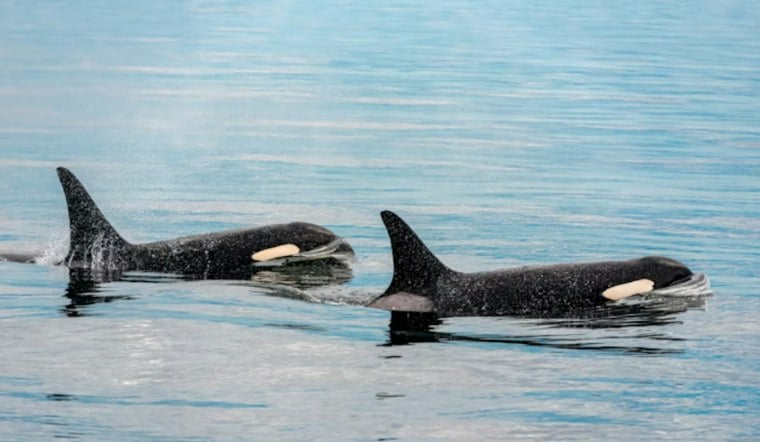
A Southern Resident killer whale known as J31 was spotted this past Saturday carrying her dead newborn calf near Sombrio Point in the Strait of Juan de Fuca, off Vancouver Island. Researchers say they cannot determine the calf's sex, nor whether it was carried to full term or was stillborn, leaving the circumstances of the loss unresolved.
The sighting was reported by the Center for Whale Research, according to thecanadianpressnews.ca, which noted that it remains unclear whether the calf died shortly after birth or was stillborn. The outlet reported that J31, born in 1995, has one surviving offspring — a daughter named J56, born in 2019. The whale's image, distributed as a handout, was credited to the Center for Whale Research under NMFS/NOAA Research Permit 27038.
This is not the first time J31 has been seen grieving a lost calf. The same report noted that she had suffered previous losses, including failed pregnancies, and was seen in 2016 carrying a dead calf as well. Drone footage separately reviewed by FOX 13 Seattle offered a closer look at the endangered population off Washington state, with that video credited to San Diego Zoo Wildlife Alliance via Storyful.
A Population Still Struggling to Reproduce
J31's loss adds to a troubling pattern for Southern Resident killer whales, a population classified as critically endangered. The whales numbered about 73 in 2024, per the same Canadian Press account, though population counts have shifted since — KUOW separately reported the population at 76, down from 88 in 2005. The Center for Whale Research has described successful reproduction as a continuing challenge for the species, according to CBC.
KUOW reported that fewer than one-third of pregnancies among Southern Resident killer whales result in a calf surviving to its first birthday. Researchers point to a shortage of Chinook salmon, the whales' primary food source, as the single biggest threat to their survival, per the same report. The Marine Mammal Commission has said the population's ongoing decline is most likely tied to a combination of factors: reduced prey quantity and quality, persistent pollutants, and disturbance from vessel presence and noise.
Echoes of Past Grief Among J Pod
J31's story recalls other recent losses within the same community of whales. Last September, researchers found J36 pushing a dead female calf in Rosario Strait, Washington, with CBC reporting that the calf was likely born within the preceding three days and was full-term or nearly full-term — though it remained unclear whether it was a stillbirth or died shortly after birth.
Another female, J35, became known worldwide in 2018 after she carried her dead calf on her nose for 17 days and roughly 1,000 miles, according to KUOW. J35 repeated the behavior in early 2025, pushing the remains of another calf for at least five days, per CBC's reporting.
What Recovery Would Require
The Center for Whale Research has said that recovery for the Southern Resident population depends on conditions where mothers and calves can survive and thrive, adding that the successful birth and survival of every calf matters for such a small population. That recovery, researchers say, hinges significantly on restoring adequate Chinook salmon supplies.
Wildlife officials continue to caution the public against flying drones or other unmanned aircraft near marine mammals, noting per NOAA Fisheries guidance that the noise and proximity of such devices can harass the animals.





