

























































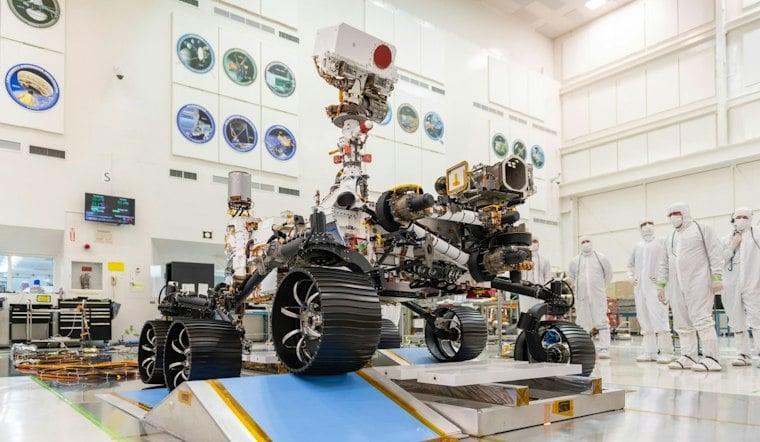
NASA's Perseverance rover has driven farther across another world than any vehicle in history, rolling past the 28.10-mile mark on Mars and edging out a record set more than a decade ago by its predecessor, Opportunity. The milestone arrived on the rover's 2,006th Martian day, or sol, as Perseverance pushed toward a destination nicknamed Idubi, according to the seed facts behind this report.
A Record Nearly 11½ Years in the Making
NASA announced that Perseverance's odometer reached 28.10 miles, or 45.22 kilometers, eclipsing the 28.06-mile, 45.16-kilometer record set by Opportunity, according to NASA's Jet Propulsion Laboratory. Opportunity explored Mars from 2004 to 2018, per the same JPL announcement, meaning it took the earlier rover nearly 15 years to cover ground that Perseverance matched and surpassed in roughly five and a half years, as reported by NBC Los Angeles. Perseverance landed on Mars in February 2021 and has spent its mission exploring Jezero Crater in search of evidence of ancient microbial life.
The rover is built and operated by the Caltech-managed Jet Propulsion Laboratory in Pasadena, and its original mission plan called for no more than 12.4 miles of total driving, NBC Los Angeles reported. Steven Lee, project manager for the Curiosity and Perseverance rovers at JPL, said drives that would once have been extraordinary have become routine as the technology has evolved, and he expects Perseverance to keep extending the record for years to come. All of the rover's mobility systems remain fully operational, according to the outlet's account.
How Autonav Lets the Rover Drive Itself
Much of that distance has piled up because Perseverance increasingly drives itself. The rover's navigation system, known as Autonav, uses cameras to build three-dimensional maps of the surrounding terrain, letting it identify hazards and plot paths between destinations chosen by rover planners without constant direction from Earth, per the same NBC Los Angeles report. Officials said Perseverance has used Autonav for more than 90% of its total driving distance, compared with roughly 5% for the Opportunity and Spirit rovers, which relied on an earlier navigation system.
That autonomy comes through in how the images themselves are assembled. Navcam image pairs are combined with data on the rover's orientation, wheel speed, steering angle and readings from its inertial measurement unit, then placed into a 3D virtual environment used for driving, according to JPL imagery documentation. Mark Maimone, deputy team chief for robotic operations on Perseverance, said the rover set the new record by choosing its own path, crediting the added autonomy for the pace of progress, NBC Los Angeles reported. On its best days, Perseverance can travel as far as 1,351 feet in a single Martian day, the outlet noted. Separately, NASA Science notes that the rover has already broken the driving records of previous rovers, though its top speed remains a modest 0.1 miles per hour.
Next Stop: An Ancient Lakebed Called Lac de Charmes
The rover broke the record while traveling through an area called Lac de Charmes, beyond the western rim of Jezero Crater, en route to a site nicknamed Idubi, according to the NBC Los Angeles report. Scientists believe Lac de Charmes contains some of the oldest terrain yet explored by a robotic mission and hope to find evidence of ancient hydrothermal systems there, which could offer clues about conditions that may once have supported life on Mars. Lac de Charmes lies along Perseverance's route to Idubi.
Along the way, Perseverance has collected 29 rock and soil samples from the crater floor, an ancient river delta, and the crater rim, with some of those rocks believed to be about 4 billion years old, per the NBC Los Angeles account. Among its finds is a rock called Cheyava Falls, which contains a potential biosignature that could indicate past microbial activity, though the outlet's reporting is careful to note that finding does not establish that life ever existed on Mars.
NASA has approved the first extension of Perseverance's mission, which began in October and is expected to continue exploring the crater rim through roughly the end of 2028, according to the same report. For comparison, Opportunity logged 28.06 miles and its twin rover Spirit covered 4.8 miles before their missions ended, according to NASA Science's mission archive. Perseverance has now surpassed Opportunity's 45-kilometer distance record.





